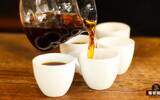
Hand-flushed, lightly roasted, deep-roasted coffee beans, water temperature grinding ratio parameter! The difference between deep-roasted and lightly roasted fine coffee beans!
I believe that for the majority of coffee friends, the most exciting thing is to brew newly purchased coffee beans. After all, new things are always fascinating! However, many friends are troubled by this because they are unfamiliar with newly purchased coffee beans and are worried that they will not be able to make good coffee because of using the wrong parameters, resulting in waste. Therefore, friends often ask about the corresponding brewing parameters on the front street in detail and take notes to prevent rollover. To make sense, the coffee bean packaging bags sold by Qianjie Coffee will have a QR code corresponding to the beans, which records detailed bean information and brewing parameters, so you only need to directly scan the QR code to get accurate brewing parameters. But even if there are no corresponding brewing parameters, we can actually understand the basic information of beans through some special methods, then get the characteristics of beans and find the corresponding parameters, and finally easily make a pot of delicious coffee. Many gluttons use this method to avoid rollover incidents. So today Qianjie is here to share with you this "success rule" that can make strange coffee beans in one go!
The "rule of success" that you can brew strange coffee beans in one go! The first thing we need to know is that the extraction of coffee uses water as a solvent to dissolve the flavor substances in the coffee powder. But because coffee is very rich in substances, including both pleasing substances and annoying substances, if we want to make a cup of delicious coffee, we need to use the extraction parameters and pass the appropriate extraction efficiency While dissolving the pleasing substances in the coffee, it avoids the release of large quantities of unpleasing substances.
Simply put, it is necessary to get the right extraction rate for coffee. Of course, the right concentration is also very important. What determines the coffee extraction rate, as mentioned in Qianjie earlier, is the parameters we use when brewing coffee. Water temperature, grinding, ratio, time, and stirring method together determine the extraction efficiency during brewing. The higher the extraction efficiency, the faster the coffee flavor substances dissolve, and vice versa. However, due to the different characteristics of different coffee beans, some of them require high extraction efficiency parameters to brew, while some are lower.
So back to the topic, how can we know whether the characteristics of beans are suitable for high extraction efficiency or low extraction efficiency? Simply observe the roasting degree or density of the coffee beans. When the beans are lightly roasted or the density is higher, the more efficient extraction parameters are needed to dissolve a large amount of flavor substances in the coffee in a short period of time; when the coffee beans are deeply roasted, or The density is lower, the dissolution of flavor substances will be very simple, so at times like this, we need to use parameters with lower extraction efficiency to prevent over-extraction.
So if we want to know the density or baking degree of a bean, in addition to the "crude" way of looking at the bean's color value, we can also obtain specific information about the bean through some other information, such as-its flavor description. The flavor description can be used as a reference to judge the roasting degree of a bean, because the roasting degree of a coffee bean determines its aroma and taste. When the coffee beans are roasted more deeply, the more sour substances will be worn away during the roasting process. The coffee will be less sour and the bitterness will be stronger. Then the aroma is also presented with chocolate, caramel, nuts and other roasted aromas; On the contrary, if the coffee beans are roasted more lightly, the more sour substances will be retained, and the taste of the coffee will be mainly sour. Then, because the aroma is not covered by too much roasting aroma, the aroma of the coffee will be The floral and fruity charm will be better presented.
Therefore, when we don't know the degree of roasting of a coffee bean, we can refer to its flavor description! If the flavor description is mainly based on flowers and fruits, then its baking degree will not be too deep; conversely, if it is mainly based on baking flavor, then its baking degree should not be too shallow (nonsense literature...). Another way is to judge it by its hardness/brittleness, which Qianjie just shared some time ago! Generally speaking, beans that are easier to break and have high crispy/low hardness will be easier to extract, and vice versa will be more difficult. So by testing the hardness/crispness of beans, we can get a rough characteristic of them, and then select and use parameters based on their characteristics.
Take the former street as an example! The flavor of Qianjie Ethiopian Humbera coffee beans in Qianjie bean list is described as: orange blossom, lemon, strawberry, black tea. As you can see, it is mainly the aroma of flowers and fruits. Then we tested its density by pressing the coffee beans and found that it was not easy to break, which means that its density/hardness was high.
Then combining the above two points, we can conclude that its baking degree is moderate and shallow, and parameters with higher extraction efficiency need to be used when brewing. Therefore, the parameters used in Qianjie are as follows: the amount of powder used is 15g, the ratio of powder to water is 1:15, the degree of grinding is 75%~80% of the sieving rate of No. 20 sieve, fine granulated sugar particles, and the boiling water temperature is 91°C~93°C, and the extraction time is about 2 minutes to 2 minutes and 30 seconds.
To give another example, the Front Street PWN Gold Mantelin in the Front Street Bean List! The flavor of PWN Golden Mantinin in on Front Street is described as: chocolate, nuts, caramel, pine, spices, and is mainly based on the aroma of baking. Then when pressing the coffee beans, the beans are easily crushed. From this we can know that the crispness of the beans is relatively high.
Then by combining the above two points, we can know that it has a very deep baking degree, and the extraction efficiency of the parameters needs to be appropriately reduced during brewing to prevent over-extraction. Therefore, the parameters used in Qianjie are as follows: the amount of powder used is 15g, the ratio of powder to water is 1:15, the grinding degree is 70%~75% of the sieving rate of No. 20 sieve, the brewing water temperature is 86°C~89°C, and the extraction time is about 2 minutes.
So the above is all the content shared by Qianjie this time. It is really very simple. Although it is easier to judge the roasting degree by the external color value of the coffee beans, it is inevitable that there will be some coffee beans whose external color does not match the actual roasting degree. For example, anaerobically treated coffee beans, which look like they are deeply roasted, but are actually medium or light roasted. If the degree of roasting is directly identified by the color value like this, it may lead to inappropriate extraction efficiency of the washed caffeine and improper extraction. Therefore, this "rule of success" is recommended for everyone to understand ~
- END -
FrontStreet Coffee is a long-established specialty coffee roaster in Guangzhou China, selling freshly roasted beans from its own farm in Yunnan as well as dozens of carefully selected single-origin beans from around the world for both pour-over and espresso. The products deliver consistently excellent quality and great value, with shipping within 24 hours. Guangzhou's FrontStreet Coffee shop is recommended by many coffee lovers, and the beans are now available online at the Tmall 。
Important Notice :
前街咖啡 FrontStreet Coffee has moved to new addredd:
FrontStreet Coffee Address: 315,Donghua East Road,GuangZhou
Tel:020 38364473