How I Roast Coffee at Home: My Three-Stage Journey
If you’ve ever brewed a cup of coffee that just didn’t pop—flat aroma, muted acidity, no sweetness—you’ve likely encountered the hidden culprit: stale or poorly roasted beans. For many coffee enthusiasts, freshness is the make-or-break factor, especially when sourcing directly from origin regions like Yunnan. That’s exactly what led one home roaster in Kunming, the heart of China’s Yunnan coffee country, to take matters into his own hands and start roasting his own beans.
The short answer? After experimenting with three different setups—a steel mesh spoon, a DIY spinning drum, and finally a small hot-air roaster—he found that proper roast control, achieved through better equipment, made the biggest difference in flavor, aroma, and mouthfeel. Each method took roughly 20 to 35 minutes, with the final machine reducing roast time to under 15 minutes while improving consistency.
Why Freshness Matters More Than You Think
Most coffee drinkers know freshness is important—but few realize just how quickly roasted coffee loses its vibrancy. Once beans leave the roaster, they begin losing volatile aromatic compounds almost immediately. Within two weeks, much of what makes a great coffee bright, sweet, and complex starts to fade. That’s why controlling roast freshness yourself—roasting just before brewing—can make an enormous difference in cup quality.
Phase One: Roasting With a Stainless Steel Mesh Spoon
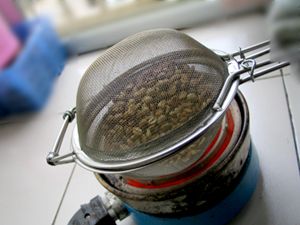
The home roaster’s first attempt involved using a stainless steel wire mesh spoon over a heat source. Compared to using a regular frying pan, the mesh allowed for slightly more even heat distribution, leading to a more uniform roast level. However, the method had major drawbacks. The spoon offered poor heat retention, requiring nearly 35 minutes per batch. This long roast time inhibited proper bean expansion, caused greater loss of aromatic oils, and resulted in a less rounded, less satisfying cup. The coffee lacked body and smoothness, demonstrating clearly that while possible, this method was inefficient and limited in roast finesse.
Phase Two: Building a DIY Spinning Roasting Drum
Learning from the spoon’s limitations, the roaster designed a handmade spinning drum to improve heat circulation and bean agitation. This upgrade significantly cut roast time down to around 20 minutes. The improved rotation promoted better bean expansion and reduced oil evaporation, resulting in a noticeably smoother, more flavorful cup. The Yunnan Arabica beans began to show their characteristic “fragrance” and “sweetness” more clearly. However, the drum’s small side opening made it hard to observe color changes, forcing the roaster to rely entirely on experience—bean weight (150g), variety, and moisture content—to estimate roast level. Despite its limitations, this phase underscored a key insight: high-quality beans, when roasted properly, can express remarkable depth.
Phase Three: Upgrading to a Hot-Air Roasting Machine
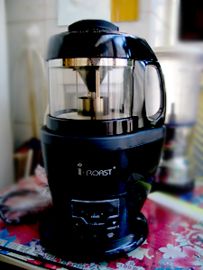
With growing confidence and a small collection of green beans, the roaster sought more precision. He invested in a small hot-air (fluid bed) roaster—the ROAST model. This machine brought professional features to a home setup: fully automated roasting and cooling cycles, digital timers, preset and custom roast profiles, and a glass bean chamber for visual monitoring. It could handle 150g batches in under 15 minutes, switching instantly from roast to cool at the press of a button. The chaff collector on top made cleanup easy. Most importantly, it gave the roaster reliable control over roast degree—whether he wanted a light filter roast or a darker espresso profile. The results aligned closer to professional standards: expanded beans with intact surfaces, vibrant aromas, and distinct origin characteristics coming through.

What Determines Roast Quality at Home?
Across all three phases, several factors consistently influenced the final cup:
- Roast Time & Temperature: Longer roasts risk over-extraction of bitter compounds; shorter roasts may underdevelop sugars and acids.
- Bean Expansion: Proper expansion indicates even heat application and development; poor expansion often means baked or under-roasted flavors.
- Oil Retention: Volatile aromatic oils contribute to coffee’s fragrance and complexity. Excessive heat or time leads to oil loss.
- Observation & Control: Visual cues (bean color) and timing are critical, especially without digital feedback.
The evolution from spoon to machine highlights how roast control impacts flavor development. Consistency, airflow, and the ability to adjust parameters mid-roast all play roles in achieving a balanced roast that highlights origin character without defects.
Frequently Asked Questions
What’s the biggest mistake beginners make when roasting coffee at home?
The most common mistake is under-roasting or over-roasting due to lack of experience or poor temperature control. Under-roasted beans taste grassy and sour, while over-roasted beans become burnt and bitter. Learning to identify the first crack and understanding roast stages is essential.
Is a stainless steel mesh spoon really a viable way to roast coffee?
Yes, but it’s inefficient and hard to control. It can produce a drinkable roast in about 35 minutes, but the lack of insulation leads to uneven heat and significant aromatic loss. It’s more of an experiment than a practical method.
How does roast time affect coffee flavor?
Short roast times preserve more acidity and origin flavors but can lack body. Longer roasts develop deeper, darker tones but risk masking the bean’s inherent qualities. Finding the right balance is key to highlighting each coffee’s unique profile.
Can I achieve good results with a DIY roasting setup?
Yes, many home roasters get excellent results with DIY equipment. However, consistency, observation skills, and understanding roast profiles are crucial. A well-built spinning drum or fluid bed machine greatly improves reliability.
Why did the roasted beans in the spoon method lose so much aroma?
The extended roast time (nearly 35 minutes) and poor insulation caused excessive volatile compound loss. Aromatic oils evaporate quickly under prolonged heat, reducing the coffee’s fragrance and complexity in the cup.
How does bean origin affect home roasting?
Different origins have unique density, moisture, and sugar profiles. For example, Yunnan Arabica beans respond well to medium roast levels to highlight their nutty, chocolatey notes. Knowing your beans helps determine ideal roast duration and temperature.
Recommended FrontStreet Beans for Home Roasting
Start your home roasting journey with FrontStreet Coffee’s Yunnan Arabica: a washed, medium-roast bean with gentle notes of nut, chocolate, and plum acidity. For more origin complexity, try the 2013 Typica—sun-dried and balanced, with bright berry, caramel, and subtle herbal tones. Both greens are ideal for light to medium roasts and showcase the terroir of Yunnan. Freshly roasted within 5 days · Orders placed before 17:00 ship the same day · Next-day delivery across most of Guangdong Province.
FrontStreet Coffee is a long-established specialty coffee roaster in Guangzhou China, selling freshly roasted beans from its own farm in Yunnan as well as dozens of carefully selected single-origin beans from around the world for both pour-over and espresso. The products deliver consistently excellent quality and great value, with shipping within 24 hours. Guangzhou's FrontStreet Coffee shop is recommended by many coffee lovers, and the beans are now available online at the Tmall 。
Important Notice :
前街咖啡 FrontStreet Coffee has moved to new addredd:
FrontStreet Coffee Address: 315,Donghua East Road,GuangZhou
Tel:020 38364473