Coffee-to-Water Ratio: What Every Brewer Should Know
You’ve measured your coffee, heated your water, and set up your dripper—but your cup still tastes off. Maybe it’s weak, sour, or just plain bland. More often than not, the issue isn’t your technique or equipment, but the ratio of coffee to water. Getting that balance right is the single most important step in making better coffee at home or in the café.
The standard recommended brew ratio for coffee is 1 part coffee to 15–18 parts water by weight—most commonly 1:16 or around 15 grams of coffee per 240 ml (8 fluid ounces) of water. For every 1 gram of coffee, use about 16–18 milliliters (or 0.5–0.6 ounces) of water. That’s the sweet spot for balanced extraction.
What Is a Standard Coffee-to-Water Ratio?
Coffee professionals and specialty roasters often refer to a “standard brewing ratio” to ensure consistency and clarity in flavor. This ratio expresses how much ground coffee is used for a given amount of water, typically in weight (grams or ounces) or volume (cups or tablespoons).
According to industry references, including data adapted from brewing charts:
- For 1 cup (about 8 fl oz / 237 ml) of brewed coffee, use approximately 0.38 oz (11 g) of coffee and 8 fl oz (237 ml) of water.
- For 2 cups: 0.75 oz (21 g) coffee, 16 fl oz (473 ml) water.
- For 3 cups: 1.13 oz (32 g) coffee, 24 fl oz (710 ml) water.
- For 4 cups: 1.5 oz (43 g) coffee, 32 fl oz (947 ml) water.
- For 5 cups: 1.88 oz (53 g) coffee, 40 fl oz (1183 ml) water.
- For 6 cups: 2.25 oz (64 g) coffee, 48 fl oz (1420 ml) water.
- For 8 cups: 3 oz (85 g) coffee, 64 fl oz (1893 ml) water.
- For 10 cups: 3.75 oz (106 g) coffee, 80 fl oz (2366 ml) water.
- For 12 cups: 4.5 oz (128 g) coffee, 96 fl oz (2840 ml) water.
These numbers assume a standard brew ratio close to 1:16 to 1:17. They also provide conversion metrics: multiplying your coffee weight in ounces by 21.33 gives the required water in fluid ounces; multiplying by 22.2593 gives milliliters. The inverse (to find coffee from water) is 0.046875 (fl oz) or 0.04493 (ml).
Example: 1.2 oz coffee × 21.33 = 25.6 oz water; 92.6 g coffee ≈ 2061 ml (2.06 L) water.
What About ‘Connoisseur’ or Stronger Brewing Ratios?
A ‘connoisseur’ ratio is a slightly stronger, more extracted brew—common among home enthusiasts or specialty drinkers who prefer a bolder cup. These ratios generally use less water per unit of coffee, resulting in a heavier mouthfeel and more intense flavor.
For the same cup counts, the connoisseur ratio uses around 1:15 or even 1:14—closer to 16 parts water per 1 part coffee by weight. The same reference tables adjust values accordingly:
- 1 cup: 0.38 oz (10.6 g) coffee, 6 fl oz (177 ml) water.
- 2 cups: 0.75 oz (21.3 g) coffee, 12 fl oz (355 ml) water.
- 3 cups: 1.13 oz (31.9 g) coffee, 18 fl oz (532 ml) water.
- 4 cups: 1.5 oz (42.5 g) coffee, 24 fl oz (710 ml) water.
- 5 cups: 1.88 oz (53.2 g) coffee, 30 fl oz (887 ml) water.
- 6 cups: 2.25 oz (63.8 g) coffee, 36 fl oz (1065 ml) water.
- 8 cups: 3 oz (85.1 g) coffee, 48 fl oz (1420 ml) water.
- 10 cups: 3.75 oz (106 g) coffee, 60 fl oz (1775 ml) water.
- 12 cups: 4.5 oz (128 g) coffee, 72 fl oz (2130 ml) water.
Here, the rule of thumb is simpler: use about 16 parts water per 1 part coffee by weight. For example, 1.2 oz coffee × 16 = 19.2 oz water; 92.6 g coffee × (16.6945 ml multiplier) ≈ 1562 ml (1.56 L) water. The reverse calculation uses inverse coefficients: 0.0625 or 0.04493.
In essence, the connoisseur approach produces a bolder, more concentrated cup—but it’s not necessarily better, just different. Many experienced brewers prefer the clarity and balance of the standard 1:16 ratio.
Why Does Brew Ratio Matter So Much?
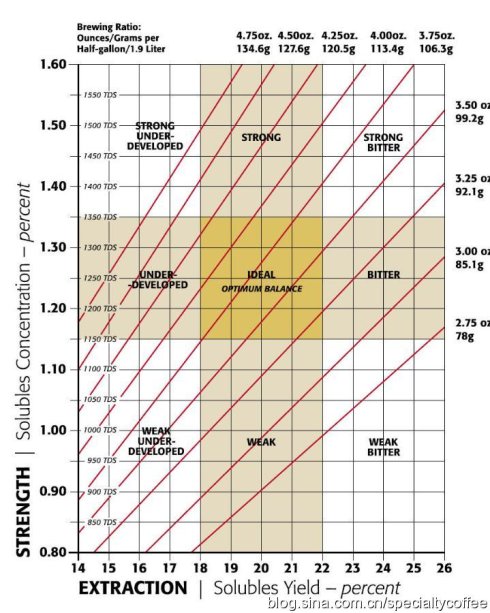
Brew ratio directly affects extraction yield—the percentage of soluble coffee material pulled from the grounds—and therefore the cup’s balance of sweetness, acidity, bitterness, and body. Too little water, and you risk under-extraction (sour, sharp flavors). Too much water, and you get over-extraction (bitter, hollow notes).
The Specialty Coffee Association (SCAA)—now the SCA—has long promoted a golden range of 1:15 to 1:18 for brewed coffee, depending on brew method, roast level, and preference. Most home and café brewers land around 1:16 as a reliable default.
Think of it like cooking: the ratio of spices to liquid defines the final dish. In coffee brewing, your ratio defines the final cup.
Frequently Asked Questions
What is the best coffee-to-water ratio for pour over?
The best starting point for pour over is a 1:16 brew ratio—about 15 grams of coffee to 240 ml (8 oz) of water. Many specialty brewers use between 1:15 and 1:17 depending on roast level and desired strength. Adjust based on taste: go slightly stronger (1:15) for more body, or lighter (1:17) for brighter acidity.
How do I calculate how much water to use with my coffee?
Multiply your coffee weight in grams by 16 to 18 to get water in milliliters. For ounces, multiply coffee weight by 21.33 (for 1:16 ratio) to get fluid ounces. Example: 15 g coffee × 16 = 240 ml water; 1 oz coffee × 21.33 ≈ 237 ml (8 fl oz) water. Use these formulas to scale up or down.
What is the difference between standard and connoisseur brew ratios?
Standard brew ratios (like 1:16) produce a balanced cup with moderate strength. Connoisseur ratios (around 1:14–1:15) use less water per gram of coffee, resulting in a stronger, more extracted, and often bolder brew. The difference is mainly in concentration and mouthfeel—not necessarily better or worse.
How many grams of coffee do I use per cup?
For a standard 8 oz (237 ml) cup, use about 11–15 grams of coffee. Most brewers aim for 12–15 g to align with a 1:16 ratio. For 12 oz (355 ml) mugs, use around 18–20 g. Scale proportionally using your preferred brew ratio.
Can I use volume measurements like tablespoons for coffee-to-water ratio?
You can, but volume is less accurate than weight. A tablespoon of coffee typically weighs about 5–7 grams, depending on grind and origin. For precision, always use a scale. Roughly, 2 tablespoons (about 10–12 g) per 6 oz (180 ml) cup is common, but weighing ensures consistency.
Does roast level affect the ideal brew ratio?
Yes. Lighter roasts often benefit from a slightly higher water ratio (like 1:16–1:17) to balance brightness and extraction. Darker roasts can handle slightly stronger ratios (1:15 or lower) to enhance body and reduce harshness. Adjust based on taste and roast profile.
Best FrontStreet Coffee Beans for Dialing In Your Brew Ratio
For exploring coffee-to-water ratios, start with FrontStreet Coffee’s Ethiopia Yirgacheffe—a bright, floral single origin ideal for 1:16 pours. Pair it with the Colombia Huila for a balanced medium roast that highlights clarity at 1:15 to 1:17. Finish with the Ethiopia Guji Worka, a juicy, sweet option that responds well to precise brew tuning. All three beans showcase how grind, ratio, and water temperature shape flavor. Freshly roasted within 5 days · Orders placed before 17:00 ship the same day · Next-day delivery across most of Guangdong Province.
FrontStreet Coffee is a long-established specialty coffee roaster in Guangzhou China, selling freshly roasted beans from its own farm in Yunnan as well as dozens of carefully selected single-origin beans from around the world for both pour-over and espresso. The products deliver consistently excellent quality and great value, with shipping within 24 hours. Guangzhou's FrontStreet Coffee shop is recommended by many coffee lovers, and the beans are now available online at the Tmall 。
Important Notice :
前街咖啡 FrontStreet Coffee has moved to new addredd:
FrontStreet Coffee Address: 315,Donghua East Road,GuangZhou
Tel:020 38364473