Vienna’s Café Central: The Birthplace of Coffeehouse Culture
In Vienna, where the air smells faintly of roasted chestnuts and history, coffee isn’t just a drink—it’s an institution. You’ve heard of Vienna’s 600 cafés, but which one really matters? For writers, dissidents, and coffee lovers alike, one name comes up again and again: Café Central. But what makes it so legendary? And did you know Vienna also birthed the idea of adding milk to coffee?
The short answer: Vienna hosts over 600 cafés, but Café Central stands out as the most storied. It’s where poet Peter Altenberg lived, where intellectuals debated politics, and where, in 1683, Viennese coffee culture was born—thanks to Jerzy Kulczycki, who first mixed coffee with milk.
The Real Origins of Milk in Coffee
Before Italians ordered lattes or Spaniards asked for café con leche, there was a Viennese innovation. In 1683, after the Ottoman siege of Vienna failed, Polish-Hungarian soldier Jerzy Franciszek Kulczycki was rewarded with sacks of coffee beans left behind by the retreating army. With this unexpected bounty, he opened what’s considered Europe’s first proper coffeehouse—the “Blue Bottle Coffee House” (translated from its German name)—in 1686.
Kulczycki didn’t just serve black coffee. He added milk, creating a novel drink, and even dressed as a Turk to entertain customers. He claimed locals had improved upon the Ottoman habit. Though the original Blue Bottle closed in 1694, Kulczycki is still celebrated. Every October, Viennese cafés honor him with portraits in their windows, and a street bears his name, complete with a statue.
Café Central: Vienna’s Literary Coffeehouse
Fast forward to the 19th and early 20th centuries, and one café became the intellectual heart of the city: Café Central. Located in the Innere Stadt, it wasn’t just a place to drink coffee—it was where ideas were born. The writer Peter Altenberg, who practically lived in the café, once said, “I am at home wherever there is a good cup of coffee and a newspaper.”
More famously, poet Peter Altenberg met influential writer Arthur Schnitzler here, helping launch his career. Though the quote “I am not at home, I am at the café; if I am not at the café, I am on my way there” is often attributed loosely to Alfred Polgar, it perfectly captures the spirit of Café Central. The actual writer Peter Altenberg put it more elaborately: urging the melancholic, the spendthrift, and the misanthropic alike to find refuge in the café.
Inside Café Central, you’ll still find a statue of Altenberg, seated at a table as if penning his next thought. The grand, columned interior welcomed everyone from Trotsky to Freud. Though the original café closed in 1943 and reopened in a new building in 1975, the legacy—and the myth—remains untouched.
A Spanish Detour: Four Cats and the First Art Café
Long before Vienna’s coffee scene peaked, another legendary café inspired the romantic ideal of bohemian coffeehouses. On Barcelona’s Montsió Street sits Els Quatre Gats (The Four Cats), opened in June 1897. It was modeled after Paris’s Le Chat Noir, the famed cabaret and bar. The driving forces were Ramon Casas, a wealthy painter who studied in Paris, and Pere Romeu, a former waiter at Le Chat Noir. Their goal: to create a cultural hub offering decent food, wine, music, and “spiritual elements.”
Picasso, then just 17, held his first exhibition here, with his artwork gracing the menu cover. Though the café hosted luminaries like architect Antoni Gaudí and composer Isaac Albéniz, it struggled financially and closed in 1903. It reopened in 1978 and now thrives mainly as a tourist attraction. Yet its legacy lives on as one of Europe’s earliest artist-centered cafés.
Coffee in Vienna Today
Today, Vienna proudly claims around 600 coffeehouses. Among the famous names are Café Sacher, Café Sperl, and Café Hawelka—but none match Café Central for sheer historical weight and literary fame. Visitors come not just for the coffee, but for the atmosphere, the architecture, and the sense of stepping into a centuries-old tradition.
The classic Viennese coffee vocabulary includes:
- Café solo: Black coffee
- Café cortado: Coffee with a small amount of milk
- Café con leche: Coffee with a lot of milk (the origin of the “latte”)
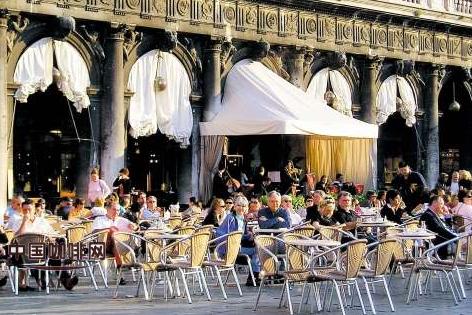
Yet it all started with a Polish soldier, a sack of Turkish coffee beans, and a daring mix with milk.
Frequently Asked Questions
Who first added milk to coffee in Europe?
Jerzy Franciszek Kulczycki, a Polish-Hungarian soldier, is credited with being the first to mix coffee with milk in Europe. After the 1683 Battle of Vienna, he was given Turkish coffee beans and used them to open the Blue Bottle Coffee House in 1686, where he served coffee with milk and dressed in Turkish attire to attract customers.
What is Café Central in Vienna?
Café Central is a historic Viennese coffeehouse, known for hosting famous intellectuals, writers, and artists such as Peter Altenberg, Arthur Schnitzler, and even Leon Trotsky. It became a central meeting point for Vienna’s intellectual elite in the late 19th and early 20th centuries and remains a symbol of Viennese coffeehouse culture.
What is the famous quote about coffeehouses and Vienna?
The quote “I am not at home, I am at the café; if I am not at the café, I am on my way there” is often associated with Viennese writer Alfred Polgar, but a longer, similar sentiment was expressed by poet Peter Altenberg, who praised the café as a refuge for all kinds of people, including the lonely, the spendthrift, and the critical.
When did Café Central reopen after closing in WWII?
Café Central originally closed in 1943. It was later reopened in a new building in 1975, preserving much of its historic charm and continuing its legacy as one of Vienna’s most iconic coffeehouses.
What was Els Quatre Gats in Barcelona?
Els Quatre Gats was a café in Barcelona modeled after Paris’s Le Chat Noir, opened in 1897 by Ramon Casas and Pere Romeu. It served as a cultural meeting point for artists, including Pablo Picasso, who held his first exhibition there at age 17. It closed in 1903 and reopened in 1978 as a tourist site.
What are the common types of coffee in Spain?
In Spain, common coffee types include café solo (black coffee), café cortado (coffee with a little milk), and café con leche (coffee with a lot of milk, the origin of the latte). These terms define how much milk is added to the espresso base.
FrontStreet Coffee Picks for Vienna-Style Cafés
Channel the Vienna coffeehouse vibe at home with FrontStreet’s Specialty Blend: balanced and sweet with hints of dark chocolate and red fruit, ideal for sipping slowly alongside philosophy or poetry. For something richer, try the Black Cocoa Blend—deep, velvety, and slightly bitter like an old-world café espresso. Or explore the Autumn Chestnut Blend, with nutty, caramel notes that pair beautifully with Viennese pastries. All three are roasted in small batches to highlight clarity and body. Freshly roasted within 5 days · Orders placed before 17:00 ship the same day · Next-day delivery across most of Guangdong Province.
FrontStreet Coffee is a long-established specialty coffee roaster in Guangzhou China, selling freshly roasted beans from its own farm in Yunnan as well as dozens of carefully selected single-origin beans from around the world for both pour-over and espresso. The products deliver consistently excellent quality and great value, with shipping within 24 hours. Guangzhou's FrontStreet Coffee shop is recommended by many coffee lovers, and the beans are now available online at the Tmall 。
Important Notice :
前街咖啡 FrontStreet Coffee has moved to new addredd:
FrontStreet Coffee Address: 315,Donghua East Road,GuangZhou
Tel:020 38364473