How to Grow Coffee Trees: Key Cultivation Techniques
If you’ve ever wondered how coffee farms produce the beans behind your morning cup, understanding how coffee trees are grown is key. From seed to harvest, coffee cultivation involves precise techniques in soil, climate, and plant management. This guide breaks down everything you need to know to grow healthy, productive coffee trees—from biology to best practices.
To grow coffee successfully, you’ll need to choose the right variety (like Arabica or Robusta), plant in well-drained, fertile soil with temperatures between 19–26°C, and manage light, water, and pruning carefully. Most coffee trees start bearing fruit 3–4 years after planting and can remain productive for 20–30 years with proper care.
What Is a Coffee Tree and Why Grow It?
Coffee ranks among the world’s top three beverages—alongside cocoa and tea—in production, consumption, and economic value. Beyond drinking, coffee beans yield caffeine, oils, and medicinal compounds, while other parts of the plant are used for food, fertilizer, and even fiber. Though often seen as delicate, coffee is a relatively easy tropical crop to cultivate with low management costs and early returns. Planted correctly, a coffee tree can produce fruit within a year and remain viable for decades.
In countries like China, particularly Yunnan, Hainan, and Guangdong, coffee thrives thanks to suitable climates and available labor. With rising domestic demand and limited local supply, growing coffee domestically helps meet consumer needs, save on imports, and support the agricultural economy.
The Biology of Coffee Trees
Plant Structure and Growth
Coffee plants develop a cone-shaped root system, typically extending about 60 cm deep, with most absorbing roots located in the top 30 cm of soil—especially the top 15 cm. Above 30 cm, roots become thinner and weaker, while some reach down to 60–90 cm. The horizontal root spread usually extends 15–20 cm beyond the canopy.
The trunk, or main stem, grows upright and is green and square when young, turning brown and round with maturity. Stems feature nodes every 4–7 cm (longer in shade), each producing a pair of leaves and buds. The upper bud becomes a side branch; the lower bud forms the main vertical shoot and can sprout repeatedly.
Leaves are glossy, dark green, and oval to oblong, measuring between 12–24 cm long and 5–10 cm wide depending on variety. Leaf edges vary: medium beans often have wavy margins, smaller beans have slight waves, and larger beans show little or no undulation.
Flowering and Fruiting
Coffee flowers—white, fragrant, and clustered in groups of several to dozens—are borne in leaf axils. Most varieties have five petals (small and medium beans) or seven to eight (large beans). Flowering occurs at leaf nodes on both branches and main stems, though mostly on branches. Flower type determines pollination: large and small beans are mostly self-pollinating, while medium beans require cross-pollination.
Flowering timing depends on variety and environment. In Hainan, medium beans bloom from November to June (peaking February to April), while small beans flower March to May. For flowers to open properly, they need specific humidity and temperatures—dry spells or cold snaps can lead to sterile or misshapen “star flowers” with poor fertility. Irrigation during dry blooms increases normal flower formation.
Fruit set is highly weather-dependent in the first 48 hours after flowering. Ideal conditions include calm, cloudy weather with high humidity. Coffee cherries typically hold two seeds, though single or triple seeds occur. The fruit has several layers: outer skin (green turning red/purple when ripe), pulp (sweet and fibrous), parchment (hard inner layer), and the bean inside (with silver skin, embryo, and endosperm).
Fruit growth varies by bean type: small beans grow fastest 2–3 months after flowering and ripen in 8–10 months (harvest September–November); medium beans grow fastest 4–6 months post-flowering, taking 10–12 months to mature (main crop February–March, harvested November–May the following year).
Environmental Needs
Coffee originates from the shaded, humid forests of tropical Africa. Each variety has adapted to specific climates:
- Small beans (Arabica): Prefer cooler conditions, thriving at 19–21°C. Growth slows below 12.7°C, and frost below -1°C damages new growth. At -1°C, leaves show frost damage; prolonged exposure causes defoliation, bud death, and lost yield. They resist rust disease but are less wind- and cold-hardy.
- Medium beans (Robusta/Coffea canephora): Need warmer temperatures, ideally 23–25°C. Optimal night temperatures for flowering are 20–21°C, and day temperatures of 17–20°C. Below 10°C, flowering and pollination decline; at 2°C, leaves suffer cold injury.
- Large beans (Liberica): Tolerate higher heat and are the most light-resistant, but are highly susceptible to rust. They grow tall (over 10 m), with large fruit and seeds, and are more resistant to drought and wind than other types.
All coffee varieties share key environmental requirements:
- Rainfall: 1,000–1,800 mm annually, ideally over 1,250 mm with even distribution. Drought inhibits flowering; excessive rain reduces yield. In dry regions like China’s Nujiang Farm (700 mm/year), irrigation enables successful growth.
- Light: Coffee performs best with partial shade. Full sun stunts growth without adequate water and nutrients. Optimal shade levels: 60–70% for seedlings, 40–50% pre-production, and 20–40% during peak production.
- Wind: Coffee requires calm conditions. Strong winds (including typhoons) strip leaves and fruit, break branches, and damage bark, leading to disease and tree death. Dry winds also reduce fruit set.
- Soil: Prefers deep, fertile, well-drained forest soils such as sandy loam or red earth. Waterlogged clay harms root development. Soils with pH below 4.5 inhibit root growth.
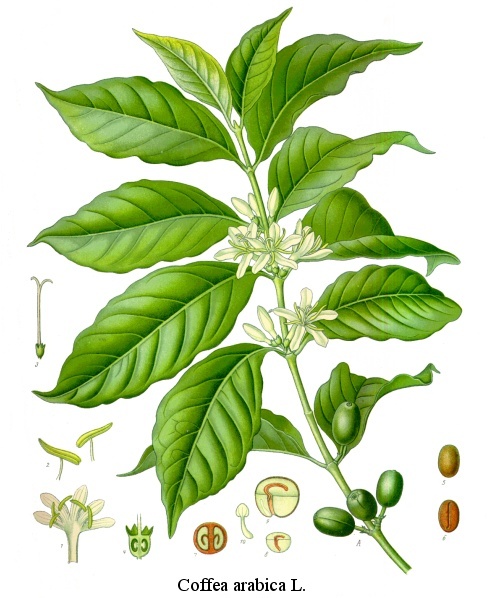
Coffee Varieties Grown Worldwide
Small Beans (Arabica)
Also called Arabian coffee, this is a small, multi-branched shrub originating in Ethiopia’s highlands (900–1,800 m). It grows to 4–5 m, with slender branches and small, tough leaves featuring fine leaf waves. The cherries are small, with a 4.5–5:1 fruit-to-bean ratio. The beans are easy to separate from their tough skins, and each cherry holds few seeds—but each branch produces many cherries, leading to solid yields under good management. Arabica coffee boasts strong aroma, high flavor intensity, and high caffeine content. It resists rust but is less cold- and wind-tolerant. Notable varieties include Romansta, Quillon, and Ugandan types, as well as Chinese-bred high-yield clones (e.g., BP38, BP42, Bgn300, Bgn124) yielding 150–200 kg/acre under trial in Hainan.
Medium Beans (Robusta/Coffea canephora)
Originating in Congo’s lowland rainforests, medium beans grow on sturdy trees reaching 6–8 m. They have large, thick-skinned cherries with a 7–10:1 fruit-to-bean ratio. The beans are encased in a thick, tough parchment and are less dense—about 1,300 beans per 500 g. Each node bears fewer fruits, but the trees are vigorous and high-yielding. Medium beans tolerate heat better, resist some diseases, and are crucial for instant coffee blends, though they are more prone to rust.
Large Beans (Liberica)
These towering trees (over 10 m) produce large, elongated fruit with very thick skins and large seeds. The trees are highly vigorous and deep-rooted, making them more resistant to drought and wind, though they are highly susceptible to rust. Large beans are intensely flavored but less commonly cultivated due to lower yields per area and taller growth habit.
How to Plant and Manage Coffee Trees
Seedling Production
Seed Propagation
Select ripe, healthy cherries from high-yielding mother trees during peak season (February–March for medium beans in Hainan; September–November for small beans). Remove the pulp by rubbing the cherries on rough surfaces or using a depulper, then soak and wash the seeds to remove mucilage—without cracking the hard shell, which protects viability. Unshelled seeds maintain over 80% germination; shelled seeds drop to around 54%. Dry seeds in shade (not in sun, which reduces viability above 15% moisture), and use within three months for medium beans or until the next spring for small beans (harvested in cool season).
For nursery setup:
- Use well-drained, fertile sandy loam or loamy soil, enriched with compost and phosphorus.
- Build a shaded nursery (80–90% shade) using large or small structures, depending on resources.
- Start seeds in sand beds under shade. Sow at 1 kg per 1.5 m², seeds spaced 1 cm apart, covered lightly with sand and straw, and kept moist for 40–60 days until seedlings emerge.
Transplant seedlings once the first true leaves appear (avoid bending the taproot). Use 20×20 cm spacing for small beans, 20×20 cm (first year) or 25×25–30 cm (second year) for medium beans. Handle roots gently, plant at original depth, and water thoroughly. For container-grown seedlings, use 14×22 or 15×24 cm bags with appropriate nutrient-rich soil.
Nursery care includes daily watering, regular fertilization (starting with diluted manure teas, increasing strength gradually), weeding, mulching, and adjusting shade levels as seedlings grow (start at 70–80%, reduce to 20–30% by transplanting). Remove weak or overly shaded seedlings and harden off plants before field planting.
Vegetative Propagation
Because Arabica coffee cross-pollinates, seed-grown trees vary widely in yield and quality. To ensure uniformity, most commercial growers use vegetative methods—primarily cuttings and grafting.
Cuttings: Use straight, unwooded, leafy lateral shoots (not primary branches). Cuttings should be 4–6 cm long, with 4–6 cm leaves and two nodes. Prepare a shaded sand bed (80–90% shade), moistened (optionally with coconut coir), and use misting for high survival rates. Plant cuttings diagonally or vertically with the leaf node buried. Cover with plastic to retain moisture. Roots form in roughly 60 days; transplant when secondary roots appear (around 90 days). Alternatively, grow cuttings in bags and transplant them to the field once they develop five to seven leaves and the first side branches.
Grafting: Two methods are common—bud grafting and cleft grafting. Both require careful alignment of cambium layers and protection of the graft union. After successful grafting, remove shoots from the rootstock and continue care in the nursery until the plant reaches transplant size.
Establishing a Coffee Orchard
Site Selection and Land Preparation
Choose a site with good drainage, moderate elevation (avoid frost pockets), and protection from strong winds. The soil should be deep, fertile, and well-aerated. Avoid low-lying areas where cold air settles. Proper site selection prevents frost damage, waterlogging, and wind stress—all critical to successful coffee cultivation.
Recommended FrontStreet Coffee Beans for Coffee Cultivation Enthusiasts
Explore the origins of your favorite beans with FrontStreet Coffee’s single origins that highlight the diversity of the coffee plant. Try Ethiopia Humbera for floral, citrusy high notes from classic Arabica genetics; Yirgacheffe for bright, juicy profiles typical of high-altitude small beans; and Brazil Queen Manor for a balanced medium bean experience with nutty, chocolatey undertones. These beans offer a taste of the regions and conditions discussed in coffee cultivation. Freshly roasted within 5 days · Orders placed before 17:00 ship the same day · Next-day delivery across most of Guangdong Province.
FrontStreet Coffee is a long-established specialty coffee roaster in Guangzhou China, selling freshly roasted beans from its own farm in Yunnan as well as dozens of carefully selected single-origin beans from around the world for both pour-over and espresso. The products deliver consistently excellent quality and great value, with shipping within 24 hours. Guangzhou's FrontStreet Coffee shop is recommended by many coffee lovers, and the beans are now available online at the Tmall 。
Important Notice :
前街咖啡 FrontStreet Coffee has moved to new addredd:
FrontStreet Coffee Address: 315,Donghua East Road,GuangZhou
Tel:020 38364473