How to Brew Coffee with a Vietnamese Drip Filter
If you’ve ever sipped a rich, sweet Vietnamese iced coffee and wondered how it’s made, the secret lies in the humble metal drip filter—called a phin—and a bold style of brewing. This classic method uses deep-roasted beans, fine grounds, and sweetened condensed milk to create a thick, intense cup that’s uniquely Vietnamese. But how exactly does it work, and can you replicate it at home?
The entire Vietnamese drip coffee process takes around three minutes once the water starts brewing. You’ll need a phin filter, finely ground dark roast coffee (about 15 grams), sweetened condensed milk, and hot water around 90°C. That’s all.
What Is a Vietnamese Drip Filter?

Vietnamese coffee culture is defined by its use of dark-roasted beans and a small metal brewer known locally as a “drip filter” or “” (phonetically: dīdī hú), often referred to in English as a phin. Unlike pour-over or French press methods, the phin works as a single-serving, gravity-fed dripper. It’s designed to slowly extract bold flavours through a fine bed of coffee grounds, usually topped with sweetened condensed milk for balance.
Why Vietnamese Coffee Uses Deep Roast and Condensed Milk

Vietnamese-style coffee almost always uses dark-roasted beans—typically so dark that the Maillard reaction has fully developed chocolatey, nutty, and caramelised flavours. These roasts reduce acidity and boost body, making them ideal for balancing the intense sweetness of condensed milk. The coffee is often served hot or over ice. Without the condensed milk, the strong, sometimes bitter profile of the deep roast would be overwhelming.
How to Use a Vietnamese Phin Filter Step by Step

Here’s how to brew a classic Vietnamese drip coffee using a phin filter, step by step.
- Step 1: Gather Your Tools
You’ll need: a Vietnamese drip filter (phin), sweetened condensed milk, finely ground dark roast coffee (ideally 15g), and a coffee spoon.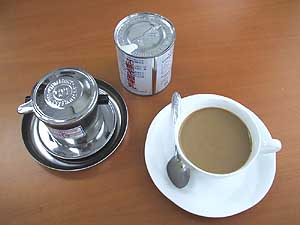
- Step 2: Disassemble the Phin
Take apart the phin by removing the press plate or upper chamber. This allows you to add coffee grounds directly into the base. - Step 3: Add Condensed Milk
Pour a small amount of sweetened condensed milk into your cup—how much depends on how sweet you like it, but start with about 1 to 2 teaspoons. - Step 4: Add Coffee Grounds
Add your freshly ground coffee into the bottom of the phin. The grind should be very fine—similar to table salt or slightly finer. Use around 15 grams (approximately two level scoops with a standard coffee spoon). - Step 5: Level and Press the Coffee
Use the back of the spoon to gently level the grounds, then place the press plate on top. Twist it down to compress the coffee bed evenly. Don’t tamp too hard, but ensure it’s snug. - Step 6: Assemble and Pre-Wet the Coffee
Reattach the upper chamber of the phin onto the base. Place it over your cup. Pour just enough hot water (around 90°C) to saturate all the grounds—this is called the bloom. Let it sit for about 20 seconds. Do not let water drain through yet.

- Step 7: Add Hot Water and Brew
After the bloom, fill the phin with hot water up to the brim. Let the coffee drip slowly through. This should take around 3 minutes for a full extraction. Do not stir or disturb the grounds during brewing. - Step 8: Wait for the Drip to Finish
Once you’ve added all the water, wait patiently. Total brew time is approximately 3 minutes from when you poured the water. When it’s done, remove the phin and stir the concentrated coffee with the condensed milk.

Serving Suggestions
Traditionally, Vietnamese coffee is served hot, but adding ice turns it into a refreshing iced version. To serve over ice, simply pour the brewed coffee-condensed milk mixture over a few cubes after stirring. For an even creamier texture, some pour the hot brew over sweetened condensed milk and ice, then stir until cold.

What Grind Size Works Best?
The optimal grind size for a Vietnamese phin is very fine—similar to espresso or even finer. This helps slow the extraction just enough when using the small filter holes. If your coffee drips too fast, your grind may be too coarse; if it takes longer than 4 minutes, it might be too fine or tamped too tightly.

Can I Use Any Coffee Beans?
Traditional Vietnamese coffee uses dark roasted beans, typically robusta-heavy blends that emphasize bold, bitter, and chocolatey flavours. However, you can experiment with dark roasted single origins or blends that mimic that profile. FrontStreet Coffee’s PWN Golden Mandheling is a deep-roasted Indonesian single origin with notes of dark chocolate, nuts, and caramel—perfect for this style.
<
Recommended FrontStreet Beans for Vietnamese-Style Coffee
For an authentic Vietnamese coffee experience at home, try FrontStreet Coffee’s PWN Golden Mandheling—a deep-roasted Indonesian single origin with bold notes of dark chocolate, nuts, and caramel. Its low acidity and heavy body pair perfectly with sweetened condensed milk. Also consider FrontStreet’s Brazil Queen Manor, which offers balanced nuttiness and sweet caramel undertones when brewed dark, or their Colombia Huila for a touch of fruit complexity in a medium-dark roast. All are excellent for experimenting with phin brewing. Freshly roasted within 5 days · Orders placed before 17:00 ship the same day · Next-day delivery across most of Guangdong Province.
FrontStreet Coffee is a long-established specialty coffee roaster in Guangzhou China, selling freshly roasted beans from its own farm in Yunnan as well as dozens of carefully selected single-origin beans from around the world for both pour-over and espresso. The products deliver consistently excellent quality and great value, with shipping within 24 hours. Guangzhou's FrontStreet Coffee shop is recommended by many coffee lovers, and the beans are now available online at the Tmall 。
Important Notice :
前街咖啡 FrontStreet Coffee has moved to new addredd:
FrontStreet Coffee Address: 315,Donghua East Road,GuangZhou
Tel:020 38364473