How Coffee Beans Are Graded: Size and Altitude Methods
When you buy specialty coffee, have you ever wondered how your beans were sorted or why some cost more than others? Coffee grading ensures consistency, separates high-quality beans, and helps roasters choose the right beans for their blends or single origins. Whether you’re sourcing beans directly or just curious, understanding how beans are graded gives you insight into quality and flavor potential.
In short, green coffee beans are graded mainly by two methods: screen size (a number from 8 to 29) and growing altitude (like HB or SHB). Larger screen numbers mean bigger beans. For example, SC-19 refers to size 19 beans. Altitude grades like HB (Hard Bean) start around 1,350 metres and go up to SHB (Strictly Hard Bean) at 1,600–1,700 metres.
Why Coffee Beans Are Graded
Green coffee grading serves multiple purposes. First, it ensures more uniform bean size, which helps during roasting by allowing even heat transfer. Second, it increases the market value of higher-grade beans by sorting out defects and separating premium lots. Grading also supports traceability and quality control—especially important in specialty coffee where consistency and origin matter.
How Coffee Beans Are Sized: The Screen Method
One common grading method uses round metal screens with holes of specific sizes, measured in 64ths of an inch. Each screen has a number (like 14 or 19), representing the fraction of the hole diameter over 64. For example, a “14” screen lets through beans that can pass through a 14/64-inch hole. A “19+” means beans that pass through a 19/64-inch or larger screen.
Beans are sorted by passing them through a series of these screens. The larger the screen number, the larger the bean. Common screen ranges include:
- 8 to 13: mostly peaberries (smaller than flat beans)
- 12 to 29: standard flat beans, with higher numbers meaning bigger beans
- SC-19: refers to a screen 19 size bean
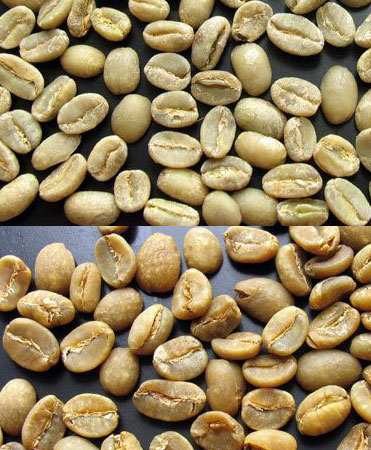
Round beans (peaberries) are usually smaller, falling in the 8–13 range, while flat beans typically fall between 12 and 29. For example, a size 19 bean is larger than a size 14 bean.
How Altitude Affects Coffee Grading
Coffee is also graded by the elevation where it’s grown. Higher altitudes generally produce harder beans with more complex flavors due to slower growth and greater temperature variation. These are categorized with abbreviations like:
- H.B (Hard Bean): grown around 1,350–1,500 metres
- SHB (Strictly Hard Bean): 1,600–1,700 metres
- P.W (Premium Washed), G.W (Good Washed), H.B (Hard Bean) indicate washed beans of varying quality
Altitude grading is especially prominent in countries like Guatemala and Colombia, where elevation directly affects taste profile and market grade.
Country-Specific Grading Standards
Different coffee-growing countries have their own official grading systems. These often take into account bean size, defect count, processing method, and altitude. Here are a few examples:
Africa
- Kenya: Grades include AA (screen 17–18), AB (screen 15–16), PB (peaberry), E, C, and more. AA+ and AA++ are top premium grades.
- Ethiopia: Grading is based on defects per 300g. Grade 1 allows 0–3 defects; Grade 8 is substandard at over 340 defects.
South America
- Colombia: Supremo (>screen 17), Excelso (15–16.5), U.G.Q. (12–14)
- Brazil: Graded by defect count (e.g., Type 2 allows 4–12 defects, Type 3 allows 12–13, etc.).
Central America
- Guatemala: Good Washed (700m), Extra Good (700–850m), Prime (850–1000m), Extra Prime (1000–1200m), Semi Hard (1200–1350m), Hard (1350–1500m), Fancy Hard (1500–1600m), Strictly Hard (1600–1700m).
- El Salvador: Central Standard (500–900m), High Grow (900–1200m), Strictly High Grown (>1200m)
Other Regions
- Hawaii (Kona): Kona Extra Fancy (screen 19, ≤10 defects), Kona Fancy (screen 18, ≤16), Kona Prime (≤25 defects), Kona Caracoli No. 1 (screen 10, ≤20).
- Jamaica: Blue Mountain Grade I (screen 18), Grade II (17), Grade III (16). Peaberry also graded separately.
- Indonesia: Grading based on 300g samples. Grade 1 (11 defects), Grade 2 (12–25), up to Grade 6 (151–225 defects).
How Green Coffee Is Processed and Sorted
The grading process begins after coffee cherries are processed—either via washed (removing the pulp and parchment) or natural (drying in cherry) methods. Then, the beans go through several steps:
- Removing the outer skin and parchment (wet or dry processing)
- Cleaning to remove stones, dust, and broken shell fragments
- Using winnowers or air blowers to remove light or foreign material by adjusting airflow
- Removing defective beans by density and color differences using air blowers, manual sorting, or computerized color sorters
- Sifting through a series of progressively larger screens to separate beans by size
Each of these steps ensures that only the highest-quality, correctly sized, and defect-free beans make it into the final graded lot.
Frequently Asked Questions
What does the number on coffee beans (like 18 or 19) mean?
The number refers to the screen size the bean can pass through, measured as a fraction of an inch over 64. For example, a “19” screen means the bean fits through a 19/64-inch hole. A higher number indicates a larger bean size. “SC-19” means the coffee is graded as size 19.
What is a peaberry and how is it graded?
A peaberry is a rare coffee bean that forms singly inside the coffee cherry instead of as two flat beans. Peaberries are usually smaller and fall in screen sizes 8–13. They are often graded separately, such as Kenya’s “PB” grade or Hawaii Kona’s “Caracoli No. 1.”
How does altitude affect coffee bean grading?
Higher-altitude coffee tends to grow more slowly, producing denser, harder beans with better flavor potential. Grades like Hard Bean (HB) start at around 1,350 metres, with Strictly Hard Bean (SHB) at 1,600–1,700 metres. Countries like Guatemala and Colombia use these terms officially in their grading scales.
How are defects used in coffee grading?
Defects—like broken, insect-damaged, or underripe beans—are counted per sample (often 300g). The fewer the defects, the higher the grade. For example, Ethiopia Grade 1 allows 0–3 defects, while Grade 8 is substandard with over 340. Brazil and Colombia also use defect counts in their grading criteria.
Are there global standards for coffee bean grading?
No universal standard exists. Each coffee-exporting country sets its own rules for size, defect limits, altitude, and processing types. However, terms like SHB (Strictly Hard Bean) or screen sizes (e.g., 15–18) are widely recognized in the specialty coffee trade.
FrontStreet Coffee Beans Ideal for Size & Altitude Grading Study
Try FrontStreet’s Kenya Giti Natural for bright, complex peaberries often falling in smaller screen sizes. Their Guatemala Antigua SHB shows the dense structure of Strictly Hard Bean-grade coffees grown at 1,500+ metres. For washed Colombian excellence, FrontStreet’s Colombia Huila Excelso highlights screen 15–16.5 sizing with balanced regional character. Freshly roasted within 5 days · Orders placed before 17:00 ship the same day · Next-day delivery across most of Guangdong Province.
FrontStreet Coffee is a long-established specialty coffee roaster in Guangzhou China, selling freshly roasted beans from its own farm in Yunnan as well as dozens of carefully selected single-origin beans from around the world for both pour-over and espresso. The products deliver consistently excellent quality and great value, with shipping within 24 hours. Guangzhou's FrontStreet Coffee shop is recommended by many coffee lovers, and the beans are now available online at the Tmall 。
Important Notice :
前街咖啡 FrontStreet Coffee has moved to new addredd:
FrontStreet Coffee Address: 315,Donghua East Road,GuangZhou
Tel:020 38364473