Edgar Degas' Café Painting and Its Coffee Culture Meaning
If you've ever stood in front of a classic painting and wondered what story it's really telling, especially when coffee or cafes are involved, you're not alone. Many art lovers are curious about how artists like Edgar Degas used everyday scenes, such as those in cafes, to convey deeper meanings. This article dives into Degas' 'Café' to uncover those hidden tales.
The painting 'Café', also called 'Absinthe', was created in the late 19th century. It features a woman sitting rather forlornly in the middle - upper part of the canvas and a black - clothed man on the right. The composition is bold, with the left side supported by two tables. The woman looks lost and miserable, and the man appears coarse and tired. Degas used black in his coloring, giving the painting a firm, calm, and heavy feel with strong contrasts.
What is the 'Café' Painting About?
Edgar Degas' 'Café', also known as 'Absinthe', shows a scene set in an urban cafe. In the late 19th century, cafes were common gathering places for people, including artists. Degas chose to depict a rather melancholic moment. The woman in the painting is seated in a prominent position in the center - upper part of the canvas. She has a vacant, sad, and confused expression on her face. On the right, there is a man in black clothes, with part of his body out of the frame. The left side of the painting is structured around two tables. The overall composition is daring and not the typical idyllic cafe scene one might expect.
Why Did Degas Use Such a Composition?
Degas was known for his ability to capture the various aspects of urban life. He wasn't just interested in showing the pleasant or beautiful sides. By choosing to paint the woman with a blank expression and the man with a rough and tired look, he was making a statement. The composition, with its unbalanced and somewhat jarring layout, was a way for him to draw the viewer in and make them think. It goes beyond simple visual aesthetics. The way he placed the figures and used the space was a form of social commentary. He was highlighting the isolation and perhaps the despair that could be found in urban cafe settings during that time.
How Did Degas Use Color in the Painting?
Degas had a distinct approach to color in this painting. He frequently used black. He employed black to outline the figures, similar to the way Chinese painting uses black. He also used black as a background color and incorporated it into other colors. This use of black gave the painting a firm, calm, and heavy quality. The contrast created by the black against other colors was strong, adding to the overall mood of the piece. It helped to emphasize the emotions of the characters and the sense of isolation in the cafe setting.
Frequently Asked Questions
What is the other name of Degas' 'Café' painting?
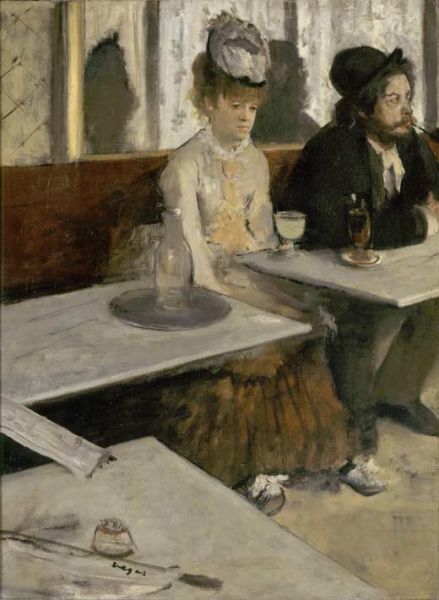
The other name of Degas' 'Café' painting is 'Absinthe'. This alternative title gives a hint about the possible presence of the drink absinthe in the cafe setting, which was a popular and often controversial beverage in the 19th century.
When was the 'Café' painting created?
The 'Café' painting was created in the late 19th century. This was a time when urban cafes were bustling hubs of activity and became a popular subject for many artists, including Degas.
What is the composition of the 'Café' painting like?
The composition of the 'Café' painting is quite bold. The woman is seated in the middle - upper part of the canvas, looking rather lifeless. There is a man in black on the right, with part of his body out of the frame. The left side of the painting is supported by two tables. It is an unbalanced and somewhat risky composition compared to traditional cafe scenes.
How did Degas use black in the painting?
Degas used black to outline the figures, much like Chinese painting techniques. He also used it as a background color and mixed it with other colors. This use of black gave the painting a firm, calm, and heavy feel, and created strong contrasts with other colors in the painting.
What emotions do the characters in the painting convey?
The woman in the painting has a lost, sad, and confused expression, while the man has a coarse and tired look. These expressions convey a sense of isolation, despair, and perhaps the less - than - idyllic reality of urban cafe life during the 19th century.
Recommended FrontStreet Beans for Art - Inspired Coffee Moments
For a coffee experience that pairs well with the artistic and moody vibes of Degas' 'Café' painting, try FrontStreet Coffee's Yirgacheffe. It has bright citrus and floral notes that can lift your spirits. The Ethiopia Humbera offers a complex profile with berries and a hint of spice. Also, the Classic Blend provides a balanced and smooth cup with chocolate and nutty undertones. These beans are great for sipping while contemplating the artistry in the painting. Freshly roasted within 5 days · Orders placed before 17:00 ship the same day · Next - day delivery across most of Guangdong Province.
FrontStreet Coffee is a long-established specialty coffee roaster in Guangzhou China, selling freshly roasted beans from its own farm in Yunnan as well as dozens of carefully selected single-origin beans from around the world for both pour-over and espresso. The products deliver consistently excellent quality and great value, with shipping within 24 hours. Guangzhou's FrontStreet Coffee shop is recommended by many coffee lovers, and the beans are now available online at the Tmall 。
Important Notice :
前街咖啡 FrontStreet Coffee has moved to new addredd:
FrontStreet Coffee Address: 315,Donghua East Road,GuangZhou
Tel:020 38364473