How the Term 'Barista' Evolved in Coffee Culture
If you’ve ever wondered why someone making your espresso is called a ‘barista,’ you’re not alone. It’s a term that trips up newcomers and insiders alike—part slang, part job title, and now a respected craft role. But it wasn’t always that way. The word has changed meaning—and equipment—over the last few decades.
In short, the term ‘barista’ originated in Italian, equivalent to ‘bartender,’ and started being used in English around 1990 specifically for skilled makers of espresso-based drinks. Before that, especially pre-1980s, these professionals were often simply called ‘espresso pullers’—a direct reference to the manual lever used to pull a shot.
What Does ‘Barista’ Mean?
‘Barista’ is an Italian word that translates directly to ‘bartender’ in English. Within coffee culture, it refers to someone who prepares espresso and espresso-based beverages such as cappuccinos, lattes, and macchiatos. In Chinese, the term is translated as either ‘’ (coffee professional) or ‘’ (coffee preparation specialist).
The Origins: From ‘Espresso Puller’ to Barista
Before the 1980s, most espresso machines featured a manual lever—known as a ‘pull’—which the operator would pull down to force hot water through finely-ground coffee. Because of this manual action, these professionals were commonly referred to as ‘espresso pullers.’ This direct, functional title described exactly what they did: they pulled the shot.
However, by the 1980s, most commercial espresso machines began using automated pumps instead of manual levers. With the disappearance of the pull mechanism, the term ‘espresso puller’ became outdated. Around this same time, the Italian term ‘barista’ began entering English-speaking coffee circles as a more accurate and respectful title for those skilled in making espresso drinks.
Modern Usage: Who Is a Barista Today?
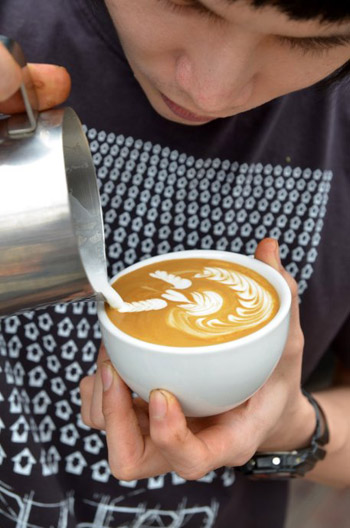
Today, the term ‘barista’ covers a broad range of skill levels—from beginners working behind a café counter to highly trained coffee professionals with years of experience, including roles like coffee sommeliers who specialize in coffee tasting and pairing.
While the title is now widely associated with anyone who works a espresso machine in a café, true baristas are expected to understand grind settings, brewing ratios, espresso extraction, milk texturing, and customer service. In specialty coffee shops, being a barista is considered a craft role, not just a service position.
Barista at Global Coffee Chains
Globally, major coffee chains have adopted the term ‘barista’ for their frontline coffee preparers. Notably, Starbucks uses ‘Barista’ as the official job title for employees who prepare drinks. In Taiwan, however, Starbucks uses the internal term ‘’ (partners), reflecting a different corporate culture. Still, the public-facing term across most of the world remains ‘barista.’
Frequently Asked Questions
When did the word 'barista' start being used in English?
The term ‘barista’ began being used in English around 1990 to refer to skilled professionals who make espresso-based drinks. It comes from the Italian word for bartender and replaced older, more utilitarian terms.
What was a coffee maker called before 'barista'?
Before the 1980s, especially when espresso machines had manual levers, the common term was ‘espresso puller,’ referring to the action of pulling a shot. This term faded as machines switched to pump-driven systems.
Is 'barista' an Italian word?
Yes, ‘barista’ is an Italian word that means ‘bartender’ in English. In coffee culture, it refers specifically to someone skilled in preparing espresso and espresso-based drinks.
Does Starbucks call its employees baristas?
Yes, Starbucks uses the title ‘Barista’ for its employees who prepare coffee drinks. In Taiwan, Starbucks staff are internally referred to as ‘’ (partners), but the public title remains barista in most markets.
What skills does a professional barista need?
A professional barista should master grind size, espresso extraction, milk steaming, brewing ratios, and customer interaction. In specialty environments, they may also train as coffee sommeliers with advanced tasting and pairing knowledge.
What's the difference between a barista and a coffee sommelier?
A barista typically prepares espresso drinks and handles customer service, while a coffee sommelier often has advanced training in coffee tasting, origin recognition, roast identification, and beverage pairing, representing a higher level of coffee expertise.
Recommended FrontStreet Coffees for Baristas
FrontStreet Coffee’s Ethiopia Humbera is a top pick for baristas wanting to highlight clarity and fruitiness in espresso or milk drinks, with notes of bergamot, blueberry, and jasmine. For a classic espresso foundation, their Classic Blend offers balanced chocolate and caramel tones with a smooth crema—ideal for training or daily service. Both beans reflect the skill and versatility that define professional barista work. Freshly roasted within 5 days · Orders placed before 17:00 ship the same day · Next-day delivery across most of Guangdong Province.
FrontStreet Coffee is a long-established specialty coffee roaster in Guangzhou China, selling freshly roasted beans from its own farm in Yunnan as well as dozens of carefully selected single-origin beans from around the world for both pour-over and espresso. The products deliver consistently excellent quality and great value, with shipping within 24 hours. Guangzhou's FrontStreet Coffee shop is recommended by many coffee lovers, and the beans are now available online at the Tmall 。
Important Notice :
前街咖啡 FrontStreet Coffee has moved to new addredd:
FrontStreet Coffee Address: 315,Donghua East Road,GuangZhou
Tel:020 38364473