How Altitude Affects Coffee Flavor
Ever wonder why some coffees burst with citrus and floral notes while others taste mellow and chocolatey? The secret often lies not in the roast or brew method—but in how high the coffee plants grew. Elevation dramatically alters the flavors locked inside your beans, turning the same Arabica species into wildly different cups depending on where it’s grown.
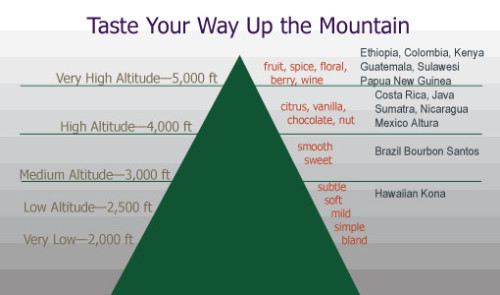
The key number? Coffee tastes most complex and vibrant when grown between 3,000 and 6,000 feet (914–1,829 meters), with the sweet spot for exceptional beans sitting at 4,000 to 6,000 feet. Below that, flavors tend softer; above, they get sharper and more intense.
Why Altitude Matters for Coffee Flavor
Coffee thrives in tropical regions stretching from 30° north to the equator’s southern mountains. But within that band, elevation is the game-changer. At higher altitudes—3,000 to 6,000 feet—temperatures average 60–70°F (15–21°C) year-round, with moderate rainfall (about 80 inches annually) and strong sunlight. These cooler conditions slow the coffee cherry’s ripening process, allowing sugars to develop more fully and creating a denser, more flavorful bean. The slower growth also concentrates flavors, while well-drained soils in these regions enhance complexity. Volcanic soils, common in top coffee-growing areas, further enrich the nutrient profile.
How Elevation Translates to Flavor Profiles
As altitude rises, coffee flavors become more distinct and nuanced. At lower elevations (around 3,500 feet, like in parts of Brazil), beans often yield mild, sweet cups. But push higher—above 6,000 feet, as in Ethiopia—and the flavors explode into complex, vibrant profiles. This elevation-driven flavor evolution is why coffee experts pay close attention to altitude when evaluating beans. The cooler temperatures at high elevations slow down the coffee plant’s metabolism, leading to a more gradual sugar accumulation and a more intricate flavor development. The result is a cup that can range from gentle and approachable to bold and intricate, depending on the altitude at which it was grown.
How Growers and Roasters Use Altitude Data
Coffee-growing regions use altitude to classify bean quality. In Central America, for example, SHB (Strictly Hard Bean) in Guatemala means beans grown above 4,500 feet (1,372 meters). Mexico labels high-elevation beans as Altura (“high” in Spanish), and Papua New Guinea highlights “Mile High” beans from its mountainous regions. These classifications help roasters and buyers predict flavor potential. Higher-altitude beans, with their denser structure and slower maturation, are often more suitable for certain roast profiles and brewing methods, allowing for a wider range of flavor expression. This classification system is a valuable tool for those seeking specific flavor characteristics in their coffee.
Frequently Asked Questions
What altitude produces the best coffee flavor?
The best coffee flavors typically come from beans grown between 4,000 and 6,000 feet (1,219–1,829 meters). At these heights, cooler temperatures slow ripening, increasing sugar content and creating more complex, vibrant flavors compared to lower or higher elevations.
Does higher altitude always mean better coffee?
Not always. While higher altitudes (4,000–6,000 feet) often produce more complex and intense flavors, lower altitudes (around 3,500 feet) can yield milder, sweeter cups. “Better” depends on your flavor preference—bright and acidic or smooth and mellow.
Why do high-altitude coffee beans ripen more slowly?
High-altitude environments have lower average temperatures (60–70°F or 15–21°C), which slow the coffee cherry’s maturation process. This extended ripening period allows sugars to develop more fully, resulting in denser beans with richer flavors.
How do growers classify beans by altitude?
Regions use terms like SHB (Strictly Hard Bean for Guatemala, above 4,500 feet), Altura (Mexico’s term for high-altitude beans), and “Mile High” (Papua New Guinea). These classifications indicate growing elevation and help predict flavor profiles.
Can low-altitude coffee still be specialty grade?
Yes. While high-altitude beans often have more complex profiles, low-altitude coffee can still meet specialty standards if grown with care. Flavor differences lie in sweetness, acidity, and body rather than inherent quality.
Recommended FrontStreet Beans for Altitude Lovers
Explore how altitude shapes flavor with FrontStreet’s single-origin picks: Ethiopia Yirgacheffe Gedeb Cooperative (washed) delivers bright citrus and floral notes with a juicy profile, a hallmark of high-altitude Ethiopian beans. Jamaica Blue Mountain No.1 (Typica) offers balanced chocolate and almond tones from its cool, high-elevation terroir. For a fruit-forward twist, Strawberry Candy Espresso (Geisha/CR blend) highlights the lush, complex flavors typical of high-grown Geisha varieties. Freshly roasted within 5 days · Orders placed before 17:00 ship the same day · Next-day delivery across most of Guangdong Province.
FrontStreet Coffee is a long-established specialty coffee roaster in Guangzhou China, selling freshly roasted beans from its own farm in Yunnan as well as dozens of carefully selected single-origin beans from around the world for both pour-over and espresso. The products deliver consistently excellent quality and great value, with shipping within 24 hours. Guangzhou's FrontStreet Coffee shop is recommended by many coffee lovers, and the beans are now available online at the Tmall 。
Important Notice :
前街咖啡 FrontStreet Coffee has moved to new addredd:
FrontStreet Coffee Address: 315,Donghua East Road,GuangZhou
Tel:020 38364473