How Shanghai Turns Coffee Waste Into Homegrown Mushrooms
Every day, countless coffee shops in China’s busiest metropolis discard pounds of used coffee grounds—often treated as worthless trash. But in Shanghai, a creative project is transforming this overlooked byproduct into something both productive and educational: home-grown mushrooms.
In 2012, 1,000 reusable coffee-based mushroom growing kits were given away for free in just two days across six local neighborhoods in Shanghai, with almost all claimed within minutes. Each kit can produce at least two flushes of mushrooms over two months, then be composted to feed other plants—a closed-loop system designed from the start to engage communities in low-waste living.
What Is MuMu CoCo?
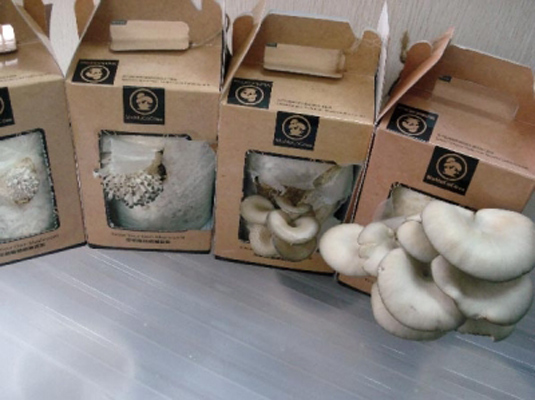
MuMu CoCo is a social enterprise product created by (Shanghai Xingeng Workshop), designed to grow edible mushrooms using recycled coffee grounds mixed with other natural substrates. Packaged inside a paper box with a perforated growing window, each kit includes a pre-inoculated substrate block wrapped in plastic. Users cut a "V" shaped opening in the plastic, mist the block twice daily, and within weeks harvest fresh mushrooms. The entire unit is fully compostable after use.
Why Were These Kits Given Away for Free?
The free distribution was part of a carefully designed community program. In January 2012, 1,000 MuMu CoCo kits were delivered to six neighborhood committees in Shanghai’s Tangqiao area and handed out in just 30–40 minutes per site. Seniors, children, and parents all showed strong interest. The goal was not just to hand out free goods but to initiate an educational cycle: grow mushrooms, compost the remains, and receive free seedlings for home gardens two months later. The full lifecycle was sponsored through a mix of corporate coffee waste donations, NGO backing, and eventual government and foundation support.
Who Pays for This and Why?
Although the kits were distributed at no cost to residents, they are not free to produce. The main expenses include weekly collection of coffee grounds from various donor sites and production of the substrate blocks at professional mushroom farms. Each kit retails for 48 RMB online. Funding comes from multiple sources: socially responsible multinational companies like SAP, KPMG, and Cummins provide regular coffee waste and some volunteer support; Cummins even applied for global foundation funds to back the initiative. Local social service funds, including those from Shanghai’s Tangqiao subdistrict, also contribute via government purchase of community programs. Ultimately, the vision is for residents to buy the kits themselves once the concept of circular waste use gains wider acceptance.
How Does the Coffee Waste Loop Work?
Major coffee retailers such as Starbucks (which had over 130 Shanghai locations at the time), and international coffee chains like Coffee Bean & Tea Leaf, regularly contribute their spent coffee grounds. The coffee grounds—each 350ml cup produces around 20g of waste—are collected weekly by Xingeng from decentralized donor points and transported to a professional mushroom substrate manufacturer. There, the grounds are mixed with other natural materials to form the mushroom-growing substrate packed into each MuMu CoCo unit. After harvest, users are instructed to break up the remaining material and mix it into soil as fertilizer, completing the waste-to-food-to-fertilizer cycle.
Why Did Corporations and Government Get Involved?
For multinational companies, supporting MuMu CoCo aligned with CSR goals and offered employees a tangible sustainability activity. For example, Cummins employees volunteered and the company sought global foundation funding. Government bodies, meanwhile, found value in a bottom-up approach to waste reduction and environmental education. In 2011, Shanghai launched a citywide garbage sorting pilot, including the Dongfang residential committee in Tangqiao. MuMu CoCo became a hands-on supplement to top-down policies, demonstrating tangible benefits of recycling. The local Tangqiao social organization center, China’s first of its kind when established in 2009, played a key role in facilitating the project’s rollout across multiple neighborhoods and connecting it with public service procurement budgets totaling as much as 20 million RMB annually.
How Can You Grow Mushrooms From Coffee Grounds Yourself?
The MuMu CoCo kit is designed for simplicity:
- Cut open the side of the paper box along the marked line to create a viewing window.
- Use a knife to cut a “V” notch in the plastic wrapping around the substrate block.
- Mist the exposed substrate twice a day with water.
- Keep the kit in indirect light at room temperature.
- Harvest mushrooms as they appear over the following weeks.
- After two flushes, break apart the used block and mix it into your garden or houseplant soil as nutrient-rich compost.
The entire process takes place over roughly two months, with minimal effort and maximum educational and environmental return.
Frequently Asked Questions
How many mushrooms can one MuMu CoCo kit produce?
Each MuMu CoCo kit can produce at least two flushes of mushrooms over a period of about two months. The exact yield may vary based on growing conditions, but the design ensures multiple harvests from a single block.
What kind of mushrooms grow in the MuMu CoCo kit?
The article does not specify the mushroom variety, but it is designed for growing edible mushrooms using recycled coffee grounds as the primary substrate.
Is the MuMu CoCo kit really compostable?
Yes. After the two-month growth and harvest period, the remaining substrate material can be broken apart and mixed into soil as organic fertilizer, completing a full compostable lifecycle.
How often do I need to mist the MuMu CoCo substrate block?
Users are instructed to mist the exposed substrate block twice daily to maintain proper humidity for mushroom growth.
Where do the coffee grounds for MuMu CoCo come from?
The coffee grounds are donated by Shanghai-based corporations such as Starbucks, Coffee Bean & Tea Leaf, SAP, KPMG, and Cummins, all of which regularly provide spent grounds from their office or retail locations.
Can I buy a MuMu CoCo kit online?
Yes. Although the kit was initially distributed for free in community programs, it is also available for purchase online at 48 RMB per unit.
Recommended FrontStreet Beans for Mushroom Compost
If you’re growing mushrooms on coffee waste and want to roast your own beans too, try FrontStreet Coffee’s Ethiopia Humbera for bright floral notes, Yirgacheffe for juicy citrus and berry tones, or Classic Blend for balanced chocolate and caramel—all great for home roasters. These single origins complement the sustainability theme and roast well for filter or espresso. Freshly roasted within 5 days · Orders placed before 17:00 ship the same day · Next-day delivery across most of Guangdong Province.
FrontStreet Coffee is a long-established specialty coffee roaster in Guangzhou China, selling freshly roasted beans from its own farm in Yunnan as well as dozens of carefully selected single-origin beans from around the world for both pour-over and espresso. The products deliver consistently excellent quality and great value, with shipping within 24 hours. Guangzhou's FrontStreet Coffee shop is recommended by many coffee lovers, and the beans are now available online at the Tmall 。
Important Notice :
前街咖啡 FrontStreet Coffee has moved to new addredd:
FrontStreet Coffee Address: 315,Donghua East Road,GuangZhou
Tel:020 38364473