
How Coffee Spread Across the Globe: From Ethiopia to Hawaii
Ever wondered how your morning cup of coffee made it from a remote Ethiopian highland to your local café? The path coffee took to become a global staple is a fascinating tale of trade, colonization, and botanical adventure spanning centuries and continents. It didn’t just appear in your shop — it traveled the world first.
Coffee originated in Ethiopia between the 7th and 9th centuries, then spread to Yemen by the Arab world before reaching India (1600), Sri Lanka (1658), Java (1690–1696), and eventually Europe. From Amsterdam, it journeyed to France, the Caribbean, South America (especially Brazil), Central America (like Guatemala), and Hawaii. Each stop added to coffee’s global genetic and cultural legacy.
The Birthplace: Ethiopia (7th–9th Century)
The earliest records place coffee’s discovery in Ethiopia, likely in the Kaffa region, between the 7th and 9th centuries. Though its use as a stimulant began earlier among local communities, it was here that coffee’s journey truly began. These highland regions hosted the wild coffee plant, later cultivated and eventually traded across the Red Sea.
Yemen and the Arab World
From Ethiopia, coffee beans were transported across the Red Sea to Yemen, where the Arabs began cultivating and trading coffee systematically in the 15th century. By the 16th century, coffee drinking was well-established in Yemeni cities like Mocha, which became a major hub. Yemen’s role was crucial — it was where coffee was first roasted, brewed, and widely disseminated outside Africa.
India: The First Overseas Cultivation (1600)
In 1600, Baba Budan, an Indian pilgrim, smuggled seven coffee seeds out of Yemen and planted them in the hills of Karnataka (then part of the Mysore region), marking the first successful cultivation outside Arabia. This marked the beginning of coffee’s geographic expansion beyond its birth continent.
Sri Lanka (Ceylon), Java, and Beyond: The Dutch Expansion (1658–1696)
The Dutch played a central role in spreading coffee across Asia. In 1658, they introduced coffee to Sri Lanka (then Ceylon). By 1690–1696, they had established plantations in Java (Indonesia), expanding their control over the coffee trade. These efforts created some of the earliest large-scale coffee farming outside the Arab world.
Europe: Arrival in Amsterdam and the French Court (1706–1713)
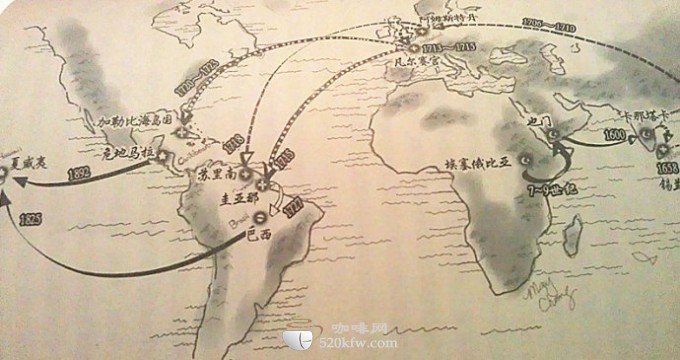
Between 1706 and 1710, coffee plants made their way to Amsterdam, where the Dutch cultivated them in greenhouses. By around 1713, a coffee plant reached the court of Louis XIV in Versailles, France. Shortly after, plants were also sent to the French colony of Île de Bourbon (now Réunion), spreading the species further into the French colonial sphere.
The Americas: From the Caribbean to Brazil (Late 1700s–1800s)
Coffee’s journey to the New World began in the Caribbean and Guyana, with plants arriving via French and Dutch colonies. Eventually, coffee was introduced to Brazil — likely through the state of Pará — in the early 1700s, but expanded greatly in the 19th century. Brazil would go on to become the world’s largest coffee producer. Around the same time, coffee also spread to Guatemala and other Central American countries.
Hawaii: The Late Bloomer (1825 and 1892)
Coffee arrived in Hawaii in two major waves — once in 1825 and again in 1892 — becoming a key agricultural product. The islands’ climate proved ideal for high-quality production, leading to the development of celebrated Hawaiian coffees such as Kona.
The Global Migration of the Bourbon Variety
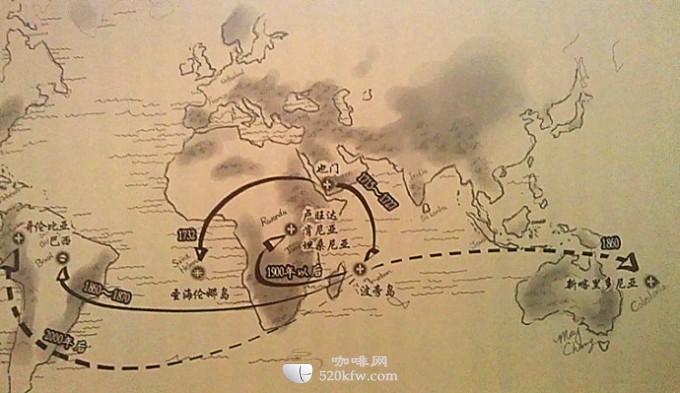
The Bourbon coffee variety, originating from Yemen and cultivated on the Île de Bourbon, became a key genetic line in coffee’s international expansion:
- By 1732, the round-seeded Bourbon variety was taken to the British territory of Saint Helena.
- By 1860, both the pointed and round variants of Bourbon had reached new destinations: the pointed type went to New Caledonia, and the round type was introduced to Brazil.
- In the late 1800s, around 1860, the round Bourbon was also taken to Rwanda, Kenya, and Tanzania.
- After 2000, the pointed Bourbon variety finally made its way to Colombia, further diversifying the genetic base of high-altitude arabica.
Frequently Asked Questions
Where did coffee originate?
Coffee originated in Ethiopia between the 7th and 9th centuries. Local communities first used the wild coffee plant as a stimulant, and it later spread to the Arabian Peninsula.
How did coffee get to India?
Coffee was first brought to India in 1600 by Baba Budan, who smuggled seven coffee seeds from Yemen and planted them in Karnataka, marking the crop’s first cultivation outside Arabia.
What role did the Dutch play in spreading coffee?
The Dutch were instrumental in introducing coffee to Sri Lanka in 1658 and Java in 1690–1696. They also facilitated the plant’s movement to Europe and later to the Americas through botanical exchanges.
When did coffee arrive in Brazil?
Coffee arrived in Brazil in the early 1700s, likely through Pará, but expanded significantly from the 19th century onward, making Brazil the world’s leading coffee producer.
What is the Bourbon coffee variety and where did it spread?
Bourbon is a key arabica variety originating from Yemen and Île de Bourbon. It spread to Saint Helena (1732), Brazil (1860), Rwanda, Kenya, and Tanzania (by 1860), New Caledonia (1860, pointed type), and Colombia (after 2000, pointed type).
When did coffee reach Hawaii?
Coffee was introduced to Hawaii in two major waves, in 1825 and 1892, and became a significant agricultural product due to the islands’ ideal growing conditions.
FrontStreet Coffee Beans That Trace Coffee’s Journey
Explore the origins of coffee with FrontStreet’s Ethiopia Yirgacheffe, a bright and floral single origin that reflects coffee’s roots in the Ethiopian highlands. For a taste of Java’s legacy, try FrontStreet’s Indonesia Java — a classic low-acid, full-bodied brew that recalls the Dutch plantations of the 18th century. Finally, experience the Bourbon genetic line with our Yellow Bourbon offering, highlighting the variety that travelled from Yemen to Brazil and beyond. Freshly roasted within 5 days · Orders placed before 17:00 ship the same day · Next-day delivery across most of Guangdong Province.
FrontStreet Coffee is a long-established specialty coffee roaster in Guangzhou China, selling freshly roasted beans from its own farm in Yunnan as well as dozens of carefully selected single-origin beans from around the world for both pour-over and espresso. The products deliver consistently excellent quality and great value, with shipping within 24 hours. Guangzhou's FrontStreet Coffee shop is recommended by many coffee lovers, and the beans are now available online at the Tmall 。
Important Notice :
前街咖啡 FrontStreet Coffee has moved to new addredd:
FrontStreet Coffee Address: 315,Donghua East Road,GuangZhou
Tel:020 38364473

