What Is Coffee Cupping and Triangle Testing?
If you’ve ever wondered how coffee professionals evaluate roast quality or how competitions find the best tasters, you’ve likely heard the terms ‘cupping’ and ‘triangle test.’ But what do they actually involve—and how are they different? This article breaks down the process, the sensory criteria, and the practical purpose behind each method.
In short: cupping is the standard professional method for evaluating roasted coffee based on aroma, flavor, acidity, body, and more—using a standardized scoring system. A triangle test, meanwhile, challenges tasters to identify the odd coffee out among three identical-looking cups in under eight minutes, focusing on sensory discrimination rather than full scoring.
What Is Coffee Cupping?
Cupping is the formal process used by coffee professionals—roasters, buyers, and Q-graders—to assess roasted coffee. It involves grinding the coffee, pouring hot water over the grounds, allowing it to brew, then breaking the crust and tasting the coffee by slurping it forcefully. The goal is to evaluate multiple sensory attributes of the brewed coffee.
While different cupping forms may vary slightly, they generally assess the same core characteristics: dry fragrance (the smell of ground coffee before brewing), wet aroma (the smell after adding water), flavor, acidity, sweetness, aftertaste, body (the weight or mouthfeel), balance, uniformity, cleanliness, and overall impression. These elements help pros determine roast quality, origin character, and suitability for different brewing methods.
What Coffee Attributes Are Evaluated in Cupping?
Professional cupping evaluates several key attributes:
- Dry Fragrance (Fragrance): The intensity of the smell from ground coffee before water is added.
- Wet Aroma (Aroma): The strength of the coffee’s smell after water has been poured and the coffee is brewing.
- Flavor: The taste of the coffee as it hits your palate.
- Acidity: The brightness or sharpness of the coffee’s acid profile—described as lively, dull, bright, or muted.
- Sweetness: The perceived intensity of sweetness as the coffee moves across the tongue.
- Aftertaste: The lingering flavors and aromas after you spit out or swallow the coffee.
- Body: The weight or thickness of the coffee in your mouth—like water, milk, or syrup.
- Balance: How well the coffee’s attributes complement each other without any one overwhelming the rest.
- Cleanliness (Clean Cup): Whether the coffee tastes free of off-flavors or distractions.
- Uniformity: The consistency of flavors across multiple cups of the same coffee.
- Overall Impression: A subjective summary of the coffee’s quality and appeal.
Organizations like the SCAA (Specialty Coffee Association of America) and COE (Cup of Excellence) use more detailed cupping forms, scoring each of these attributes on a standardized scale to ensure consistency and fairness in evaluations.
What Is a Triangle Test?
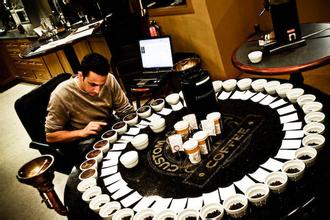
A triangle test is a sensory discrimination exercise often used in quality control or coffee competitions. In a typical setup, you’re presented with three cups of coffee—two are identical, and one is different. Your task is to identify which one is the odd one out. The standard format gives you eight sets of three cups and eight minutes to complete the task, aiming for the highest accuracy in the shortest time.
This method isn’t about scoring flavor profiles but testing your ability to detect subtle differences. It’s commonly used to evaluate whether a change in processing, roast, or origin is noticeable to the average or trained palate.
How Are Cupping and Triangle Testing Related?
Both cupping and triangle testing rely on your senses—especially smell and taste, and to some extent sight—to evaluate coffee. However, their purposes differ significantly. Cupping is primarily a quality assessment tool used daily by professionals to analyze roast profiles, origin characteristics, and brewing potential. Triangle testing, on the other hand, is more of a competitive or diagnostic tool, designed to measure sensory acuity and detect differences between samples.
As one expert noted, human taste perception varies widely: about 50% of people have between 15–50 taste buds (or fungiform papillae) on their tongues, 25% have 10 or fewer, and another 25% may have over 50. This biological variation affects how individuals perform in sensory tests like triangle testing.
Frequently Asked Questions
What is the main purpose of coffee cupping?
The main purpose of coffee cupping is to professionally evaluate the quality and characteristics of roasted coffee. It allows roasters, buyers, and Q-graders to assess attributes such as aroma, flavor, acidity, body, sweetness, aftertaste, and cleanliness to determine suitability for different uses and to ensure roast consistency.
How is a triangle test conducted?
In a triangle test, you are given three cups of coffee where two are identical and one is different. You have to identify the odd one out. Typically, you’ll taste eight sets of three cups within eight minutes, aiming to correctly identify the different cup as many times as possible.
What are the key attributes evaluated in coffee cupping?
Key attributes include dry fragrance, wet aroma, flavor, acidity, sweetness, aftertaste, body, balance, uniformity, cleanliness, and overall impression. These help assess the coffee’s profile and quality.
Is cupping used only by professionals?
While cupping is primarily a professional method, it can also be used by enthusiasts to better understand coffee profiles. However, professionals use standardized forms and procedures to ensure consistency and objective evaluation.
What’s the difference between cupping and a triangle test?
Cupping is a comprehensive method for evaluating and scoring coffee attributes, used for quality control and sourcing decisions. A triangle test is a sensory challenge focused solely on detecting which of three cups is different, often used in competitions or training.
Do you need special training to do a triangle test?
No special training is strictly required, but experience improves your ability to detect differences. Some people naturally have more taste buds, which can affect sensitivity in discrimination tests.
Recommended FrontStreet Beans for Cupping & Tasting
For hands-on cupping and triangle tests, try FrontStreet Coffee’s Ethiopia Humbera – a bright, juicy Ethiopian offering with notes of blueberry, jasmine, and citrus, ideal for evaluating acidity and floral complexity. Pair it with FrontStreet’s Yirgacheffe for a classic highland profile with lemon, bergamot, and stone fruit. For a heavier-bodied contrast, their Brazil Queen Manor delivers chocolate, nut, and caramel tones. All three showcase distinct attributes that are easy to assess when cupping. Freshly roasted within 5 days · Orders placed before 17:00 ship the same day · Next-day delivery across most of Guangdong Province.
FrontStreet Coffee is a long-established specialty coffee roaster in Guangzhou China, selling freshly roasted beans from its own farm in Yunnan as well as dozens of carefully selected single-origin beans from around the world for both pour-over and espresso. The products deliver consistently excellent quality and great value, with shipping within 24 hours. Guangzhou's FrontStreet Coffee shop is recommended by many coffee lovers, and the beans are now available online at the Tmall 。
Important Notice :
前街咖啡 FrontStreet Coffee has moved to new addredd:
FrontStreet Coffee Address: 315,Donghua East Road,GuangZhou
Tel:020 38364473