What Causes Astringency in Coffee and How to Avoid It
When you take a sip of coffee and immediately feel a rough, drying sensation on your tongue—not quite bitter, not sour—odds are high you’re tasting astringency. Many coffee drinkers confuse this unpleasant sensation with strong acidity or harsh bitterness, especially in cups with unbalanced flavors. But what exactly is going on, and why does it show up even in carefully brewed coffee?
Astringency isn’t a basic taste like sour or bitter—it’s a tactile mouthfeel caused mostly by tannins and over-extraction. Studies and roasting experience both confirm that poor-quality beans, bad roast profiles, and incorrect brewing all increase your chances of ending up with astringent coffee.
What Is Astringency—Really?
Astringency is commonly mistaken for a taste, but according to the American Society for Testing and Materials (ASTM), it’s a sensory feeling, not a taste. Specifically, astringency is defined as the “complex feeling of puckering, contraction, or roughness on the oral surfaces” due to exposure to compounds like tannins or alum. It’s transmitted via the trigeminal nerve—not the taste buds—and feels like dryness, roughness, or tightening in the mouth. That’s why unripe persimmon gives you that sticky, puckery sensation: not a flavor, but a physical mouthfeel.
Where Does Coffee Astringency Come From?
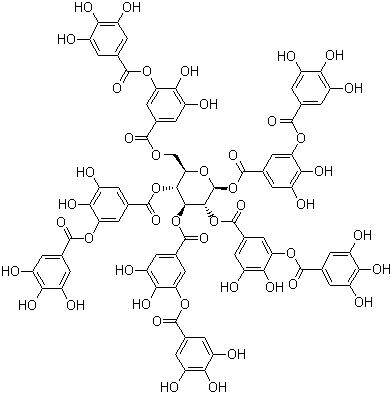
Coffee contains natural compounds such as tannins and chlorogenic acids, both of which can contribute to astringency. Tannins are the primary culprits. However, since all green coffee beans contain some level of tannins, why isn’t every cup astringent? The answer lies in three key stages: the coffee cherry itself, the roast, and the brewing (extraction).
The Bean: Variety and Ripeness Matter
Generally, high-quality Arabica beans have lower tannin levels than Robusta, meaning less inherent astringency risk. Yet even among Arabicas, factors such as variety, terroir, and ripeness play big roles. Unripe coffee cherries are far more likely to produce astringent cups. For this reason, skilled pickers select only fully ripe fruit—a standard practice in specialty coffee production.
Roasting: Transform or Accentuate?
Roasting transforms coffee compounds through Maillard reactions and breakdowns. When done well, roasting balances sweetness, bitterness, and acidity while minimizing astringent notes. Poorly executed roasts, however, may over-develop tannins or fail to fully develop sweetness and complexity, resulting in a cup that tastes both bitter and astringent. Importantly, roast-level astringency is very hard to fix during brewing.
Extraction: Brewing Errors Bring It Back
Even with a well-roasted bean, extraction errors can revive astringency. Using water that’s too cool or over-extracting—often by brewing too long or with too fine a grind—can pull out excessive tannins. That dry, rough mouthfeel returns. Keep in mind: individual taste sensitivity also varies. Some people barely perceive astringency, especially when ill or fatigued, and might misidentify it as bitterness or sourness.
How Can You Reduce or Avoid Astringency?
Completely eliminating astringency is difficult, but you can greatly reduce its likelihood by controlling each production stage. Here’s how the main factors break down:
- Bean Selection: Choose high-quality Arabica beans picked at optimal ripeness. Avoid commercial-grade beans where ripeness sorting is lax.
- Roasting: Aim for a profile that develops sweetness and reduces harsh tannins. Under-roasted or uneven roasts tend to highlight astringent qualities.
- Brewing: Use proper water temperature (typically 90–96°C), appropriate grind size, and controlled brew time. Avoid over-extraction by not brewing too long or with excessively fine grinds.
Because astringency arises from multiple stages, control at each phase improves your odds. Even then, individual perception varies—so trust your palate, and adjust variables based on feel as well as flavor.
Frequently Asked Questions
Is astringency the same as bitterness?
No. Bitterness is one of the five basic tastes detected by taste buds, often associated with dark roasts or over-extracted coffee. Astringency is a dry, rough mouthfeel caused by tannins and sensed through the trigeminal nerve, not the taste buds. While the two can occur together, they are distinct sensations.
Does roast level affect coffee astringency?
Yes. Under-roasted coffee often has more pronounced tannins and lacks the Maillard reaction byproducts that balance flavor. Over-roasted coffee may also develop harsh, astringent notes if sweetness fails to develop properly. Well-executed roasting helps minimize astringency.
Can brewing too long cause astringency?
Yes. Over-extraction from long brew times, overly fine grind sizes, or excessively hot water pulls more tannins into the cup, increasing astringency. Proper brew control is essential to avoid this effect.
Why do some people not notice astringency?
Astringency perception varies by individual. Taste sensitivity changes with health, fatigue, and genetics. Some people may confuse mild astringency with bitterness or sourness, or simply not perceive it strongly—especially when ill.
Are Robusta beans more astringent than Arabica?
Generally, yes. Robusta beans usually contain higher levels of tannins and chlorogenic acids, making them more prone to astringency. Arabica beans, especially high-quality specialty-grade, typically have lower tannin content.
Can you fix astringency in a bad cup of coffee?
Not really. Once astringency is present—whether from the bean, roast, or brew—it’s extremely difficult to reverse. Prevention through better sourcing, roasting, and brewing is the only reliable solution.
Recommended FrontStreet Coffee for Low-Astringency Brewing
For coffee lovers seeking smooth, low-astringency cups, try FrontStreet Coffee’s Ethiopia Humbera (Sidra)—bright and juicy with notes of yellow peach and rose, and Yirgacheffe—known for floral tones and citrus brightness, both expertly roasted to highlight sweetness and balance. Also consider their Brazil Queen Manor, a washed Brazilian offering with soft nuttiness and chocolate undertones. These beans are carefully selected and roasted to reduce tannin extraction issues. Freshly roasted within 5 days · Orders placed before 17:00 ship the same day · Next-day delivery across most of Guangdong Province.
FrontStreet Coffee is a long-established specialty coffee roaster in Guangzhou China, selling freshly roasted beans from its own farm in Yunnan as well as dozens of carefully selected single-origin beans from around the world for both pour-over and espresso. The products deliver consistently excellent quality and great value, with shipping within 24 hours. Guangzhou's FrontStreet Coffee shop is recommended by many coffee lovers, and the beans are now available online at the Tmall 。
Important Notice :
前街咖啡 FrontStreet Coffee has moved to new addredd:
FrontStreet Coffee Address: 315,Donghua East Road,GuangZhou
Tel:020 38364473