
How Coffee Beans Are Graded: Size and Altitude Methods
When you buy specialty coffee, you might see terms like 'AA', 'SHB', or 'Screen 18' — but what do they actually mean? Whether you're a roaster, barista, or curious coffee lover, understanding how green coffee beans are graded helps you make better purchasing decisions and appreciate the care behind high-quality lots.
Coffee beans are graded primarily by two methods: physical screen size (using mesh numbers) and growing altitude. Mesh sizes range from small (8) to very large (29+), while altitude grades such as SHB (Strictly High Grown) indicate beans grown at higher elevations, typically producing denser, more complex cup profiles.
Grading by Screen Size (Mesh Number)
Coffee beans are sorted by size using a series of round metal sieves with holes measured in 64ths of an inch. Each sieve has a number corresponding to its hole diameter — for example, a No. 18 sieve has holes of 18/64 inches. The larger the number, the larger the bean that can pass through.
Beans are categorized as follows (approximate sizes):
- 8–10: Very small
- 12–13: Medium
- 15–16: Large
- 17–18: Very large
- 19+: Extra large or 'superior'
Flat beans (the common bean shape) usually measure between screens 12 and 29, while peaberries (smaller, rounded beans formed when one seed in the coffee cherry fails to develop) typically fall between 8 and 13. For example, an SC-19 bean passes through a No. 19 sieve. Larger beans often roast more evenly and are associated with higher quality in many origins.
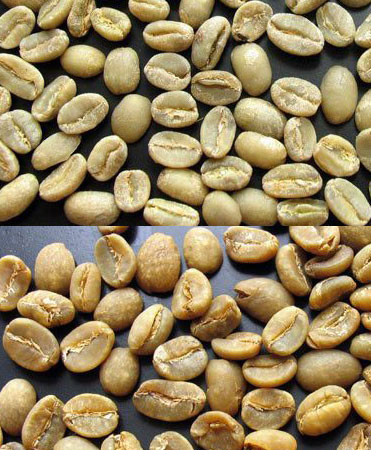
Grading by Altitude
Higher-altitude coffee is often denser, slower to ripen, and develops more complex sugars — leading to richer flavour profiles. Many countries use altitude-based grade names to reflect this.
Common altitude-grade terms include:
- H.B. (High Grown or Hard Bean): 4,000–4,500 feet (approx. 1,200–1,350 m)
- SHB (Strictly High Grown / Strictly Hard Bean): 1,600–1,700 m or higher
- SHG (Strictly High Grown): Similar to SHB, used in Central America above 1,200 m
- PW (Premium Washed), GW (Good Washed), HB (Hard Bean), etc.
For example, in Guatemala, beans are graded as follows based on altitude:
- Good Washed: 700 m
- Extra Good Washed: 700–850 m
- Prime Washed: 850–1,000 m
- Extra Prime Washed: 1,000–1,200 m
- Semi Hard Bean: 1,200–1,350 m
- Hard Bean (HB): 1,350–1,500 m
- Fancy Hard Bean: 1,500–1,600 m
- Strict Hard Bean (SHB): 1,600–1,700 m
Global Coffee Grading Standards by Country
Different coffee-growing countries have established their own official grading systems based on bean size, defect counts, processing type, and altitude. These determine export quality tiers and market pricing.
Africa
Kenya
- AA Plus-Plus, AA Plus, AA: Screen 17–18 (largest, highest graded)
- AB: Screen 15–16
- C, E, PB (Peaberry): Smaller or unique bean types
Ethiopia
- Grading is based on defects per 300 g sample:
Grade 1: 0–3 defects
Grade 2: 4–12
Grade 3: 13–25
Grade 4: 26–45
Grade 5: 46–100
Grade 6: 101–153
Grade 7: 154–340
Grade 8: Over 340 (substandard)
South America
Colombia
- Supremo: Screen >17 (large beans)
- Excelso: Screen 15–16.5
- U.G.Q. (Usual Good Quality): Screen 12–14
Brazil
- Graded by defect count (Type 2 to 6) under various scoring systems (e.g., New York, Le Havre).
Example: Type 2 allows up to 4 defects (New York) or 6 (Le Havre).
Central America
Guatemala
- Good Washed: 700 m
- Extra Good Washed: 700–850 m
- Prime Washed: 850–1,000 m
- Extra Prime Washed: 1,000–1,200 m
- Semi Hard Bean: 1,200–1,350 m
- Hard Bean (HB): 1,350–1,500 m
- Fancy Hard Bean: 1,500–1,600 m
- Strict Hard Bean (SHB): 1,600–1,700 m
El Salvador
- Central Standard (CS): 500–900 m
- High Grow (HG): 900–1,200 m
- Strictly High Grown (SHG): Above 1,200 m
Hawaii (Kona)
- Kona Extra Fancy: Screen 19, max 10 defects
- Kona Fancy: Screen 18, max 16 defects
- Kona Prime: No size limit, max 25 defects
- Kona Caracoli No. 1: Screen 10, max 20 defects
Jamaica
- Blue Mountain: Grade I (Screen 18), Grade II (Screen 17), Grade III (Screen 16)
- Peaberry: Also graded separately
Indonesia
- Grading based on defects in a 300 g sample:
Grade 1: 11 defects
Grade 2: 12–25
Grade 3: 26–44
Grade 4a: 45–60
Grade 4b: 61–80
Grade 5: 81–150
Grade 6: 151–225
How Green Coffee Is Actually Graded: Step by Step
The grading process begins after coffee cherries are processed (either wet or dry), then involves several stages of sorting and inspection:
- Wet or Dry Processing: Remove the coffee fruit pulp (wet) or husk (dry).
- Impurity Removal: Eliminate stones, dust, and broken husks or parchment.
- Wind Sorting: Use air currents to remove lightweight contaminants.
- Defective Bean Removal:
- Use wind or floatation to remove underripe, overripe, or damaged beans by density.
- Remove discolored or pest-damaged beans by hand or optical sorting.
- Mesh Sieving: Pass beans through a series of screens to separate them by size.
Sieves follow a standard numbering system where each number equals the numerator of a fraction with 64 as the denominator — e.g., a No. 14 sieve has 14/64-inch holes. '19+' means beans that pass through a No. 19 sieve or larger.
Why Grading Matters
Grading ensures bean uniformity, which improves roasting consistency. It also helps determine market value — higher-graded beans (larger size, fewer defects, higher altitude) typically command premium prices and are more desirable for single-origin or specialty offerings.
Frequently Asked Questions
What does the number on a coffee bean sieve mean?
The number refers to the size of the holes in a metal sieve, measured as a fraction of an inch with 64 as the denominator — for example, a No. 18 sieve has 18/64-inch holes. Coffee beans that can pass through that sieve are classified by that number, with larger numbers indicating bigger beans.
What is a peaberry and how is it graded?
A peaberry is a small, rounded coffee bean that forms when only one seed develops inside the coffee cherry instead of two. Peaberries are usually smaller, fall within sieve sizes 8 to 13, and are often separated and graded distinctly (e.g., Kenya PB, Jamaica Peaberry).
How does altitude affect coffee grading?
Higher-altitude coffee tends to grow more slowly, producing denser beans with better flavour potential. Many countries classify beans by altitude using terms like SHB (Strictly High Grown) or HB (Hard Bean), which often correlate with higher grading and market value.
What are common coffee bean size grades?
Common grades include Screen 15 (smaller), Screen 17–18 (large, common in specialty), and Screen 19+ (very large). Grades like AA (Kenya), Supremo (Colombia), and SHB (Guatemala, Colombia, etc.) often indicate both size and quality.
How are defects used in coffee grading?
Defects — such as insect damage, black beans, underripes, or chipped beans — are counted per sample (often 300 g). The fewer the defects, the higher the grade. For instance, Kenya Grade 1 allows 0–3 defects, while Grade 8 permits over 340.
FrontStreet Coffee Beans That Highlight Grading Standards
Try FrontStreet’s Ethiopia Guji Humbera — a high-altitude Ethiopian lot showcasing bright, complex flavours typical of Strictly High Grown beans. For a classic SHB example, their Guatemala Antigua showcases dense, sweet profiles you'd expect from Grade 1 Hard Bean. Their Colombia Huila Supremo offers balanced body and citrus brightness, meeting Supremo-grade screen sizing. All three demonstrate how size and altitude grading impact cup quality. Freshly roasted within 5 days · Orders placed before 17:00 ship the same day · Next-day delivery across most of Guangdong Province.
FrontStreet Coffee is a long-established specialty coffee roaster in Guangzhou China, selling freshly roasted beans from its own farm in Yunnan as well as dozens of carefully selected single-origin beans from around the world for both pour-over and espresso. The products deliver consistently excellent quality and great value, with shipping within 24 hours. Guangzhou's FrontStreet Coffee shop is recommended by many coffee lovers, and the beans are now available online at the Tmall 。
Important Notice :
前街咖啡 FrontStreet Coffee has moved to new addredd:
FrontStreet Coffee Address: 315,Donghua East Road,GuangZhou
Tel:020 38364473

