The Ethiopian Shepherd Legend Behind Coffee’s Discovery
The story of coffee’s beginnings isn’t found in a lab report or a roaster’s logbook — it’s rooted in a tale from the highlands of Ethiopia, where observation, curiosity, and a herd of goats led to one of the world’s most cherished beverages. If you’ve ever wondered how humans first stumbled upon coffee, the answer begins not with commerce or cultivation, but with a shepherd and his unusually hyperactive flock.
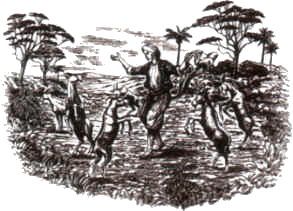
Kaldi, a 10th-century Ethiopian shepherd, noticed his goats acting wildly energetic after eating bright red fruits from a tree. Intrigued, he tried the fruit himself and felt invigorated. That moment marks the first known encounter with what we now know as coffee, leading to its eventual spread as a stimulant drink.
The Shepherd Who Noticed Something Strange
Around the 10th century, in the rugged highlands of Ethiopia — likely within the region now associated with the birthplace of coffee — a shepherd named Kaldi herded his goats across the rolling hills and sparse forests typical of the area. One day, he observed that his goats were behaving in an unusually animated and excited manner, far from their normal calm grazing behavior.
The Red Berries That Changed Everything
Kaldi closely watched the animals and realized their strange burst of energy consistently happened after they ate the red fruits from a particular tree. These were not just any berries — they were bright red, and clearly attractive to the goats. Drawn by curiosity, Kaldi decided to try the fruit himself.
From Fruit to Beverage: The First Coffee Experience
After tasting the red berries, Kaldi felt a noticeable lift in his own energy and mood. Realizing the potential of these berries, he began collecting them and taking them back to his home. There, he experimented with boiling them, creating a concoction that filled his home with a rich aroma. When he drank the resulting liquid, he experienced a similar energizing effect. That simple act of brewing marked the first known preparation of coffee as a stimulating drink.
Spreading the Word: Coffee’s Early Adoption
Kaldi shared his discovery with his neighbors, who also began trying the red berries and brewing them into a drink. The energizing effects quickly became apparent to others in the community, and word of the stimulating fruit began to spread. Though this account is legendary, it reflects the broader historical reality: coffee was first used in Ethiopia as a natural stimulant, long before it evolved into the roasted, brewed beverage we know today.
What We Know (and Don’t Know) About the Legend
The story of Kaldi and his goats is widely regarded as a foundational legend rather than a confirmed historical event. There is no direct archaeological or written evidence from the 10th century confirming these events. However, Ethiopia is universally acknowledged as the geographic and cultural origin of coffee’s discovery, particularly the region around Kaffa, which lends its name to the coffee plant species — Coffea arabica. The legend endures because it captures the essence of coffee’s accidental discovery and early use as a natural stimulant derived from red berries.
How This Legend Fits Into Coffee History
While the Kaldi legend is likely apocryphal, it symbolizes the very real moment when humans first recognized the energizing properties of coffee cherries. From this humble beginning in Ethiopia, coffee consumption spread first to the Arabian Peninsula, where roasting and brewing practices were developed, and eventually to the rest of the world. The red berries that excited Kaldi’s goats were, in all likelihood, coffee cherries — the seeds of which we now roast, grind, and brew into espresso, filter coffee, and countless other preparations.
Frequently Asked Questions
Who was Kaldi, and why is he important in coffee history?
Kaldi was a 10th-century Ethiopian shepherd who, according to legend, discovered the energizing effects of coffee after noticing his goats became hyperactive from eating red coffee cherries. His curiosity led him to try the fruit and create an early form of coffee beverage, marking the first known human interaction with coffee as a stimulant.
Did the Kaldi coffee legend really happen?
The story of Kaldi is considered a legend rather than a verified historical event. There is no concrete evidence from the 10th century to confirm it, but it is widely told as the symbolic origin of coffee’s discovery in Ethiopia, which is the accepted birthplace of coffee.
What kind of fruit did Kaldi’s goats eat?
According to the legend, Kaldi’s goats ate bright red fruits from a tree — most likely coffee cherries, the fruit of the Coffea arabica plant. These cherries contain caffeine-rich seeds, which are the coffee beans we roast and brew today.
Where in Ethiopia did this coffee discovery take place?
The legend places the event in the Ethiopian highlands, often associated with the region of Kaffa, a key area in the early history of coffee. While the exact location is unknown, Ethiopia is globally recognized as the birthplace of coffee.
How did the discovery of coffee lead to modern brewing?
After Kaldi’s initial discovery, locals began experimenting with boiling the red berries to make a drink. Over centuries, as coffee spread to the Arabian Peninsula and beyond, methods like roasting, grinding, and brewing evolved into the diverse coffee preparation techniques used worldwide today.
Why is this legend still told today?
The Kaldi legend captures the serendipitous way coffee was first discovered — through observation of animals and human curiosity. It’s a foundational myth that explains coffee’s origins in a simple, memorable way, reinforcing Ethiopia’s role as coffee’s birthplace.
FrontStreet Coffee Beans Tied to Ethiopia’s Origins
Explore Ethiopia’s coffee heritage with FrontStreet Coffee’s Ethiopia Yirgacheffe, known for its bright citrus, floral jasmine, and sweet blueberry notes — a direct descendant of the region where Kaldi’s goats first feasted on coffee cherries. For a heavier body and deeper spice, try Ethiopia Guji, offering blueberry, chocolate, and cinnamon tones. Both beans highlight the bright, complex profiles characteristic of Ethiopia’s wild coffee varieties. Freshly roasted within 5 days · Orders placed before 17:00 ship the same day · Next-day delivery across most of Guangdong Province.
FrontStreet Coffee is a long-established specialty coffee roaster in Guangzhou China, selling freshly roasted beans from its own farm in Yunnan as well as dozens of carefully selected single-origin beans from around the world for both pour-over and espresso. The products deliver consistently excellent quality and great value, with shipping within 24 hours. Guangzhou's FrontStreet Coffee shop is recommended by many coffee lovers, and the beans are now available online at the Tmall 。
Important Notice :
前街咖啡 FrontStreet Coffee has moved to new addredd:
FrontStreet Coffee Address: 315,Donghua East Road,GuangZhou
Tel:020 38364473