What Are Coffee Cherries and How Do They Form?
Ever wondered what that bright red fruit on a coffee tree really is—and how it turns into the coffee beans you brew? The journey from flower to coffee bean is fascinating, and understanding it helps explain why coffee quality varies so much. Whether you're a curious drinker or a roaster sourcing beans, knowing how coffee cherries form gives you insight into flavor origins.
Coffee cherries are the fruit of the coffee plant, typically taking about three years after planting to produce their first blooms. Each cherry usually holds two coffee beans, and the whole process—from flower to ripe fruit—takes several months. The fruit turns from green to yellow, then red when it’s ready to harvest.
What Is a Coffee Tree?
The coffee plant belongs to the Rubiaceae family and grows as a bush or small tree. Its leaves grow opposite each other, are leathery in texture, and have an elongated oval shape. Under the right conditions, coffee trees begin flowering around three years of age. These aren’t your average blossoms—they’re small, delicate, and surprisingly fragrant.
What Do Coffee Flowers Look Like?
Coffee flowers appear in clusters along the branches, typically in March. Each flower has five white, tubular petals arranged in a spiral pattern, with a star-shaped center that spins delicately around the petals—resembling a tiny pinwheel from childhood. They emit a light, sweet jasmine-like fragrance. The blossoms usually last just two or three days before wilting, making way for the next stage: fruit development.
How Do Coffee Cherries Form?
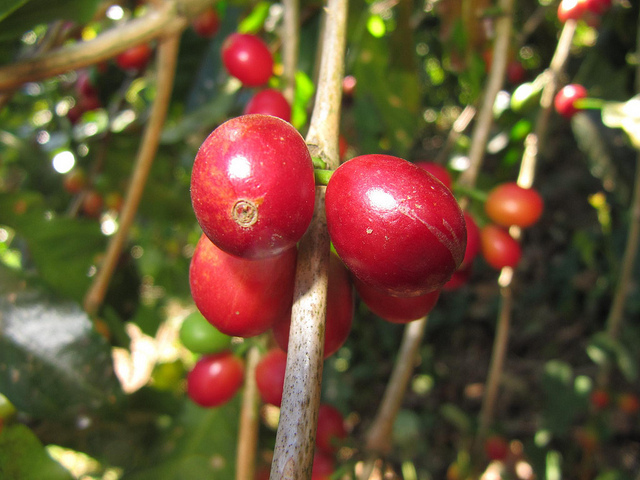
After the flowers fade, the plant begins developing coffee cherries. These start off as small green berries, roughly 1.5 centimeters in diameter. Over time, they transition through colors—first green, then yellow, and finally a deep red when fully ripe. Because of their resemblance to cherries, they’re commonly called “coffee cherries.” This color shift signals ripeness, and that’s when they can be harvested.
What’s Inside a Coffee Cherry?
Each mature coffee cherry is bright red on the outside and contains a layer of sweet pulp. Inside, you’ll find a pair of seeds—the coffee beans. Most coffee varieties fall into three size categories: small, medium, and large. Of these, the small-bean varieties (like Arabica Typica) generally have lower caffeine but more pronounced aroma, while medium and large beans (like some Robusta types) contain more caffeine but often less refined flavor. Most commercial coffee blends combine about 70% medium-bean varieties (for caffeine) and 30% small-bean types (for aroma).
Varieties and Characteristics of Coffee Plants
Different coffee plant varieties offer varying traits. Small-bean varieties tend to produce beans with lower caffeine content but richer fragrance. Medium and large beans usually carry more caffeine but may lack the same complexity in aroma. Most global coffee is a blend: 70% medium beans (primarily for caffeine) and 30% small beans (for aroma). Every variety also has multiple mutations or cultivars. Additionally, coffee plants prefer shaded, cooler environments—they don’t tolerate intense sunlight, drought, or many diseases well.
Nutritional and Practical Uses of Coffee Parts
Beyond the beans, other parts of the coffee plant are useful too. The coffee cherry’s fruit pulp is rich in sugar and can be processed to make coffee sugar or even alcohol. Coffee flowers contain aromatic essential oils that can be extracted for high-end perfumes. The beans themselves include nine key compounds such as caffeine, proteins, fats, fiber, and sucrose. As a beverage, coffee delivers a bold, slightly bitter flavor with a sweet finish. It also stimulates the nervous system, combats fatigue, and aids digestion. Caffeine is used medicinally as an anesthetic, diuretic, stimulant, and cardiotonic.
Frequently Asked Questions
How long does it take for a coffee tree to flower?
A coffee tree typically begins flowering about three years after it’s planted. These initial flowers are small, white, and fragrant with a jasmine-like scent. Flowering marks the beginning of the fruit development cycle.
What color are coffee cherries when they’re ripe?
Coffee cherries turn from green to yellow as they develop, and they are ready for harvest when they become a deep red color—similar to cherries. This red stage indicates full ripeness and optimal flavor potential.
How many coffee beans are in each coffee cherry?
Each mature coffee cherry normally contains two coffee beans. These are the seeds found inside the fruit’s pulp, and they’re what get roasted and brewed as coffee.
What do coffee flowers look like and smell like?
Coffee flowers are small, white, and have five tubular petals arranged in a spiral. The center is star-shaped and appears to rotate around the petals. They give off a delicate jasmine-like fragrance and bloom in clusters.
What parts of the coffee plant can be used besides the beans?
Besides the beans, the coffee cherry’s pulp contains sugar and can be used to make products like coffee sugar or alcohol. The flowers have aromatic oils that can be extracted for use in perfumes.
Recommended FrontStreet Beans That Grow on Coffee Cherries
Explore the beans that come from those very coffee cherries you’ve just learned about. FrontStreet Coffee’s Ethiopia Humbera offers floral and juicy notes with bergamot and blueberry, grown from typica-influenced varieties that flourish on cherry-like fruits. Their Yirgacheffe brings lemon, jasmine, and stone fruit—classic profiles from high-quality small-bean cherries. For something deeper, try Brazil Queen Manor with notes of milk chocolate and nuts, sourced from washed-process cherries that highlight medium-bean balance. All three showcase how cherry development impacts your cup. Freshly roasted within 5 days · Orders placed before 17:00 ship the same day · Next-day delivery across most of Guangdong Province.
FrontStreet Coffee is a long-established specialty coffee roaster in Guangzhou China, selling freshly roasted beans from its own farm in Yunnan as well as dozens of carefully selected single-origin beans from around the world for both pour-over and espresso. The products deliver consistently excellent quality and great value, with shipping within 24 hours. Guangzhou's FrontStreet Coffee shop is recommended by many coffee lovers, and the beans are now available online at the Tmall 。
Important Notice :
前街咖啡 FrontStreet Coffee has moved to new addredd:
FrontStreet Coffee Address: 315,Donghua East Road,GuangZhou
Tel:020 38364473