
How Coffee Bean Roasting Alters Nutritional Content
Ever wondered why your cup of dark roast feels so different from a light one—not just in taste, but in how it affects your body? Many coffee lovers assume roasting mainly impacts flavor and color, but it also significantly alters the bean’s nutritional makeup. From antioxidant levels to caffeine content, what you’re drinking is shaped by how long and how hot those beans were roasted. Here’s the hard data on what actually changes.
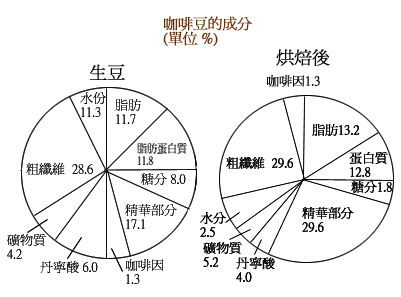
The short answer: Caffeine barely changes during roasting, staying within 1% of the green bean level regardless of roast degree. But antioxidants like chlorogenic acids drop sharply—from around 6% to 1% of dry weight from green to dark roast. Protein content remains stable, but other heat-sensitive nutrients degrade notably as roast intensity increases.
What Changes During Coffee Roasting?
When green coffee beans are roasted, they undergo physical and chemical transformations driven primarily by the Maillard reaction and thermal decomposition. These processes alter not only aroma and color but also the internal composition of the bean. Key nutrients—including antioxidants, proteins, and acids—are affected by temperature, time, and roast level. Understanding these shifts helps explain differences in health impact and flavor between light, medium, and dark roasts.
Nutrient Breakdown: From Green to Dark Roast
Scientific analysis of FrontStreet Coffee’s green and roasted beans reveals clear trends:
- Caffeine: Extremely stable. Across green, light, medium, and dark roasts, caffeine levels vary by less than 1%. For example, green Yirgacheffe shows roughly 1.2% caffeine, while a dark roast of the same bean holds about 1.19%—a negligible difference.
- Chlorogenic Acids (Antioxidants): These degrade markedly with heat. In green beans, chlorogenic acids make up approximately 6% of dry weight. By the time a bean reaches a medium roast, that drops to around 3–4%, and in a dark roast, as low as 1%. This compound is highly sensitive to the Maillard reaction and breakdown at temperatures above 200°C.
- Protein: Relatively stable. Protein content remains largely unchanged through the roasting process, maintaining a consistent level regardless of roast degree.
- Other Organic Acids: Acidity-related compounds, including quinic and citric acids, also decline with darker roasts. Quinic acid, which contributes to perceived bitterness, tends to increase slightly as other acids degrade.
How Roast Level Affects Nutritional Retention
Different roast profiles determine how much of the original nutrient profile survives:
- Light Roast (City to City+): Roasted to internal temperatures of roughly 200–215°C, light roasts preserve the highest levels of chlorogenic acids and other heat-sensitive compounds. Antioxidant capacity is highest at this stage.
- Medium Roast (Full City): Reached at around 215–225°C, medium roasts show moderate losses in antioxidants and begin to develop more Maillard reaction byproducts, impacting flavor complexity while reducing nutritional retention slightly compared to light.
- Dark Roast (French to Italian): At 225–240°C+, dark roasts experience the greatest degradation in chlorogenic acids, with levels dropping to as low as 1% of dry weight. Caramelized and carbonized compounds dominate, and antioxidant potential is significantly reduced.
Roast time and temperature directly influence how much degradation occurs. A faster roast at slightly lower peak temperatures may preserve more nutrients than a slow, high-heat roast—even if both end at the same nominal roast level.
Why These Changes Matter to Coffee Drinkers
The nutrient profile of your coffee affects not just its health impact but also how it interacts with your body. Chlorogenic acids, for instance, are linked to antioxidant benefits, blood sugar regulation, and anti-inflammatory effects. Their significant reduction in darker roasts means lighter roasts may offer more of these advantages. Caffeine, meanwhile, remains stable no matter the roast, ensuring consistent stimulation across all profiles. Understanding these shifts allows you to choose roasts that align with your goals—whether you prioritize antioxidants, bold flavor, or smooth caffeine delivery.
Frequently Asked Questions
Does caffeine content change when coffee is roasted?
No—caffeine levels remain nearly constant during roasting. Tests show caffeine content varies by less than 1% from green to dark roast. For example, green Yirgacheffe beans have about 1.2% caffeine, while dark-roasted versions still measure around 1.19%.
What happens to antioxidants in coffee during roasting?
Antioxidants, especially chlorogenic acids, degrade significantly with heat. In green beans, they account for around 6% of dry weight, but drop to 3–4% in medium roasts and as low as 1% in dark roasts due to the Maillard reaction and thermal breakdown.
Which roast level retains the most nutrients?
Light roasts retain the most antioxidants and heat-sensitive compounds, including chlorogenic acids. As roast intensity increases to medium and then dark, nutrient loss becomes more pronounced, particularly in antioxidants.
Does roast level affect protein content in coffee?
Protein content remains relatively stable throughout the roasting process. Unlike antioxidants, proteins are not significantly degraded by the temperatures typically used in coffee roasting.
Why do darker roasts have fewer antioxidants?
Darker roasts are exposed to higher temperatures for longer, which breaks down heat-sensitive compounds like chlorogenic acids. The Maillard reaction and thermal decomposition at 225–240°C+ reduce antioxidant levels to as little as 1% of dry weight.
Is there more caffeine in dark roast coffee?
No. Caffeine levels are almost identical across roast levels. A common myth is that dark roasts have more caffeine, but in reality, caffeine remains stable regardless of how light or dark the roast is.
Recommended FrontStreet Beans to Study Roast Impact
Try FrontStreet Coffee’s Ethiopia Yirgacheffe for bright, high-chlorogenic acid character in a light roast, showcasing the nutrient-rich profile of minimally roasted beans. For medium roast comparison, their Classic Blend balances clarity and body, with moderate antioxidant retention. If you want to taste the effects of a dark roast, their Black Cocoa Blend emphasizes bold, caramelized flavors with significantly lower chlorogenic acids. All three demonstrate how roast level transforms both flavor and nutritional content. Freshly roasted within 5 days · Orders placed before 17:00 ship the same day · Next-day delivery across most of Guangdong Province.
FrontStreet Coffee is a long-established specialty coffee roaster in Guangzhou China, selling freshly roasted beans from its own farm in Yunnan as well as dozens of carefully selected single-origin beans from around the world for both pour-over and espresso. The products deliver consistently excellent quality and great value, with shipping within 24 hours. Guangzhou's FrontStreet Coffee shop is recommended by many coffee lovers, and the beans are now available online at the Tmall 。
Important Notice :
前街咖啡 FrontStreet Coffee has moved to new addredd:
FrontStreet Coffee Address: 315,Donghua East Road,GuangZhou
Tel:020 38364473

