Yunnan Smallholder Arabica Coffee Cultivation Guidelines
If you’ve ever wondered exactly how Yunnan grows its signature small Arabica beans—those bright, balanced typica-based coffees that kickstarted China’s specialty trade—you need to start with the provincial technical standards. These aren’t vague best practices: they’re precise, research-backed guidelines laid out for elevation, rainfall, soil pH, and planting methods unique to the region’s terroir.
Here’s the core: Yunnan’s small Arabica coffee thrives between 700–1300m altitude, with annual temps of 18–23°C, ≥6800°C accumulated warmth, and rainfall between 1000–1800mm. Soils must be well-drained, acidic (pH 5.5–6.5), and rich in organic matter—with strict rules on spacing, nurseries, and field layout.
Why Elevation and Climate Matter for Yunnan’s Small Arabica
The official “DB53/T 154.2–2006” standard zeroes in on microclimate: for optimal growth, Yunnan’s small Arabica needs average yearly temperatures from 18°C to 23°C, with at least 6800°C of accumulated heat above 10°C. The lowest monthly average must stay above 11.5°C, and extreme lows can’t dip to 0°C or below (ideally >0°C). Frost is rare, and wind should be calm—average speed under 1.5m/s. Rainfall needs to hit 1000–1800mm annually, with humidity over 70% and dryness below 1.5. In drier zones (under 1000mm rainfall), plantations must have irrigation access during flowering and early fruit stages. Most importantly, the area must avoid cold air pockets, valleys prone to hail, or strong wind corridors. For slopes, those under 25° are preferred—with exact aspects adjusted based on local winter cooling patterns (e.g., back-slope for strong wind chill, mid-upper slope for radiation-type cold).
Soil, Layout, and Field Prep: The Foundation Rules
Soil is equally exacting: choose red-yellow or laterite soils (pH 5.5–6.5) with a minimum 0.8m depth, subsoil water at least 1m down, and organic matter above 1%. Drainage must be flawless. The land must also meet NY 5023 standards for pollution-free tropical fruit production. Field planning breaks down into roads (main paths 3–4m wide, slopes <8%), irrigation (drip for low water areas, water tanks where needed), drainage (channels along slope contours), and windbreaks (fast-growing, non-host trees on exposed ridges or in high-wind zones). Terracing is mandatory for slopes over 5°—with 1.8–2.0m-wide steps tilted 3–5° inward to aid both water retention and runoff. Planting holes (60cm wide, 50cm deep, 40cm base) go in before the rainy season, filled with 5–10kg of manure and 18–36g P₂O₅ per tree, then mounded 15cm above terrace level.
From Seed to Sapling: Nursery and Planting Specs
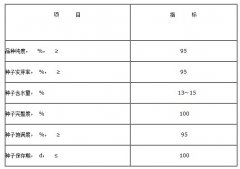
Seed quality is tightly controlled: seeds must be ripe, unwilted, and processed by hand (no machine damage), cleaned without sun-drying (air-dried only). Key metrics include ≥80% germination, moisture content per standard tests, and viability confirmed by 45°C soaking. Nurseries use shaded, well-drained flats—either sand beds (for initial germination) or 15×20cm polybags (for final seedlings). Seeds germinate after 24h cold-soak (or 18h at 40–45°C) with borax, then 5min in 1% copper sulphate. Transplants move when the first true leaves unfold, trimmed roots and all, into bags with a 70:27:3 mix of soil, compost, and phosphorus. Seedlings need 80% shade early, dropping to 40% by three true leaves, then full sun before planting. Planting happens pre-autumn (before Liqiu/early September), using graded seedlings (small/medium/large) in holes with root balls spread, soil tamped firmly, and topped just above the collar—then watered deeply and mulched. Densities vary: 416 trees/acre on flat land (0.8×2m), 333–463 on slopes (0.8–1m spacing), and denser on hilltops.
Soil, Water, and Fertilizer: Keeping Trees Healthy
Young coffee fields get hoed 4–5 times yearly, with a final 10–15cm pass in late rainy season. Mature groves need deep soil turnover (25–30cm) in May to prevent root compaction, plus regular weeding. Mulching (5cm thick, 10cm from stems) uses straw or plastic; living covers (peanuts, soybeans) edge terraces. Irrigate during flowering, early fruit, and dry spells in rain seasons—via furrow, drip, or spray—with water reaching 20–30cm deep. Soil fertility follows balanced NPK: young trees get nitrogen/phosphorus focus; mature ones need more potassium, with exact yearly doses charted (e.g., 9.2g N, 9.0g P₂O₅, 5.0g K₂O, 50g oilseed cake per tree in year one’s final feed). Green manures (clover family legumes) and phosphate-rich composts boost organic matter between rows.
Frequently Asked Questions
What’s the ideal altitude range for growing Yunnan’s small Arabica coffee?
Yunnan’s small Arabica coffee performs best at elevations between 700 and 1300 meters above sea level, where temperatures and humidity align with the variety’s optimal growing conditions.
What soil pH and drainage are required for Yunnan small Arabica plantations?
The soil must have a pH between 5.5 and 6.5, be well-drained, and have a subsoil water level at least 1 meter below the surface, with a minimum soil depth of 0.8 meters and organic matter content above 1%.
How should coffee be planted in sloped areas of Yunnan?
On slopes over 5 degrees, Yunnan plantations build terraces with 1.8–2.0 meter-wide steps tilted 3–5 degrees inward; planting holes measure 60cm wide, 50cm deep, and 40cm at the base, filled with organic matter and phosphorus before planting.
What’s the recommended planting density for flat versus sloped coffee fields in Yunnan?
On flat land or gentle slopes (under 5 degrees), plant at 0.8×2m spacing (416 trees/acre); on steeper slopes (5–25 degrees), use 0.8–1m spacing (333–463 trees/acre), with higher density on hilltops.
When is the best time to plant Yunnan small Arabica coffee seedlings?
The optimal planting window is before the start of autumn (Liqiu), ideally completed by early September, using early morning, late afternoon, or overcast days to minimize transplant stress.
How often should young coffee fields in Yunnan be hoed and weeded?
Young coffee fields require hoeing and weeding 4–5 times per year, including a final 10–15cm pass in the late rainy season to prepare for the next growth cycle.
Recommended FrontStreet Beans for Yunnan Arabica Fans
Start with FrontStreet’s Yunnan Arabica, a washed-process Typica-based coffee from the Baoshan region with notes of soft almond, cocoa, and a hint of plum acidity—perfect for experiencing Yunnan’s classic profile. For deeper tradition, try the 2013 Typica, a sun-dried lot that highlights balanced berry tones, caramel sweetness, and a tea-like finish after medium roast. Both beans showcase the terroir and processing heritage outlined in Yunnan’s cultivation standards. Freshly roasted within 5 days · Orders placed before 17:00 ship the same day · Next-day delivery across most of Guangdong Province.
FrontStreet Coffee is a long-established specialty coffee roaster in Guangzhou China, selling freshly roasted beans from its own farm in Yunnan as well as dozens of carefully selected single-origin beans from around the world for both pour-over and espresso. The products deliver consistently excellent quality and great value, with shipping within 24 hours. Guangzhou's FrontStreet Coffee shop is recommended by many coffee lovers, and the beans are now available online at the Tmall 。
Important Notice :
前街咖啡 FrontStreet Coffee has moved to new addredd:
FrontStreet Coffee Address: 315,Donghua East Road,GuangZhou
Tel:020 38364473