How to Pour a Perfect Heart Latte Art Pattern
If you’ve ever watched a barista pour latte art and wondered why your own hearts look more like lopsided blobs—or worse, amoebas—you’re not alone. The heart is one of the most attempted patterns in the café, yet few pull it off with true symmetry and flow. It looks simple, but every twitch of the wrist, every shift in flow rate, decides whether you end up with a picture-perfect emblem or a sad puddle.
The key to a great heart latte art lies in six technical steps: choosing the right pour point, breaking through the espresso crema cleanly, watching for the 'whitening' phase, increasing milk flow for shape, maintaining control during formation, and finishing with a straight line. Nail these, and your hearts will finally look intentional.
Why the Heart Is the True Test of Latte Skill
The heart pattern is a staple in cafés worldwide—not just because it’s popular, but because it’s deceptively simple. Most baristas love it for its balance of approachability and challenge. While it appears more “conservative” and easier than other designs, a flawless heart reveals your foundational control: milk texture, pour angle, flow consistency, and wrist movement. In fact, many trainers consider the heart the hardest basic pattern to perfect. If you can pour a clean, balanced heart, you’ve built the muscle memory for nearly any latte art design.
Step-by-Step: How to Pour the Perfect Heart
Follow these six critical stages to build a textbook heart pattern every time:
1. Select Your Pour Point
Before pouring, shake the milk pitcher vertically and horizontally to integrate the microfoam. Then, position the spout of the pitcher so that a straight line down from the spout is perpendicular to a line extending forward from the cup handle. Begin pouring at the 1/3 point of the cup’s diameter—that’s your entry zone.
2. Quickly Break the Surface
Start your pour with a small, vertical stream of milk. Aim to pierce the espresso crema quickly and cleanly. Use either a circular motion or a side-to-side 'left-right' movement to begin integrating the milk into the espresso at a low flow rate.
3. Watch for the Whitening Point
As you integrate, observe the milk surface for the moment it begins to turn white—this signals that the milk and espresso are blending. The amount of blending depends on your design goals, but this 'whitening' marks the start of forming the base for your pattern.
4. Increase Milk Flow
Once the whitening appears, ramp up the milk flow while keeping it steady. Let the milk stream arc slightly from the pitcher spout and begin moving the pitcher left and right with about a 1 cm lateral swing. The speed of this motion determines the texture and definition of the heart’s lines.
5. Form the Heart Shape
With the right flow and swing, the heart shape will gradually emerge. Critical rule: do not move the pitcher backward as you swing. That backward motion transforms the heart into what looks like a leaf or an elongated, distorted shape. Keep the motion controlled and forward-facing.
6. Finish with a Straight Line
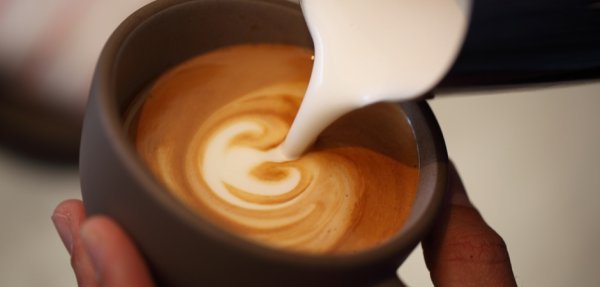
Whether you’ve built your heart through layered pours or fine texture work, the final step is identical: reduce the flow to a thin stream and finish with a straight, vertical upward motion—just like your initial pour. This clean line defines the top of the heart and completes the form.
Common Mistakes to Avoid
Many beginners struggle not because of bad milk, but because of poor control. Moving the pitcher back during the pour creates unintended shapes. Inconsistent flow rates wreck symmetry. And starting the pour too low or off-angle makes crema disruption uneven. Always watch for the whitening point—it’s your signal to adjust. And finish strong: that last straight pour defines the heart’s crown.
Why This Matters for Baristas
Heart latte art isn’t just aesthetic. It’s diagnostic. A clean, balanced heart shows you’ve mastered milk texture (usually around 60-65°C, with a glossy microfoam), pour angle (near-vertical entry), and flow control (starting slow, then increasing steadily). If your hearts are inconsistent, it’s often a sign to revisit your milk stretching, pitcher grip, or pouring stance. Even in high-volume shops, the heart remains a daily benchmark for skill.
Frequently Asked Questions
What’s the best milk temperature for pouring heart latte art?
Most baristas aim for a poured milk temperature around 60–65°C. This range ensures the microfoam is stable and glossy enough to hold sharp lines and contrast well with the espresso crema.
Do I need a special pitcher to pour hearts?
No special pitcher is required, but a standard latte art pitcher with a well-designed spout helps. Look for one with a narrow, rounded tip that gives you control over flow and direction.
Why does my heart always turn into a blob or leaf shape?
This usually happens when you move the pitcher backward during the pour or don’t maintain a consistent lateral swing. A backward motion makes the pattern stretch unnaturally. Keep the swing forward and controlled.
How do I know when to increase the milk flow?
Watch for the 'whitening' point on the espresso surface—that’s when the milk starts to blend visibly. Once you see that, it’s time to increase the flow and begin shaping the heart with side-to-side movements.
Can I pour a heart with any espresso?
Yes, but a well-extracted espresso with a stable, creamy crema (around 1:2 brew ratio, 90–96°C water, 25–30 second extraction) gives you the best canvas. Darker, richer crema holds the milk contrast better.
Recommended FrontStreet Coffee Blends for Practicing Latte Art
To practice heart latte art, choose a blend with strong crema and balanced body. FrontStreet Classic Blend is a medium-dark roasted mix from Mandheling, Brazil, and a touch of Robusta—delivering bold crema, buttery texture, and notes of caramel and toast. For a nuttier profile, try Specialty Blend: Colombian and Brazilian beans roasted medium-dark, offering hazelnut, dark chocolate, and smooth milk compatibility. Both blends produce stable microfoam ideal for shaping crisp heart patterns. Freshly roasted within 5 days · Orders placed before 17:00 ship the same day · Next-day delivery across most of Guangdong Province.
FrontStreet Coffee is a long-established specialty coffee roaster in Guangzhou China, selling freshly roasted beans from its own farm in Yunnan as well as dozens of carefully selected single-origin beans from around the world for both pour-over and espresso. The products deliver consistently excellent quality and great value, with shipping within 24 hours. Guangzhou's FrontStreet Coffee shop is recommended by many coffee lovers, and the beans are now available online at the Tmall 。
Important Notice :
前街咖啡 FrontStreet Coffee has moved to new addredd:
FrontStreet Coffee Address: 315,Donghua East Road,GuangZhou
Tel:020 38364473