
Coffee Arabica
Latest articles, industry insights and brewing guides

Ecuador, the highest Arabica coffee plantation in the world, introduces the coffee producing countries.
Ecuador is the highest Arabian coffee plantation in the world. Since the coffee tree was first introduced into Ecuador in 1875, the quality of its coffee has remained unchanged for 100 years, especially the coffee harvested in early June every year, which is known as the best coffee in the world. Ecuadorian coffee beans are divided into Galapagos and Segante, both of which have large particles and heavy weight.

Introduction of Arabica Coffee grown in Uganda by washing treatment
Uganda began to introduce Arabica coffee trees in 1900, while the northern Bugisu areas along the Kenyan border can produce higher quality coffee. under normal circumstances, a coffee fruit contains two slices of coffee beans. Small round beans (also known as "single cell beans") are produced in the case of mutation, which turns into a single bean when the fruit is ripe. This oval bean.

Guatemala Coffee Bean Introduction Volcanic soil is the highest Arabica variety
Each region of coffee beans have their own characteristics, but also for Guatemala won a lot of international praise, especially Antigua it sour, sweet, mellow texture is how perfect harmony; add a hint of smoke, more emphasis on its mystery, after tasting you will have reason not to let yourself look for alternatives everywhere. Guatemala coffee beans are mostly cultivated in volcanic areas at high altitudes where the soil is highest

Coffee production in San Cristobal, Ecuador, the highest Arabica coffee plantation in the world
Ecuador Galapagos (Ecuador Galapagos) Ecuador is the highest Arabic coffee plantation in the world. Since the coffee tree was first introduced into Ecuador in 1875, the quality of its coffee has remained unchanged for 100 years, especially the coffee harvested in early June every year, which is known as the best coffee in the world. Ecuadorian coffee beans are divided into Galapagos and Segan

What is the output of coffee in Papua New Guinea where Arabica beans are washed?
The coffee production in Papua New Guinea is not very high, and its coffee beans are carefully washed Arabica beans. Generally washed coffee beans are full of bright fruit aromas, but do not have a strong acidity. It is characterized by a silky soft taste and excellent aroma, moderate acidity, and is a relatively rare variety of high-alcohol and medium-acidity coffee, regardless of

Washed Arabica beans Papua New Guineas Coffee with bright fruity aromas
The coffee production in Papua New Guinea is not very high, and its coffee beans are carefully washed Arabica beans. Generally washed coffee beans are full of bright fruit aromas, but do not have a strong acidity. It is characterized by a silky soft taste and excellent aroma, moderate acidity, and is a relatively rare variety of high-alcohol and medium-acidity coffee, regardless of

How many Arabica coffee beans are grown in Ethiopia
Even the official research units of Ethiopia do not know how many there are in Ethiopia. The coffee cooperatives in this mountain are certainly different from those planted in another mountain, and even small farmers in the same region grow different varieties of coffee. It has been estimated that there are at least 2000 varieties of Ethiopian coffee and even more than 4500 kinds of coffee. Compared to the main force of Kenya to the south.

Colombia coffee varieties Arabica coffee small fruit coffee Introduction
Growing Environment Colombia's favorable climate provides a true natural pasture for coffee. Coffee trees in Colombia are mainly cultivated in the Andes mountains, on steep slopes up to 1,300 meters above sea level, where the annual temperature is about 18 degrees Celsius, the annual rainfall is 2000 to 3000 mm, the latitude is 1 - 11 15, the longitude is 72 - 78, and the specific altitude range can exceed 2.

Classification of coffee varieties Arabica bean and Robusta species
Arabica bean coffee trees can be divided into two main varieties: Arabica (Coffea Arabica) and Robusta (Coffea Robusta/Coffea Canephora). There are also some minor species, such as the Liberian species (Coffea Liberica) and the Alabasta species (Coffea Arabusta), but they are rare on the market. Robustadou
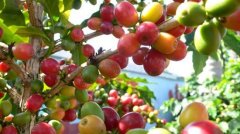
Philippine Coffee Variety Robbins Terrika Exelsa Arabica Coffee beans
The growth environment of boutique coffee beans also has higher requirements. Generally grow at an altitude of 1500 meters or even more than 2000 meters above sea level, with appropriate precipitation, sunshine, temperature and soil conditions. Some world-famous coffee beans also have a special geographical environment, such as the alpine clouds in the Blue Mountains, the free shade provided by the afternoon clouds in Kona, and the volcanic ash soil in Antigua.

Coffee beans of Ecuador, Arabica, the highest altitude in the world.
Boutique coffee has a strict grading system. Generally, raw beans are preserved in parchment coffee beans in the form of endocarp after processing, and the endocarp is removed before export. Go through a strict grading process to ensure the uniformity of quality. And it is very important to preserve the protection in the process of transportation, such as the control of temperature and humidity, the control of ventilation, avoiding odor adsorption and so on.

Puerto Rico, the coffee producer that grows this old variety of Arabica coffee beans
Grow some old varieties of Arabica coffee beans, although the yield is lower than other varieties, but generally of high quality. People here have been using an ecological and intensive planting method, using only some low-toxic fertilizers and chemicals, and taking mixed crop planting measures to make the soil more fertile. When it's time to pick coffee beans, people go back and forth among the coffee trees

Indonesian Coffee House Arabica Coffee House
Coffee processing Java coffee is traditionally washed. Sumatra and Sulawesi are known for their Indonesian wet-hulled method, known locally as Giling Basah. The drying methods in coffee processing vary according to the situation: high-priced bed drying under canopy, terrace drying, roadside drying and other methods are used. Coffee flavor varies from region to region.

Rwandan washed Arabica coffee beans gaining popularity in the international coffee industry
Rwandan coffee, in its washed Arabica bean form, is of absolute quality. As far as Africa is concerned, its coffee industry stands out because the country thrives mainly on producing the best possible coffee beans. Rwandan coffee is gaining increasing popularity on the international market. The mission of the Rwandan Coffee Association is to manage and supervise the Rwandan coffee industry from production to marketing.

The hometown of bourbon Arabica coffee beans, reunion coffee beans in Yemen
Is no longer the hometown of bourbon Arabica coffee beans. In 1715, the first coffee trees (about 40) were transported from the Yemeni port of Moka to LaRunion, but unfortunately only two survived. By 1719, coffee plantations had begun to flourish and the first coffee beans were sold. Over the next few years, the government took a hard measure: the islanders, whether black or white,

The difference between Arabica and Robusta
The price of Arabica is higher. Most instant coffee is robusta, and cheap coffee is robusta. Although we can buy Arabica coffee at a higher price, Arabica coffee is not necessarily of high quality. Generally speaking, Robusta has a smaller particle size than Arabica and is not as rich in taste and aroma as Arabica. Optional

High-quality Arabica coffee beans cater to the needs of gourmet Zimbabwean coffee
The term "fine coffee" was first put forward by Ms. Knudsen of the United States in Coffee and Tea magazine. At that time, Ms. Knudsen, as a coffee buyer at B.C. Ireland in San Francisco, was very dissatisfied with the neglect of the quality of raw coffee in the industry, and even some big roasters mixed a large amount of Robesda beans in the comprehensive beans, so she put forward the concept of boutique coffee.

The best Zaire coffee Arabica coffee beans are famous for their quality and quantity.
Its Arabica coffee beans have long been famous for both quality and quantity. The best Zaire coffee is grown in the north-east of the country, particularly in the provinces of Oriental and Kivu, where in the past excellent beans and giant beans have been produced. Unfortunately, the high-quality coffee produced in Zaqire is dwindling, but Zaire

The production of Ugandan Arabica coffee beans accounts for only 10% of the country's total coffee production.
In Uganda (Uganda), Arabica coffee beans account for only 10 per cent of the country's total coffee production, but it is enough to attract attention. Uganda's best coffee is mainly produced in the mountains of Elgon and Bugisu along the Kenyan border in the north and Ruwensori in the west, and is available for export in January or February of each year. Red

El Salvador Coffee Manor Coffee Tree species Arabica species
1 Ruth Anny Ruth introduces the LOMA LAGLORIA of the manor; 2, the coffee trees in El Salvador are mainly Bourbon and Pacas, whose coffee taste is refreshing and balanced, which is divided into three grades according to the altitude, namely SHG (Strictly High Grown), SG (High Grown) and SC (Central Standard). It is worth mentioning