
Coffee Knowledge
Latest articles, industry insights and brewing guides
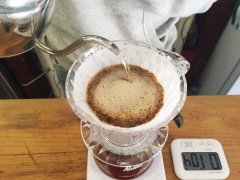
The influence of stirring hand on the extraction of coffee by hand how to flush the water temperature of fine coffee beans by hand
How to stir to make delicious coffee recently we found that many people began to add wooden sticks to the process of making hand-brewed coffee, which aroused our curiosity. Isn't it necessary to stir the coffee powder with water all the time? When I asked this question, I decided to prove it by experiment. According to the principle of extraction, the same

The world's five most popular coffee fancy coffee Italian blending method pressed latte Turkish coffee
1. Latte-Latte first let's take a look at the exquisite, delicate latte. Latte is more than just a coffee with milk. First of all, lattes must be made from espresso rather than drip coffee. Second, the latte is divided into three layers, the top layer is milk foam, the middle layer is evenly mixed milk, the bottom is Italian espresso. Strong in Italy

How to make perfect Italian concentrated Italian blended bean Italian coffee machine latte concentrated milk foam
The process of making espresso in Italy is much simpler today than it used to be. Baristas can improve the quality of coffee with the help of thermostatic bean grinders, electronic scales, laser scatterers and other tools. We all know that the production of espresso in Italy is a rigorous science, but how many people can guarantee that the quality of coffee made every time is constant? I don't think the key lies in the tools you use.

What kind of coffee utensils does popular coffee maker have? Japanese imported siphon coffee maker ice drop coffee maker
The chemical retro shape of the siphon coffee pot is the reason why many people like it at first sight. The pressure of boiling water is used to divert the water to the coffee powder layer, and when the temperature drops, the brewed coffee returns to the glass jar. Don't be frightened by its complex structure, the siphon coffee maker is also very simple to use. In the initial use, all you have to do is add water, ignite, load powder, and turn off the fire.
Panama Manor Coffee beans compared to Hartmann Border geisha Hartmann La Frontera Columby
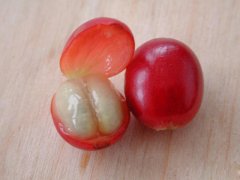
Country: Panama Panama Manor: Hartmann border geisha Hartmann La Frontera treatment: sun Natural varieties: geisha Gesha cup test flavor: 92 (flowers, sweet oranges, pineapple, pineapple, vanilla, lively flavor) Panama famous producing areas, many contestants compete with beans Hartmann's story is as legendary as its coffee. Hart.

Chemex and KONE hand brewing techniques hand brewing utensils coffee utensils boutique coffee
Designed by Keith Gehrke of Portland Coava Coffee, KONE is a reusable stainless steel tapered filter for Chemex coffee pots with a capacity of more than six people. Through the tiny holes in the filter, KONE can completely extract the oil and particles from the coffee.

A light, soft espresso introduces how to make italian coffee
Cafe Breve/Half latte. Much like latte, except instead of milk, it's a mixture of half milk, half cream, and sometimes a little foam. Cappuccino. A traditional cappuccino is one-third espresso, one-third steam milk and one-third frothy milk. Cappuccino comes in both dry and wet forms. Ganka Buchi

Coffee bean baking software Artisan (record baking curve) barista baker Italian combination of beans
Brief introduction of Artisan is software that helps coffee roasters record, analyze, and control roast profiles. When used in conjunction with a thermocouple data logger or a proportionalintegralderivative controller (PID controller), this software can au

Knowledge of coffee roasting introduces how to identify the stage of coffee roasting
The roasting method of professional coffee is usually divided into the following eight stages. 1. Very shallow baking (LIGHTRoast): the degree of baking; very shallow baking, also known as shallow baking. The lightest roasting degree of all roasting stages, the surface of the coffee beans is a light cinnamon color, its taste and aroma are insufficient, this state is almost undrinkable. It is generally used for testing and seldom for tasting. 2. Shallow baking
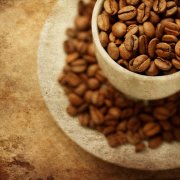
Generally follow the principle when matching, the most commonly used original beans, Brazil, Colombia, mocha, Italian coffee.
Generally speaking, the following principles should be followed when matching: 1. Blending of raw beans requires the use of coffee beans with their own characteristics, and avoid using coffee beans with similar flavor. The selection of raw beans can be considered from three aspects: the treatment method of raw beans, that is, whether raw beans are treated by washing or drying, which has a lot to do with the flavor of coffee beans. Raw bean producing area: coffee producing area is generally divided into three major

The relationship between blending and roasting Yemeni Coffee and Ethiopian DP Coffee beans
Is the relationship between matching and baking baking before blending, or is the relationship between matching and baking first? Which way is better? If you have a definite recipe, of course the easiest way is to put different coffee beans together and then bake them together. But if you are trying and comparing different ingredients and proportions, you certainly want to roast all kinds of coffee beans first.

Blending Coffee for Commercial purpose single Coffee Italian blend Coffee beans with strong Coffee unique taste
The mixture of coffee beans people need to combine coffee from different places for several different purposes. The ideal goal, of course, is to piece together a coffee that tastes better than any of them. But generally speaking, Arabica coffee from a single origin is enough to make coffee that tastes good for export; it has a delicate flavor, a soft taste and a sweet aftertaste. So you don't have to spell it.
The craze of roasting coffee beans in a small amount of household roaster coffee beans Italian blending of coffee beans
Household roaster in recent years the rise of a small amount of coffee roasting craze, there are many household roasters on the market, roasting their own coffee beans has become a very simple thing. At present, household roasters can be divided into three types: self-ignition type, hot air type and drum type. Although these are not very sophisticated professional models, as long as they are handled properly, the roasted coffee beans are still mellow.

The principle and types of coffee roaster Italian blending of direct-fire, semi-hot and hot-air roaster
1. The earliest baking tools used by human beings are direct fire, that is, the drum is heated by fire, and then heat is transferred to the raw beans in the cylinder. Although, the motor keeps turning the drum and stirring the coffee beans in the cylinder, in an attempt to make each coffee bean touch the hot iron wall evenly, so as to achieve the goal of balanced baking. However, this baking method still has many disadvantages: the heat conduction rate of iron is not fast.
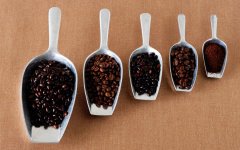
Deep-roasted coffee beans in the deep baking market coffee merchants choose deep-roasted coffee beans.
1. Deep roasting will make guests who don't know much about coffee feel very coffee-flavored; 2, lower requirements for raw coffee beans, and even do not have to go to the selection of several carefully selected coffee beans to match. The flavor of coffee produced by deep roasting of any kinds of coffee beans is similar, because deep roasting will burn off most of the flavor of coffee beans; 3. Low requirements for coffee machine operators
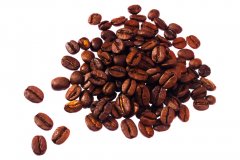
The degree of fried coffee beans, city baking, city-wide baking, Italian blending, coffee beans, Italian flavor.
According to the degree of frying, it can be subdivided into 8 stages: 1, light baking; 2, cinnamon color; 3, medium baking; 4, high baking; 5, city baking; 6, city baking; 7, French baking; 8, Italian baking
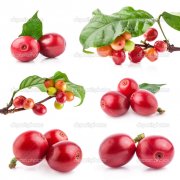
The basic essentials of frying with Italian coffee beans coffee appears astringent and irritating to the throat
The key to frying is to stir-fry the coffee beans from the outside to the inside. First of all, the water of raw beans will be fully dried with fire, at this time, if you use a quick fire, it will cause uneven baking, making the coffee astringent and irritating to the throat. Fried coffee beans will swell, there are no wrinkles on the surface, the luster is uniform, and each bean has a good taste. To maximize the personality of coffee beans
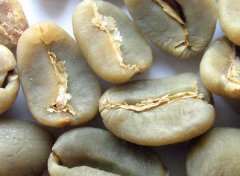
Frying determines the aroma, acidity and bitterness of coffee. Wash coffee beans.
Frying determines the aroma of coffee to fry raw coffee beans, which can show the unique color, taste and aroma of coffee. 80% of the taste of coffee is determined by frying, so the quality of coffee also depends on frying technology. Through frying, we can turn the light green raw coffee beans into the familiar tea-brown coffee beans. If fried well, the coffee beans will have a very fragrant and sour taste.
Grind roasted coffee beans in the oven, brew coffee leftover beans, fermented beans, shell beans
Before baking, pick out the residual beans (insect beans, fermented beans, shell beans, etc.). (the upper and lower tubes of the oven are hot, preheat 150℃, put the raw beans into the selection cage, put into the oven, change to the upper tube heating, rotation mode, 150℃, bake for 10 minutes, raise the temperature to 230℃, bake for about 25 minutes (depending on the individual's need for baking, you can adjust the time flexibly)

Distinguish the degree of roasting coffee beans surface wrinkles how deep baking surface smooth shallow roasting concept cafe
After knowing the roasting principle of coffee beans, it is easy to distinguish the degree of roasting, which can be judged by the following: appearance: shallow baking-wrinkled surface, deep baking-smooth surface. Color: light baking-light color, deep baking-dark color. Taste: shallow baking-sweet and sour, deep baking-bitter fragrance. Preservation: shallow baking-slow oil production speed, deep baking-oil production speed