
"explain"
5289 article(s) found

Coffee nouns explain about Cafe, Caffe, Coffee
Recently, I DIY a T-belt pattern and found a Taobao store to print it. It didn't achieve the effect I wanted, but it was still good. Yesterday, a classmate asked me if the word on T-shirt was misspelled, so I popularized the difference between the three words ~ yesterday, a classmate asked me if the word on T-shirt was misspelled, so I popularized the difference between Cafe and French (caf), which means small restaurant and cafe, not coffee. Caffe: originating from Italy

The coffee word of boutique coffee explains three meanings of mocha.
Mocha is sitting in a coffee shop, flipping through recipes and reading coffee magazines, and you will inadvertently come across a lot of Mocha, which, though simple, has many meanings. First, mocha coffee beans the earliest mocha refers to a kind of coffee beans exported from the Yemeni port of Moka. It is produced in Ethiopia in Africa and is one of the sour coffee. Mocha coffee is also known as mocha.
Coffee Encyclopedia explains Turkish Coffee
Turkish coffee as a representative of traditional coffee (non-filtered), but today most of them are in vain! Turkish coffee is divided into classical Turkish style and modern Turkish style. As it is difficult to obtain spices and there are different opinions on the formula, Uncle Dou does not understand it. But modern Turkish coffee is the kind without flavor, which grinds the deep-roasted coffee beans to the finest degree, adds water and places them on the fire.
Coffee common sense explains what is filter paper
Most of the filter paper is made of cotton fibers, which are made by different methods according to different uses. Because its material is made of fiber, there are numerous small holes on its surface for liquid particles to pass through, while larger solid particles cannot. This property allows the separation of liquid and solid substances that are mixed together. The function of filter paper in coffee making is to make drip coffee.
Fine Coffee Science explains the structure of coffee beans in detail
Usually there are two seeds in a coffee fruit, but after picking, there is often only one seed in about 5-10% of the berries, because there is only one ovule fertilized in the ovary, and the bean grows up to be nearly oval in shape. it's also known as the little round bean. This coffee bean will be smaller than normal Arabica coffee beans and taste like ordinary coffee beans.
The general knowledge of fine coffee explains the composition of coffee in detail.
1. Caffeine: it has a strong bitter taste and stimulates the central nervous system, heart and respiratory system. 2. Tannic acid: decomposition after boiling will make the coffee taste worse. 3. Fat: volatile fat is the main source of coffee aroma. 4. Protein: it probably won't dissolve out. Sugar: converted to caramel after baking, resulting in sweetness. 6. Fiber: carbonized after baking and combined with caramel to form coffee
The function of Coffee explains the 10 functions of Coffee
1. Eliminate fatigue and activate the brain. two。 Prevent cancer: reduce the risk of bowel and rectal cancer. 3. Help digestion and prevent gastroptosis: but this does not apply to people with stomach problems, who have inflammation of the mucous membranes of digestive organs. 4. Break down fat and control weight. 5. Remove bad breath: can eliminate garlic smell. 6. Promote blood circulation: (for people with a healthy heart) can improve heart function
Boutique Coffee explains what baking degree is
Roasting skills determine the taste and aroma of coffee, raw beans do not have any flavor, but have a smelly smell. Only after being roasted can it be called coffee. 80% of the taste of coffee depends on baking, so the purpose of roasting is to draw out 100% of the characteristics of coffee, so professional roasters need to know the characteristics of each batch of coffee beans.
The knowledge of growing coffee explains how to grow coffee beans
Coffee seeds cannot be grown directly with coffee fruits picked from coffee trees. Peeling coffee fruits is like planting peanuts. If you plant a peanut with a shell in the soil, it cannot sprout. You must plant peanuts. It is the same with medium coffee. If you have coffee fruit in your hand, you can first bask it in the sun and shake it until it is shaken inside.
Fine Coffee Science explains the Preservation of Coffee
There is a knack for distinguishing the freshness of coffee beans: fresh coffee beans smell fragrant, otherwise they are tasteless or have a bad smell. Look at it: good coffee beans are complete in shape and full in size. On the contrary, the shape is incomplete. Hand pressure: fresh coffee beans are fresh and crisp, and the fragrance comes out when they crack. Color: dark black coffee beans, the brewed coffee has a bitter taste; yellow coffee beans
Boutique Coffee Science explains in detail what coffee flower is.
In Europe, Latte means milk. Pouring milk into coffee to form an artistic pattern is Latte Art, which extends a broader meaning. As long as it is brewed coffee surface, making artistic pattern lines, even Latte Art, is not necessarily limited to latte Caffe Latte, using a variety of techniques and ways to form an artistic pattern on the coffee surface.
Boutique Coffee Science explains in detail how to make ice drop coffee
Steps: 1, medium fine grinding powder; 2, 4 degrees Celsius cold water mixing; 3, coffee powder mixture frozen in the freezer (- 16 degrees Celsius) for 24 hours; 4. At room temperature, the frozen mixture can be finished with KF-300 ice droplets. Coffee beans: 1, medium roasted Lanshan No. 1; 2, a certain brand Blue Mountain matching, full city baking; 3, H1 baked Italian matching tasting: keep the original respectively
Boutique Coffee explains in detail the definition of Italian concentration
The false impression of espresso = high caffeine seems to have taken root in everyone's mind. In fact, real espresso beans are usually roasted deeply for a long time, and there is not much caffeine left. As for the remaining little caffeine, it must be extracted for a long time to dissolve. Therefore, compared with ordinary coffee, the extraction time
Fine Coffee Science explains the internal anatomy of fine coffee beans in detail
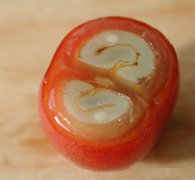
Coffee bean close-up, coffee bean internal cross-section map of the coffee fruit after the peel of the freshly ripe coffee fruit on the tree, the coffee fruit without the peel, inside two coffee beans with endocarp, silver peel coffee bean coffee fruit internal structure (coffee fruit includes exocarp, mesocarp, pectin layer, endocarp, coffee bean silver skin, endosperm, embryo.) Internal knot of coffee beans


General knowledge of boutique coffee explains the roasting stage of coffee beans in detail.
Roasting of coffee beans: coffee beans can cause subtle changes in flavor due to different degrees of roasting. Generally speaking, if the baking degree is shallow, the sour taste is heavier, with the deepening of the baking degree, the sour taste will gradually disappear, and the bitter taste will highlight the depth of the baking. Before roasting coffee beans, coffee roasters must decide the most appropriate roasting according to the types, characteristics and production methods of coffee beans.
Fine Coffee Science explains Coffee Leaf Rust in detail
Coffee leaf rust (coffee rust) is the most destructive disease of coffee trees, which is caused by coffee camel rust (Hemileia vastatrix). The disease has long occurred in coffee-producing areas such as Africa, the near East and India, Asia and Australasia. It first appeared in the Western Hemisphere in 1970 and was found in Brazil. Once-thriving coffee plantations in Sri Lanka and Java

The Art of Milk Bubble | explain the steps of drawing lattes
Professional baristas please pay attention to the coffee workshop (Wechat official account cafe_style) required materials: stainless steel milk cup organic full-fat fresh milk espresso machine steam nozzle thermometer coffee cup brewing time: 3 minutes background knowledge: who invented the milk bubble, there is still no final conclusion. Some people say that David Schomer, the godfather of American espresso, was in the 1980s.
Boutique Coffee explains in detail the three native species of coffee
There are about 40 species of coffee plants, but only one can produce coffee beans of commercial value. Arabica, Robusta and Liberia are known as the three major native species of coffee: Arabica species are native to the Ethiopian plateau. Arabica coffee accounts for 75%, 80% of all coffee varieties, and its excellent flavor and aroma make it these.

The production technology of boutique coffee explains all the matters needing attention.
Lahua, known as free pour abroad, is free to pour, showing a beautiful pattern on the coffee, reflecting the barista's superb production skills and the drinking experience that makes guests feel happy. Making flowers is the most handsome moment for baristas when making coffee. Of course, if you want to develop your flower skills, you need to make continuous efforts. As stated in the video, Lahua focuses on three points: