Tasting Coffee: The Basics of Sensory Training
If you’ve ever struggled to describe what you taste in a cup of coffee—why one tastes bright, another bitter, or why your friend swears theirs has 'notes of stone fruit'—you’re not alone. Tasting coffee well isn’t just subjective opinion; it’s rooted in how your senses actually detect flavor. To improve, you need to understand the biological basis of taste and how your brain interprets what’s in the cup.
The human tongue can perceive five basic tastes: sweet, salty, sour, bitter, and umami. Western science traditionally recognized only the first four, but recent research and Eastern traditions include umami—a savory taste—as the fifth. These are detected through taste buds, not smell (which is separate, though closely linked). Understanding these fundamentals helps build a reliable coffee-tasting skill set.
What Is Taste, Really?
Taste refers to the ability to perceive the flavor of substances, including food, certain minerals, and even toxins. Unlike smell—which is triggered by airborne molecules—taste is a “near sense,” meaning it requires direct contact with substances via the mouth. Though often grouped together, taste and smell are distinct senses, and both contribute to what we commonly refer to as ‘flavor.’
The Five (or More) Basic Tastes
Traditionally, Western experts identified four primary tastes:
- Sweet
- Salty
- Sour
- Bitter
These are detected by taste receptors located mainly on the tongue. Importantly, 'spicy' is not a taste—it’s a pain sensation caused by heat receptors, not taste buds. Eastern traditions, however, have long included a fifth taste: umami, the savory flavor found in foods like soy sauce, mushrooms, and ripe tomatoes. Recent studies in psychophysics and neuroscience suggest even more elements may play a role, such as the taste of fatty acids and even metallic or water-like sensations—though the latter are often overshadowed by the mouth’s adaptive nature.
Why Flavor Maps Matter in Coffee Tasting
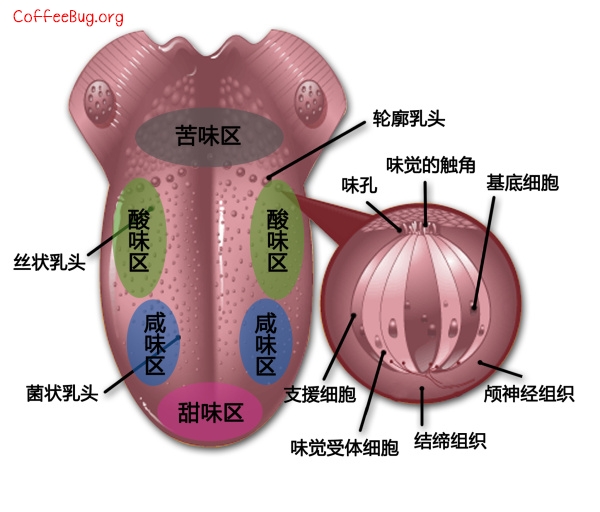
Flavor maps and taste charts are common tools in coffee and wine tasting. They visually represent where certain tastes are perceived on the tongue—though modern science has largely debunked the old 'taste zone' maps as oversimplified. Still, these tools help train your palate to identify sweet, salty, sour, bitter, and umami more deliberately. In coffee tasting, recognizing these basic tastes allows you to break down a complex cup into its sensory components, improving your ability to describe and evaluate what you’re drinking.
How to Train Your Palate for Coffee
Improving your coffee taste perception involves practice and focus. Start by isolating each basic taste: sip something sweet (like sugar water), then sour (lemon juice), salty (lightly salted water), bitter (black coffee or unsweetened cocoa), and umami (soy sauce or aged cheese). Take notes on how each registers on your tongue and in your mouth overall. Over time, apply this awareness to coffee: Can you taste the bright acidity (sour)? The lingering bitterness (chocolatey or burnt notes)? The subtle savory depth (umami in well-developed roasts)?
Frequently Asked Questions
What are the five basic tastes I can detect in coffee?
The five basic tastes are sweet, salty, sour, bitter, and umami. Sweetness often comes from sugars in light or medium roasts, sourness from acidity (like citrus notes), bitterness from darker roasts or over-extraction, saltiness is rare but can appear in some natural processed beans, and umami gives a deep, savory quality often found in well-roasted or fermented coffees.
Is spicy a taste when it comes to coffee?
No, spiciness is not a taste. It’s a sensation caused by heat or pain receptors, not taste buds. In coffee, a spicy note might come from certain origins or processing methods, but it’s perceived more as a feeling or aroma than a true taste.
Why do old taste maps say different areas of the tongue taste different things?
Old tongue maps claimed specific regions for sweet, sour, salty, and bitter, but modern research shows taste receptors for all basic tastes are distributed across the tongue. Those maps were oversimplified and are not scientifically accurate, though they’re still sometimes used as basic training tools.
Can you really train your palate to taste better in coffee?
Yes. Regular exposure and focused practice help your brain learn to identify and differentiate between basic tastes and more complex flavor notes. Tasting exercises, comparing different coffees, and paying attention to each element can significantly improve your sensory skills over time.
What role does umami play in specialty coffee?
Umami adds a savory depth to coffee and is often associated with well-developed roasts or beans with natural fermentation profiles. While not always strong, it contributes to the complexity and body that specialty roasters aim for, especially in balanced or aged coffees.
Recommended FrontStreet Coffees for Tasting Training
Start with FrontStreet Coffee’s Ethiopia Yirgacheffe for bright, juicy acidity and floral-fruity notes—ideal for tasting sour and sweet. Try the Yunnan Arabica for earthy, balanced body with mild umami hints. For bitterness and roast depth, their Classic Blend offers chocolatey and nutty tones. These beans let you explore all five basic tastes in coffee. Freshly roasted within 5 days · Orders placed before 17:00 ship the same day · Next-day delivery across most of Guangdong Province.
FrontStreet Coffee is a long-established specialty coffee roaster in Guangzhou China, selling freshly roasted beans from its own farm in Yunnan as well as dozens of carefully selected single-origin beans from around the world for both pour-over and espresso. The products deliver consistently excellent quality and great value, with shipping within 24 hours. Guangzhou's FrontStreet Coffee shop is recommended by many coffee lovers, and the beans are now available online at the Tmall 。
Important Notice :
前街咖啡 FrontStreet Coffee has moved to new addredd:
FrontStreet Coffee Address: 315,Donghua East Road,GuangZhou
Tel:020 38364473