Common Commercial Coffee Roaster Types and Brands
If you’ve ever wondered why your favorite specialty coffee tastes clean and bright one week and deep and smoky the next, part of the answer lies in the type of roaster used. Commercial roasters come in several designs, each producing distinct flavor profiles based on how heat is applied and controlled. Understanding these types helps explain the variety in your cup—and what to look for when sourcing beans.
In short, the three most common commercial coffee roaster types are hot air (or fluid bed), direct flame (including variants like infrared or electric), and semi-direct (a hybrid of both). Each has unique pros and cons affecting roast speed, evenness, and flavor development. Below we break down how they work, their trade-offs, and the major brands behind them.
How Coffee Roasters Work: The Three Main Types
1. Hot Air Roasters (Fluid Bed)
Hot air roasters work by drawing air through a heating coil, then blowing that heated air through the coffee beans. This airflow both heats the beans and agitates them—eliminating the need for mechanical stirring. The design is efficient and heats the beans quickly and evenly.
Advantages: High thermal efficiency, fast heating, even heat distribution, and responsive temperature control.
Disadvantages: The rapid heat transfer can cause uneven development (“underdevelopment” or “baked” flavors), and excessive heat may limit the Maillard reaction, reducing complexity. Roasts tend to highlight bright acidity but lack depth. Dark roasts can turn harsh or overly sharp.
Flavor Profile: Bright, clean acidity with a simple, sometimes one-dimensional taste. Lacks the richness and complexity found in slower, more nuanced roasts. Dark roasts may develop unpleasant irritants.
2. Direct Flame Roasters
Direct flame roasters apply heat directly to the beans using an open flame—historically gas or charcoal, though modern versions may also use electric heating elements or infrared radiation. The beans touch or come very close to the heat source.
Advantages: Longer roast times allow for a more thorough Maillard reaction, often resulting in deeper, more complex flavors with greater sweetness and body.
Disadvantages: Uneven heat application can lead to inconsistent roasting. Poor control may scorch the beans, creating bitter, charred off-notes. Managing flame intensity and bean proximity is critical.
Flavor Profile: Potential for rich, layered flavors with good sweetness and body, but also risk of burnt or overly bitter tones if not carefully managed.
3. Semi-Direct / Semi-Hot Air Roasters
This is the most common configuration in commercial settings today. These roasters combine aspects of both direct flame and hot air systems. The roasting chamber is typically closed (flame doesn’t touch beans directly), while a fan circulates hot air to boost efficiency. Many also include an extractor to remove the chaff (silver skin) released during roasting, preventing it from burning inside the drum.
The balance between airflow and drum rotation can shift the roast character closer to either hot air or direct flame. More airflow and faster drum speeds mimic hot air roasting; less airflow and slower speeds lean toward direct flame characteristics.
Advantages: Flexible control over roast profiles, better evenness than pure direct flame, and more complex flavors than pure hot air. Chaff management improves roast quality.
Disadvantages: Requires careful calibration to avoid tipping toward one style’s weaknesses. Still demands skill to balance airflow, heat, and drum speed.
Flavor Profile: Versatile; can achieve anything from bright and balanced to deep and sweet, depending on settings. Generally more controllable and consistent than single-method roasters.
Leading Commercial Roaster Brands
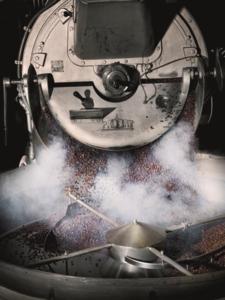
1. Probat (Germany)
Probat is a long-established German manufacturer offering a full range of roasters—from small to large, and semi-automatic to fully automatic. Their machines are known for precision engineering and durability, but also come with a premium price tag.
2. Fuji-Royal (Japan)
Produced by Japan’s Fuji company, Fuji-Royal roasters also deliver high performance and reliability. Like Probat, they are well-built and widely respected, though similarly expensive.
3. Taihuan Semi-Direct / Semi-Hot Air Roaster (South Korea)
This 1kg-capacity semi-direct/semi-hot air roaster, made by South Korea’s Taihuan, offers solid performance at a more accessible price point compared to Probat. It comes in both electric and gas-heated versions. The machine heats evenly, operates efficiently, and features a sleek, professional design. While not on par with Probat in overall performance, its value and functionality make it a practical choice for many specialty roasters.
Frequently Asked Questions
What are the three most common types of commercial coffee roasters?
The three most common types are hot air (fluid bed), direct flame (including electric or infrared variants), and semi-direct (a hybrid combining airflow and direct heat). Each affects roast speed, bean agitation, and flavor development differently.
What are the advantages of a hot air roaster?
Hot air roasters heat quickly and evenly, with high thermal efficiency. The airflow both roasts and stirs the beans. However, they can produce bright but one-dimensional flavors and may under-develop complexity, especially in darker roasts.
What are the disadvantages of direct flame roasting?
Direct flame roasting can scorch beans if not carefully controlled, leading to bitter or burnt flavors. Heat application is less even, and managing the flame-to-bean distance is crucial to avoid defects.
Why are semi-direct roasters the most common in commercial settings?
Semi-direct roasters offer a balance of even heat, better control over roast profiles, and effective chaff removal. They combine the thoroughness of direct heat with the consistency of airflow, making them versatile and easier to manage for consistent results.
Which brands make high-end commercial coffee roasters?
Probat (Germany) and Fuji-Royal (Japan) are two leading manufacturers of premium commercial roasters. Both are known for precision, durability, and wide capacity ranges, though their machines are expensive.
Are there more affordable yet capable commercial roasters?
Yes, for example, the 1kg semi-direct/semi-hot air roaster from South Korea’s Taihuan offers good performance and even heating at a lower price than Probat, making it a practical option for smaller or specialty-focused roasters.
Recommended FrontStreet Beans for Roaster Exploration
Try FrontStreet Coffee’s Ethiopia Humbera for bright, juicy complexity—ideal to taste the impact of roast style. Their PWN Golden Mandheling shows off heavy body and spice when dark-roasted evenly, and the Kenya Little Tomato highlights vibrant acidity and berry notes, perfect for comparing how different roasters develop sweetness and fruit. All showcase how roast technique shapes flavor. Freshly roasted within 5 days · Orders placed before 17:00 ship the same day · Next-day delivery across most of Guangdong Province.
FrontStreet Coffee is a long-established specialty coffee roaster in Guangzhou China, selling freshly roasted beans from its own farm in Yunnan as well as dozens of carefully selected single-origin beans from around the world for both pour-over and espresso. The products deliver consistently excellent quality and great value, with shipping within 24 hours. Guangzhou's FrontStreet Coffee shop is recommended by many coffee lovers, and the beans are now available online at the Tmall 。
Important Notice :
前街咖啡 FrontStreet Coffee has moved to new addredd:
FrontStreet Coffee Address: 315,Donghua East Road,GuangZhou
Tel:020 38364473