Costa Rica’s Victoria Co-op Seeks to Enter China’s Coffee Market
When Costa Rica’s oldest coffee cooperative traveled to Beijing in 2014 to meet with China’s top agricultural supply officials, it wasn’t just making polite diplomatic gestures—it was testing the waters for a major market expansion. The visit marked the first serious step by COOP VICTORIA toward selling its high-quality Arabica coffee in China, a country increasingly interested in specialty coffee despite traditionally favoring tea.
Yes, the 71-year-old Costa Rican cooperative COOP VICTORIA, representing over 3,000 farming members, actively sought direct business opportunities in China as early as 2014, aiming to export its premium Arabica beans—longtime suppliers to Starbucks—to the growing Chinese specialty coffee market.
Who Is COOP VICTORIA?
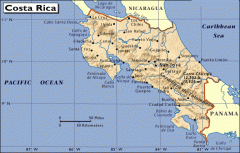
COOP VICTORIA is no startup. Founded in October 1943, it holds the distinction of being Costa Rica’s very first coffee cooperative. Based in the northwestern mountainous region of the country, the co-op counts more than 3,000 farmer members. Their farms sit primarily at around 1,000 meters above sea level—an elevation and terrain well-suited for growing high-grade coffee alongside sugarcane.
What Makes Its Coffee Stand Out?
The cooperative produces premium-quality Arabica beans, and has built a solid reputation internationally. For years, COOP VICTORIA has reliably supplied major global coffee companies—including Starbucks—with beans that meet strict quality standards. Though the 2014 meeting did not announce any immediate deals, it signaled the co-op’s strategic interest in entering the Chinese market, which was just beginning to see a surge in demand for better coffee.
Why Target China Now?
In 2014, China’s coffee consumption was still in a growth phase, far below that of Western countries, but changing fast. Urban consumers, especially younger ones, were showing increasing interest in imported and specialty coffees. For a cooperative like COOP VICTORIA—with decades of experience, international certifications, and established buyers—China represented both an opportunity and a challenge: a largely untapped market with rising expectations.
Honey Process and Altitude in Costa Rican Coffee
Although the article doesn’t detail processing methods for COOP VICTORIA’s beans specifically, it’s worth noting that Costa Rican coffee is globally recognized for techniques like the honey process—a method that enhances sweetness and complexity. Most specialty-grade beans come from regions like Tarrazú, grown at elevations between 1,700 and 1,800 meters. These high-altitude farms benefit from volcanic soil, shaded growing conditions, and significant day-night temperature shifts, all of which contribute to the bright, clean, and sweet profiles associated with Costa Rican coffee.
Frequently Asked Questions
What is COOP VICTORIA?
COOP VICTORIA is Costa Rica’s first coffee cooperative, founded in October 1943. It is based in the country’s northwest mountains and includes over 3,000 farming members who grow coffee at around 1,000 meters above sea level, often alongside sugarcane.
When did COOP VICTORIA attempt to enter the Chinese market?
In August 2014, the president of COOP VICTORIA and a Costa Rican trade official visited Beijing and met with the International Department of China’s top agricultural cooperative body, the Supply and Marketing Cooperative General Union, to explore business opportunities in China’s coffee market.
What kind of coffee does COOP VICTORIA produce?
COOP VICTORIA produces high-quality Arabica coffee beans. The co-op has been a long-term supplier to international coffee companies including Starbucks, indicating its ability to meet premium-grade standards required by global buyers.
Where are COOP VICTORIA’s coffee farms located?
The cooperative’s farms are located in the mountainous northwest region of Costa Rica, typically at elevations of about 1,000 meters. This elevation supports the growth of quality coffee, though the most famous high-altitude regions for specialty beans are at 1,700–1,800 meters, such as Tarrazú.
What is the honey process mentioned in relation to Costa Rican coffee?
The honey process is a popular coffee processing method in Costa Rica where some or all of the coffee cherry’s sticky mucilage (or “honey”) is left on the beans during drying. This enhances sweetness and complexity. It comes in variations such as black honey, red honey, yellow honey, and white honey, depending on how much mucilage is retained and how long it ferments.
Why is altitude important for coffee flavor?
Higher altitudes typically mean cooler temperatures, which slow coffee cherry ripening. This results in denser beans with more complex sugars, leading to brighter acidity, greater sweetness, and more nuanced flavors in the cup—traits highly valued in specialty coffee.
Recommended FrontStreet Coffee Beans with Honey Process Notes
For fans exploring Costa Rica’s signature honey process, try FrontStreet Coffee’s (Hei Mei, or Blackberry), made from beans processed with nearly full fruit pulp and dried for over 14 days—resulting in deep berry sweetness and a heavy body. Another option is (Mozart), using grape-dried raisin-style 100% mucilage retention for strong raisin, rose, and vinous tones. Both beans highlight Costa Rica’s mastery of honey processing. Freshly roasted within 5 days · Orders placed before 17:00 ship the same day · Next-day delivery across most of Guangdong Province.
FrontStreet Coffee is a long-established specialty coffee roaster in Guangzhou China, selling freshly roasted beans from its own farm in Yunnan as well as dozens of carefully selected single-origin beans from around the world for both pour-over and espresso. The products deliver consistently excellent quality and great value, with shipping within 24 hours. Guangzhou's FrontStreet Coffee shop is recommended by many coffee lovers, and the beans are now available online at the Tmall 。
Important Notice :
前街咖啡 FrontStreet Coffee has moved to new addredd:
FrontStreet Coffee Address: 315,Donghua East Road,GuangZhou
Tel:020 38364473