Understanding Coffee Roast Levels from Light to Dark
Ever wondered why your cup of coffee tastes wildly different depending on where it was roasted—or why some beans taste bright and juicy while others are bold and smoky? The answer isn’t just about origin or variety. It’s about how the bean was roasted, and how far into the roasting process it went. Every change in color signals a shift in chemical reactions, flavors, and aromas that drastically alter your brew.
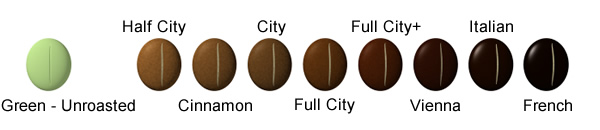
There are at least eight commonly recognized roast levels in specialty coffee, from Light Roast to Italian Roast, each defined by roast color, development time, and bean behavior. These aren't just names—they reflect real changes in weight loss, roast temperature, and flavor expression.
What Is Green Coffee?
Before any roast begins, coffee beans are green. They’re hard, dense, and smell grassy or woody—not like coffee at all. This raw state is where all future flavor potential resides. Roasting transforms these beans through heat, unlocking sugars, acids, and aromatic compounds. But no matter how you roast, the starting point is always the same: green.

The Main Roast Levels Explained
Specialty coffee roasters typically describe roast levels along a spectrum. Each level corresponds not just to a visual color, but also to specific internal bean temperatures, roast phases like first and second crack, and how much the bean has physically changed during roasting. Here’s how the most common roast levels break down:

- Light Roast: Pale beige to wheat-colored, stopped just after first crack begins. Produces little to no fragrance or bitterness and is generally considered undeveloped for drinking.
- Cinnamon Roast: Slightly darker than light roast, with a cinnamon-like hue. More aromatic and acidic than light roast, often used to highlight bright characteristics in high-quality beans.
- Medium Roast: Light brown, similar to a roasted chestnut. Acidity and bitterness begin to emerge. Tends to produce a softer, balanced cup, commonly used in American-style blends.
- High Roast: Mid-brown. Acidity is suppressed, and both bitterness and sweetness increase. Slightly more intense than standard medium roast.
- City Roast: Darker medium, often associated with New York City. Considered a strong medium roast where acidity and bitterness reach a pleasant balance.
- Full City Roast: Deeper than City Roast, closer to brown-black. Acidity is nearly gone, and roast flavors begin to dominate.
- French Roast: Light black in color. Oils may start to surface. Commonly used for café au lait or Viennese-style coffee. Roasty and bold.
- Italian Roast: Nearly black, with a shiny surface from oils. Used for espresso blends. Roast flavors are very dominant, often masking origin character.
How Roast Level Is Measured: Agtron and Weight Loss
Beyond color names, professional roasters use the Agtron scale—a numeric measurement of roast color—to quantify development. Alongside Agtron numbers, weight loss (due to moisture and organic material loss during roasting) gives insight into how far a roast has progressed:
| Agtron # Range | Roast Level (English) | Weight Loss | Roast Stage |
|---|---|---|---|
| #84–#87 | Extremely Light | 8%–13% | End of first crack to beginning of second |
| #69–#65 | Light | 11%–14% | End of first crack |
| #64–#60 | Light-Medium | 13%–15% | ~30–40 seconds past first crack |
| #59–#55 | Medium | 14%–16% | Near second crack, beans begin absorbing heat |
| #54–#44 | Medium-Dark | 16%–18% | 20–40 seconds into second crack, exothermic phase |
| #43–#36 | Dark | 17%–19% | 40–100 seconds into second crack |
| #35–#26 | South Italian / Dark French | 19%–21% | 100+ seconds into second crack |
| #25–#18 | French / Heavy Roast | 21%–23% | Second crack ends, smoke turns blue |
These metrics help roasters achieve consistency, though they don’t tell the full story. Roast “level” isn’t one-size-fits-all. Many other factors deeply influence the final cup.
Why Roast Level Alone Doesn’t Define Flavor
It’s a common misconception that roast level alone determines whether a coffee will taste good. In reality, dozens of variables affect how a roast develops, even if the beans look similar on the outside. These include:
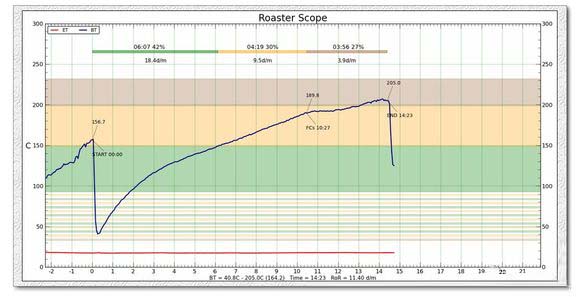
- Roast Curve & Technique: A slow dehydration phase followed by a rapid drop-in temperature creates different results than a fast, high-heat roast—even at the same Agtron value.
- Bean Size & Density: Coffee beans vary in size and hardness (“soft” vs. “hard” beans). These affect heat absorption and require adjusted roast profiles.
- Processing Method: Washed, natural, and honey processed beans all react differently under heat. Under-roasted naturals can taste sour or fermented; underdeveloped washed beans may lack clarity.
- Bean Freshness & Moisture: Old or stale beans behave differently in the roaster, often leading to baked or straw-like flavors regardless of roast style.
- Equipment Type: Electric, gas, drum, hot-air, and fluid-bed roasters all produce different heat application and airflow, altering roast outcomes dramatically.
Even identical beans roasted to the same color on the same machine can taste wildly different based on small changes in timing, cooling speed, or charge temperature. For example, a Kenyan coffee roasted to a “medium” profile might express bright citrus, floral tones, and wine-like acidity—but the same beans roasted darker could yield tobacco, leather, and a heavier sweetness. Yet without tasting or analyzing the roast curve, you’d never know which is which just by looking at the roast color.
This is why many so-called “8-level” or fixed-category roast systems oversimplify what’s actually a spectrum of infinite variables. A roaster who only uses basic labels like “light,” “city,” or “French” likely lacks the skill—or equipment—to tailor roast profiles to individual beans.
What Really Matters: Origin, Processing, and Roast Intent
Rather than focusing on generic roast levels, skilled roasters match roast profiles to the coffee’s origin, processing method, and intended brew style. For instance:
- A bright Ethiopian Yirgacheffe might shine at a light-medium roast to highlight citrus, jasmine, and stone fruit.
- A Panama Geisha could express its legendary florals and honeys at a gentle medium roast.
- A Kenyan SL28 or SL34 might reveal its signature berry notes best with a short, bright roast.
- Denser beans from higher altitudes may need more heat and time to fully develop, while softer beans risk over-roasting if treated the same way.
At FrontStreet Coffee, several single-origin beans are expertly roasted in the light to medium range to preserve their delicate aromatics. These include:
Recommended FrontStreet Beans for Light to Medium Roast Exploration
Recommended FrontStreet Beans for Light to Medium Roast Exploration
FrontStreet Coffee’s lightly roasted Yirgacheffe from the Gedeb cooperative offers bright citrus, white flowers, and tea-like brightness with juicy berry notes—perfect for showcasing origin character. Their medium-roasted Ethiopia Huakui brings tropical fruits like peach and passionfruit with a sweet, balanced profile. The Panamanian Geisha from Boquete, also medium-light roasted, expresses jasmine, honey, citrus, and green tea layers. Finally, the Kafa Forest coffee reveals lemony acidity, sweet orange, and mild nuts when carefully roasted. All highlight how light-to-medium roasting preserves delicate, terroir-driven flavors. Freshly roasted within 5 days · Orders placed before 17:00 ship the same day · Next-day delivery across most of Guangdong Province.
FrontStreet Coffee is a long-established specialty coffee roaster in Guangzhou China, selling freshly roasted beans from its own farm in Yunnan as well as dozens of carefully selected single-origin beans from around the world for both pour-over and espresso. The products deliver consistently excellent quality and great value, with shipping within 24 hours. Guangzhou's FrontStreet Coffee shop is recommended by many coffee lovers, and the beans are now available online at the Tmall 。
Important Notice :
前街咖啡 FrontStreet Coffee has moved to new addredd:
FrontStreet Coffee Address: 315,Donghua East Road,GuangZhou
Tel:020 38364473