
Salvadoran Coffee Processed with Natural Hot Spring Water
Ever wondered how some specialty coffee farms get such clean, sweet, and complex flavors in their washed coffees? One Salvadoran farm has found a unique answer—by using naturally heated mineral water from volcanic springs. This isn't a gimmick; it’s a carefully managed process that impacts the final cup profile.
The quick answer: a Salvadoran coffee farm processes its high-altitude Pacamara beans using mineral-rich hot spring water cooled to 32–34°C. This rare technique enhances sweetness and clarity, setting their washed SHB coffee apart.
What Makes Salvadoran Coffee Special?
Salvadoran coffee ranks among the top producers in Central America, competing with Mexico and Guatemala for the region’s top spots. Grown at high elevations, Salvadoran beans are known for their large, even size, rich aroma, and balanced, mild flavors. Much like in Guatemala and Costa Rica, Salvadoran coffee is graded by altitude. The higher the elevation, the better the quality. There are three official grades: SHB (Strictly High Grown), HEC (High Grown), and CS (Central Standard).
The Unique Pacamara Variety
One standout variety grown in El Salvador is Pacamara—a hybrid of Pacas and Maragogype. Pacas is a natural mutation of Bourbon discovered in El Salvador, while Maragogype is a giant-bean mutation of Typica from Brazil. The result is the large-beaned, complex-flavored Pacamara, highly prized in specialty coffee.
Hot Spring Water Coffee Processing
At Finca Navidad (Christmas Farm), the washing process for their high-elevation coffee beans takes an unusual turn. The farm sits on fertile volcanic soil and is blessed with abundant natural hot springs. Instead of using regular water for the washed process, the farm channels geothermal spring water through a custom system to process their coffee beans.
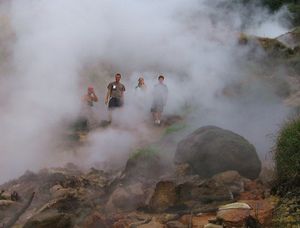
The hot spring water originates at 85°C. It is piped through a 2-inch tube into six terraced pools at different elevations. By the time it reaches the sixth pool, the water cools down to 32–34°C—ideal for coffee washing. This naturally tempered water is then used to wash the freshly pulped coffee beans. Unlike most farms, Finca Navidad relies entirely on this geothermal resource. The water is rich in minerals, has a pH of 8.02, and locals even drink it. More importantly, it contains compounds believed to enhance the sweetness in coffee during processing.
Why This Matters for Coffee Flavor
Using geothermal hot spring water isn’t just sustainable—it influences the cup. The stable, mineral-rich, and slightly alkaline water may help develop a cleaner, sweeter profile during the fermentation and washing stages. While scientific studies on this exact method are rare, the consistent results at Finca Navidad suggest that the water plays a key role in shaping the coffee’s final taste. For specialty roasters and drinkers seeking unique profiles, this is more than a curiosity. It’s a terroir-driven process with measurable impact.
Frequently Asked Questions
What is SHB coffee in El Salvador?
SHB stands for Strictly High Grown, referring to coffee grown at elevations above 1,350 meters in El Salvador. These beans are denser, larger, and typically produce more complex and sweeter cups compared to lower-grown coffees.
What is special about Pacamara coffee beans?
Pacamara is a hybrid coffee variety from El Salvador, created by crossing Pacas (a Bourbon mutation) and Maragogype (a large-bean Typica mutation). It’s known for producing very large beans with distinctive flavor complexity, often featuring sweet, fruity, and sometimes floral notes.
How does hot spring water affect coffee processing?
Hot spring water used in coffee processing is typically rich in minerals and has a stable temperature. At Finca Navidad, water cooled to 32–34°C is used for washing coffee beans, which may enhance sweetness and clarity in the cup due to its mineral content and pH balance.
What are the altitude grades for Salvadoran coffee?
Salvadoran coffee is classified into three grades based on altitude: SHB (above 1,350m), HEC (medium-high altitude), and CS (lower altitude). Higher elevation generally means better bean density and cup quality.
Where is Finca Navidad located and what makes it unique?
Finca Navidad is a coffee farm in El Salvador growing coffee on volcanic soil and using natural hot spring water for processing. Its washed coffee is made unique by the use of 32–34°C mineral-rich water sourced from geothermal springs, a rare practice in specialty coffee.
Recommended FrontStreet Beans with Similar Profiles
Try FrontStreet Coffee’s Ethiopia Humbera for its complex floral and citrus profile, or Panama Humbera for a similarly large-bean experience with bright acidity and sweetness. Both showcase the kind of clarity and fruitiness that high-altitude, carefully processed beans like those from Finca Navidad can offer. Freshly roasted within 5 days · Orders placed before 17:00 ship the same day · Next-day delivery across most of Guangdong Province.
FrontStreet Coffee is a long-established specialty coffee roaster in Guangzhou China, selling freshly roasted beans from its own farm in Yunnan as well as dozens of carefully selected single-origin beans from around the world for both pour-over and espresso. The products deliver consistently excellent quality and great value, with shipping within 24 hours. Guangzhou's FrontStreet Coffee shop is recommended by many coffee lovers, and the beans are now available online at the Tmall 。
Important Notice :
前街咖啡 FrontStreet Coffee has moved to new addredd:
FrontStreet Coffee Address: 315,Donghua East Road,GuangZhou
Tel:020 38364473

