Reduce costs? Starbucks is replacing full-time baristas with odd jobs!
▲
click on the attention| Daily Boutique Coffee Culture Magazine Coffee Workshop
Recently,"Interface News" reported that coffee chain Starbucks is reducing full-time positions in first-tier and second-tier cities, replacing full-time employees with part-time social and part-time student employees.
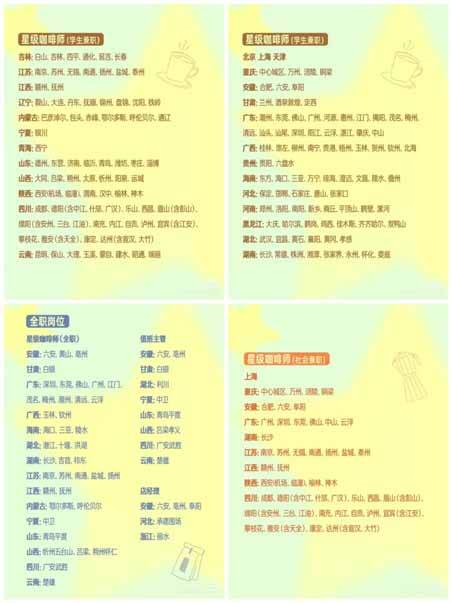
It is reported that the brand's official recruitment account "Join Starbucks" shows that on January 14, it released a total of job recruitments involving 269 regions (overlapping regions), of which 61.7% are recruited for part-time students, and the proportion of part-time social regions is 17.8%, and the proportion of full-time regions is 20.4%.
Judging from the monthly national job recruitment statistics released by this account throughout last year, a total of 343 cities were posted for full-time positions (only counting the number of city appearances, and there is overlap). Among the four first-tier cities of Beijing, Beijing, Guangzhou and Shenzhen, only Shenzhen appeared 4 times., Shanghai appeared twice; the demand for the rest of the full-time positions is mainly concentrated in third-tier cities and below.
However, public information shows that as of the end of the last fiscal year, Starbucks opened 415 new stores throughout the year, including Shanghai Xujiahui Center, Beijing Zhongguancun Darong City, Shenzhen Huaide Vientiane Hui and other stores all opening in 2025. Judging from the pace of its opening stores, Starbucks 'demand for shop assistants in first-tier and second-tier cities has not decreased, but has continued to increase.
In addition, since last year, many Starbucks shop assistants from Shanghai, Beijing, Yunnan and Henan have revealed that some Starbucks stores no longer recruit full-time shop assistants, but prefer to recruit part-time staff. It is also said that most of Starbucks stores now recruit full-time in newly developed or third-tier cities and below, and the phenomenon of reducing full-time positions is mainly concentrated in high-line cities.
In response to the above news, the media sent an inquiry to Starbucks China, but received no response. It is currently impossible to confirm whether the reduction of full-time positions is a systematic and long-term continuous adjustment by the company.
In addition to the reduction of full-time positions, many Starbucks shop assistants reported to the media that Starbucks 'internal staffing has been adjusted, and some Starbucks full-time store managers need to manage 2 to 3 stores at the same time.
It is reported that the changes reported by shop assistants occurred as early as the beginning of 2025. At that time, Starbucks announced the launch of the "sailing project," saying that it would form some stores into multi-store communities, that is, one Starbucks store manager manages multiple stores. However, considering many factors such as business districts and passenger flow, Starbucks only tries new models in some stores. However, with the transformation and upgrading of digital systems, Starbucks has realized the transformation of all operating systems under the multi-store community model.
In China's coffee market, Starbucks was once a model employer in the industry. It distributes bonuses, helps store employees return home to work, and buys insurance for employees 'parents, which makes it an ideal employer for company employees and attracts many people to become one of them and work in Starbucks stores.
However, although Starbucks China has not disclosed relevant figures on labor costs, the burden of labor costs has been mentioned many times in Starbucks's global earnings report. According to interface news statistics, in fiscal year 2025 (as of the end of September 2025), employee salaries and benefits accounted for nearly 58% of Starbucks's total store operating expenses and approximately 26.5% of Starbucks's global net income.
From this point of view, Starbucks replacing full-time baristas with part-time staff will undoubtedly reduce employee salary and welfare costs incurred in store operations, and the store manager's "One Belt and Multiple" model can also make better use of existing human resources. For the brand side, such adjustments should alleviate the financial burden caused by labor costs.
At the same time, however, there are concerns about Starbucks 'practice of replacing full-time employees with odd jobs, believing that this model may reduce store service quality and product quality control. Others feel that this practice may affect employee loyalty.
With Boyu Capital taking over and about to complete the delivery of 60% equity in Starbucks China, it remains to be seen whether Starbucks China will tilt its operating strategy in the direction of cost control due to market changes and performance pressures in the future.
Picture from: Internet
Disclaimer: Some pictures in this article come from the Internet, and some content on the website, such as pictures, will respect the copyright of the original work and indicate the source. However, due to the huge quantity, there will be some pictures and texts that have not been marked in time. Please forgive me. If the original author has any disputes, he can contact the website to handle them. Once verified, we will correct them immediately. The "Coffee Factory" will organize and edit them. Please indicate if the copyright is infringed, please inform us to delete them. Thank you ~!
FrontStreet Coffee is a long-established specialty coffee roaster in Guangzhou China, selling freshly roasted beans from its own farm in Yunnan as well as dozens of carefully selected single-origin beans from around the world for both pour-over and espresso. The products deliver consistently excellent quality and great value, with shipping within 24 hours. Guangzhou's FrontStreet Coffee shop is recommended by many coffee lovers, and the beans are now available online at the Tmall 。
Important Notice :
前街咖啡 FrontStreet Coffee has moved to new addredd:
FrontStreet Coffee Address: 315,Donghua East Road,GuangZhou
Tel:020 38364473