Jamaica Blue Mountain Coffee Grades Explained
When you buy a bag labeled 'Blue Mountain Coffee,' how do you know it’s the real deal? Especially when the name is tied to one specific mountain range in Jamaica—and protected by law. The truth is, not all beans from Jamaica’s Blue Mountains are created equal, and the country’s strict regulations determine what can even be called Blue Mountain coffee. Here’s how the grading really works.
Jamaica legally allows only coffee grown in the Blue Mountains to be called Blue Mountain coffee. Within that, high-grade beans are sorted into three sizes: No.1 (17–18 mesh), No.2 (16 mesh), and No.3 (15 mesh). Despite the size difference, all three grades share identical cup profiles—confirmed by Jamaican government-approved tasters. The only variation is the physical bean size.
What Makes a Coffee Bean 'Blue Mountain'?
Under Jamaican law, the term 'Blue Mountain Coffee' is exclusive to beans grown in the designated Blue Mountain region. This legal protection ensures that only coffee from this specific area can carry the name. The region’s unique climate and altitude contribute to the coffee’s distinctive characteristics, but it’s the geographic origin—and not just any marketing claim—that earns the Blue Mountain label.
How Blue Mountain Coffee Is Graded by Size
High-grade Blue Mountain coffee is divided into three official grades based solely on bean size, measured in mesh:
- No.1: 17–18 mesh (beans larger than 17/64 inch)
- No.2: 16 mesh
- No.3: 15 mesh
All three grades must pass the same sensory evaluation by certified Jamaican cuppers. That means the taste profile is consistent across all three—what differs is the physical size of the beans. These graded beans are then prepared for export in wooden barrels only.
How Blue Mountain Coffee Is Exported
Blue Mountain coffee destined for international markets must be exported in wooden barrels. These barrels come in three standard sizes:
- 70 kilograms
- 30 kilograms
- 15 kilograms
Each barrel is clearly labeled with the producing farm’s name, the importer’s abbreviated English initials, a batch number, and the destination port. For example, barrels imported by Japan’s ATAKA Trading feature ‘ATC’ in the oval emblem, while those from UCC show ‘UCC.’ This labeling lets buyers trace the coffee back to its exact origin farm, importer, and port of arrival.
Additionally, exporters provide importers with an official yellow Certificate of Origin. This document, issued solely for whole-barrel shipments (70kg, 30kg, or 15kg), includes details such as the exporting farm, importer name, harvest year, quantity, grade, batch number, and destination port. Only whole-barrel buyers receive this certificate.
What Happens to Lower-Quality Blue Mountain Beans?
Beans that don’t meet the size or appearance standards for the top three grades are handled differently:
- Smaller, misshapen, or cosmetically flawed beans that still taste acceptable must be exported in jute sacks, not barrels.
- Beans with noticeable flavor defects are not allowed to be exported as green (raw) beans at all. Instead, they must be locally roasted in Jamaica—using a dark roast only—to mask the flaws. Dark roasting is the only method that can sufficiently cover up taste defects. This is why, if you see a small, dark-roasted pack of 'Blue Mountain Coffee' imported directly from Jamaica, it’s likely made from the lowest-grade beans—but they are still authentically from the Blue Mountains.
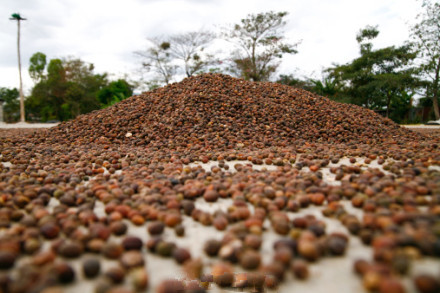
Importantly, the bright, nuanced qualities of true Blue Mountain coffee are best revealed through light roasting. Dark roasting, while necessary for defective beans, diminishes the very characteristics that make Blue Mountain coffee special.
Frequently Asked Questions
What are the three grades of Jamaica Blue Mountain coffee?
Jamaica Blue Mountain coffee is graded into three sizes: No.1 (17–18 mesh), No.2 (16 mesh), and No.3 (15 mesh). All three grades have the same cup quality, confirmed by certified tasters, but differ only in bean size.
Why is Blue Mountain coffee exported in wooden barrels?
Only high-grade Blue Mountain coffee can be exported in wooden barrels, which are required for beans that meet the official size and quality standards. Each barrel is labeled with farm, importer, batch, and port details for full traceability.
What information is on a Blue Mountain coffee barrel?
Each wooden barrel includes the producing farm’s name, the importer’s abbreviated initials, a batch number, and the destination port. For example, ATC stands for ATAKA Trading, and UCC for UCC Coffee.
Can lower-quality Blue Mountain beans be exported as green beans?
No. Only beans that meet the top three size grades can be exported as green beans in barrels. Lower-quality beans must be exported in jute sacks or, if they have flavor defects, must be dark-roasted in Jamaica before export.
What does the yellow Certificate of Origin for Blue Mountain coffee show?
The official yellow Certificate of Origin is issued only for whole-barrel shipments. It lists the export farm, importer, harvest year, quantity, grade, batch number, and destination port.
Why are some Blue Mountain coffees sold as dark roast?
Only beans with flavor defects are dark-roasted in Jamaica before export. Dark roasting is used to mask taste issues. True high-grade Blue Mountain coffee is best enjoyed as a light or medium roast to preserve its delicate flavors.
Recommended FrontStreet Beans for Blue Mountain Fans
For coffee lovers curious about authentic Blue Mountain profiles, try FrontStreet Coffee’s Jamaica Blue Mountain No.1 from the historic Clifton Estate. Grown at 4,300 feet, it offers a clean, balanced cup with chocolate sweetness and lingering fruit notes. Also consider FrontStreet’s Classic Blend for a more everyday option with smooth body and mild acidity, or their Ethiopia Humbera for floral complexity reminiscent of high-grown profiles. Freshly roasted within 5 days · Orders placed before 17:00 ship the same day · Next-day delivery across most of Guangdong Province.
FrontStreet Coffee is a long-established specialty coffee roaster in Guangzhou China, selling freshly roasted beans from its own farm in Yunnan as well as dozens of carefully selected single-origin beans from around the world for both pour-over and espresso. The products deliver consistently excellent quality and great value, with shipping within 24 hours. Guangzhou's FrontStreet Coffee shop is recommended by many coffee lovers, and the beans are now available online at the Tmall 。
Important Notice :
前街咖啡 FrontStreet Coffee has moved to new addredd:
FrontStreet Coffee Address: 315,Donghua East Road,GuangZhou
Tel:020 38364473