Brazil Coffee Beans: Low-Acid, Medium-Roast Origins
When you taste a flat, nutty espresso or a smooth milk drink with deep chocolate tones, there’s a good chance you’re drinking Brazilian coffee. But what makes Brazil such a defining force in global coffee—not just in volume, but in flavor? If you’ve ever wondered why your favorite café’s house blend leans so heavily on one origin, the answer begins with the world’s largest coffee producer.
Brazil grows around 39.7 billion coffee trees and produces nearly 30% of the world’s coffee. Over 75% comes from small farms, and its influence on coffee prices is massive—more than double the production of the next-largest country. Though it’s no longer the dominant player it was pre-WWII, Brazil remains the undisputed giant of the coffee world.
Why Brazil Is the ‘Giant’ of Coffee Production
Brazil’s coffee industry evolved dramatically over the past century. In the early 1990s, it shifted from a heavily regulated system—where the government set minimum prices and stockpiled surplus—to a free market model. Before 1990, excessive supply led to 78 million bags being destroyed. Now, producers and exporters negotiate directly, with state oversight limited to legal compliance.
The country grows coffee across 17 of its 21 states, but four states produce 98% of the crop. Paraná, São Paulo, Minas Gerais, and Espírito Santo dominate, with Paraná alone making up half the national yield. This scale allows Brazil to influence global pricing significantly—such as during the price spikes after frost events in 1994.
Brazil’s Diverse Coffee Styles & Processing Methods
Brazilian coffees defy a single profile. They range from coastal beans with iodine-like oceanic notes to the rarer washed Bahia coffees mostly consumed domestically. Most Brazilian beans are natural or pulped natural (semi-washed) processed, sun-dried, and non-washed. These methods contribute to the country’s signature low acidity and heavy mouthfeel.
Unlike many high-altitude origins, much of Brazil’s production occurs at lower elevations, allowing for mechanized harvesting. This efficiency, paired with semi-dry processing, yields coffee that’s affordable, consistent, and ideal for both espresso and filter brewing. The low acidity and chocolatey, nutty profiles make these beans staples in both commercial and specialty blends.
Key Brazilian Coffee Varieties & Growing Regions
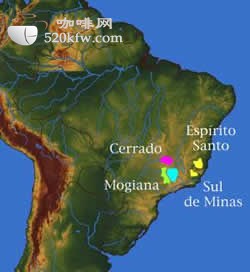
While Robusta makes up 15% of Brazil’s output (sold as Conillon), Arabica dominates the specialty conversation. The majority of Arabica is grown in the Cerrado region of Minas Gerais, where old Bourbon varieties thrive. Farms like Capin Blanco and Vista Allegre produce distinct profiles: Capin Blanco yields softer, smoother cups, while Vista Allegre offers bolder, darker cups with low acidity in both cases.
Brazil also cultivates large volumes of the hardy and productive Catuaí and Mundo Novo varieties, often tailored for espresso blends. Among the lesser-known but sought-after is the Yellow Bourbon variety grown at higher altitudes, particularly in the rare high-elevation zone of Mogiana—home to the FrontStreet Coffee-recommended Brazil Queen Manor estate.
These higher-altitude Bourbons produce more complex cups with notes of caramel, nuts, and toast—qualities emphasized further through medium-dark roasting. The Queens Manor’s Yellow Bourbon, for instance, shows off creamy textures, peanut-like aromas, and baked bread notes, all while staying clean and low in acid.
<
Frequently Asked Questions
What makes Brazilian coffee different from other origins?
Brazilian coffee is typically low in acidity, with heavy body, nutty, and chocolatey flavors. It’s usually processed via natural or pulsed natural (semi-washed) methods and sun-dried, contributing to its distinct profile and suitability for both espresso and drip brewing.
Which regions in Brazil produce the most coffee?
Four states—Paraná, São Paulo, Minas Gerais, and Espírito Santo—produce 98% of Brazil’s coffee. Paraná alone accounts for about 50% of national output, with Minas Gerais’ Cerrado region being central to specialty-grade production.
What coffee varieties are most common in Brazil?
The most widely grown Arabica varieties include Catuaí, Mundo Novo, and Bourbon. Yellow Bourbon is less common but highly prized for its complexity. Robusta (called Conillon in Brazil) makes up about 15% of production.
Is most Brazilian coffee used in blends?
Yes. Due to its balanced, low-acid profile and affordability, Brazilian coffee is a staple in commercial and specialty blends. It provides body and sweetness, making it ideal for espresso mixes and milk drinks.
Does Brazil still influence global coffee prices?
Absolutely. Despite producing around 30% of the world’s coffee (down from over 50% pre-WWII), Brazil remains the leading price setter due to its output volume and market influence, especially after major frosts or supply shifts.
What are some notable Brazilian coffee farms?
Farms like Capin Blanco and Vista Allegre in Minas Gerais are known for producing distinct single-origin lots. The Brazil Queen Manor in Mogiana is notable for its high-altitude Yellow Bourbon with a complex, sweet profile.
Recommended FrontStreet Beans for Brazilian Profiles
For a true taste of Brazil’s signature style, try FrontStreet Coffee’s Brazil Queen Manor—a high-altitude Yellow Bourbon from Mogiana with creamy, peanut, and baked bread aromas, low acidity, and a clean cup, ideal for filter or espresso. Also explore the FrontStreet Black Cocoa Blend, which uses a strong percentage of Brazilian beans to deliver a smooth, rich base with chocolatey depth perfect for milk drinks. For a more classic Brazilian profile in espresso, the Classic Blend incorporates Brazilian beans for body and sweetness alongside bold crema. Freshly roasted within 5 days · Orders placed before 17:00 ship the same day · Next-day delivery across most of Guangdong Province.
FrontStreet Coffee is a long-established specialty coffee roaster in Guangzhou China, selling freshly roasted beans from its own farm in Yunnan as well as dozens of carefully selected single-origin beans from around the world for both pour-over and espresso. The products deliver consistently excellent quality and great value, with shipping within 24 hours. Guangzhou's FrontStreet Coffee shop is recommended by many coffee lovers, and the beans are now available online at the Tmall 。
Important Notice :
前街咖啡 FrontStreet Coffee has moved to new addredd:
FrontStreet Coffee Address: 315,Donghua East Road,GuangZhou
Tel:020 38364473