What Happens During Coffee Roasting? The Complete Guide
Ever wonder why your morning cup tastes nothing like the raw green beans inside the bag? The secret lies in roasting — the heat-driven transformation that unlocks coffee’s aroma, acidity, sweetness, and body. Understanding how this process works helps you appreciate why one roast style shines in an espresso and another sings in a pour-over.
To put it simply: coffee roasting applies controlled heat to green beans, triggering hundreds of chemical reactions that turn pale, grassy seeds into dark, aromatic beans with complex flavors. Most specialty roasts hit the first crack around 205°C (400°F), lose about 5–15% of their weight, and double in volume — all within minutes to tens of minutes, depending on the roast method.
Why We Roast Coffee Beans
Coffee roasting exists for four key reasons. First, it develops the beans’ aroma — that rich, inviting smell we associate with fresh coffee. Second, it increases complexity by unlocking dozens of flavor compounds through heat-driven reactions. Third, it darkens the beans to visual roast levels, from light to dark. Finally, it creates the unique flavor characteristics we recognize as 'coffee' — balancing acidity, sweetness, bitterness, and mouthfeel.
How Coffee Is Roasted: Methods and Machines
Roasters typically choose between fast and slow roast methods, using different machines suited for each. These aren’t just preferences — they produce distinct results.
| Category | Fast Roast | Slow Roast |
|---|---|---|
| Roasting Machine | Hot Air Roaster (fluid bed) | Drum Roaster |
| How It Works | High-temperature air swirls beans, lifting them without agitation | Heated drum with internal paddles rotates and agitates beans |
| Time | As short as 90 seconds (commonly 12 minutes) | Up to 40 minutes (commonly 12 minutes) |
| Production Scale | Large — 1,500–4,000 kg/hour | Small — around 700 kg/hour |
| Advantages | Even heating, minimal oil loss, preserves cell structure; shorter roast preserves more aromatics. Best for large-scale production. | Gentler initial heat; gradual ramp-up minimizes moisture loss and cellular damage. Allows full flavor development. Popular where consumers prefer low-cost beans. |
| Disadvantages | Limited reaction time can leave polyphenols that create metallic bitterness. Volatile aromas may not fully form. | Lengthy roasting drives off both defects and desirable aromas. |
| Flavor Profile | Brighter acidity, more layered taste | Lower acidity, smoother and sweeter |
| Chlorogenic Acid (CGA) | More residual CGA | Less residual CGA |
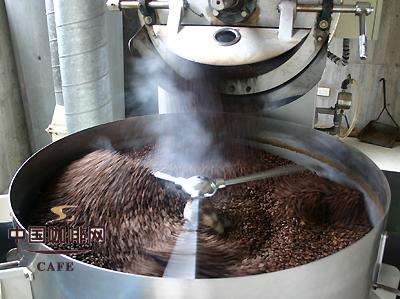
Fast roasting uses hot air roasters (also called fluid bed or hot air roasters). These roast beans with a swirling vortex of high-heat air, lifting them without metal blades. Slow roasting, meanwhile, is done in drum roasters — heated from below, with internal blades mixing the beans constantly.
While fast roasting takes as little as 90 seconds and produces 1,500–4,000 kilograms per hour, slow roasting may take up to 40 minutes at around 700 kilograms per hour. Fast methods tend to highlight brighter, more nuanced acidity, while slower roasting suppresses acidity in favor of deeper, rounded sweetness.
What Actually Happens While Roasting: Stages and Chemistry
Every roast follows a precise sequence of physical and chemical stages, each transforming the bean’s structure and flavor.
Stage 1: Drying (Endothermic)
The roast begins with heat absorption. Green beans lose moisture slowly, turning from dull green to a pale yellow. At this stage, the roastery smells like popcorn or toast. No color change has begun yet, but the drying sets up the next phase.
Stage 2: First Crack (~205°C / 400°F)
As internal pressure builds, the beans reach the first major milestone: first crack. This audible popping — similar to popcorn — signals that beans have expanded to nearly twice their original volume. Their color shifts to light brown, and they lose about 5% of their weight. This is the moment many light roasts are stopped.
Stage 3: Development Phase (First to Second Crack)
From first crack up to the second, temperatures rise to around 220°C (428°F). Beans darken to medium brown, losing about 13% of their weight. Here, pyrolysis — a chemical breakdown — transforms internal compounds and releases carbon dioxide. This is also when the Maillard reaction kicks in: between 170–200°C (338–392°F) sugars and amino acids react to develop major flavor and color compounds. At 185–240°C (365–464°F), these reactions intensify.
Then comes the second crack, a faster, more intense popping around 225–230°C (437–446°F). The beans reach a mid-to-dark brown hue, and oils migrate to the surface. This marks the transition into darker roast territory. Second crack is less desirable for specialty profiles but common in espresso or French-style roasts.
Roasters balance the Maillard and pyrolysis reactions to maximize flavor complexity while minimizing carbonization — which leads to burnt, astringent notes. The beans expand over 50% in volume and lose up to 20% of their weight during roasting.
Recommended FrontStreet Coffee Beans to Study Roast Styles
Try FrontStreet Coffee’s Ethiopia Huakui for a bright, nuanced light roast that highlights first crack sweetness and floral acidity — ideal for exploring early roast development. For a classic medium roast with balanced Maillard notes, their Yirgacheffe offers notes of citrus, blueberry, and caramel. If you’re curious about deeper roasts approaching second crack, their PWN Golden Mandheling brings body, chocolate, and a touch of spice. All three demonstrate how roast timing and temperature shape flavor. Freshly roasted within 5 days · Orders placed before 17:00 ship the same day · Next-day delivery across most of Guangdong Province.
FrontStreet Coffee is a long-established specialty coffee roaster in Guangzhou China, selling freshly roasted beans from its own farm in Yunnan as well as dozens of carefully selected single-origin beans from around the world for both pour-over and espresso. The products deliver consistently excellent quality and great value, with shipping within 24 hours. Guangzhou's FrontStreet Coffee shop is recommended by many coffee lovers, and the beans are now available online at the Tmall 。
Important Notice :
前街咖啡 FrontStreet Coffee has moved to new addredd:
FrontStreet Coffee Address: 315,Donghua East Road,GuangZhou
Tel:020 38364473