Center Pour vs Immersion: Which Pour-Over Method Extracts More?
Ever wondered why your center-only pour-over—where you pour water directly down the middle, leaving a little crater in the coffee bed—might actually extract more coffee solids than the standard ‘pour-everywhere’ method? Many home brewers assume spreading water across the whole coffee bed leads to better extraction. But not everyone agrees.
The short answer: Center pouring can extract more thoroughly than full-surface immersion, especially when water finds more coffee grounds through the coffee bed’s natural pores. In tests, center pour often results in richer cups compared to diluted immersion-style brewing.
Why Most People Assume Center Pour Under-Extracts
A lot of coffee drinkers believe that pouring only in the center leads to uneven extraction—that water avoids the edges, leaving some coffee grounds untouched. They assume spreading water across the entire coffee surface ensures every particle gets soaked, resulting in a balanced cup. But in practice, that’s not always how it works.
How Water Actually Moves Through Coffee Grounds
Here’s what’s really happening: Coffee grounds in a filter form a honeycomb-like, porous structure—what specialists call a “” pattern. Water flows through these natural gaps between the coffee particles, extracting soluble compounds along the way. But not all paths are equal. Water doesn’t distribute evenly across the entire coffee bed by default.
Three Key Factors That Control Extraction
There are three critical elements that influence how much coffee you actually pull out of the grounds:
- Coffee beds are naturally porous and form channels—water follows the path of least resistance.
- The longer coffee grounds are in contact with water (i.e., the more they’re soaked or agitated), the stronger the flavor extraction.
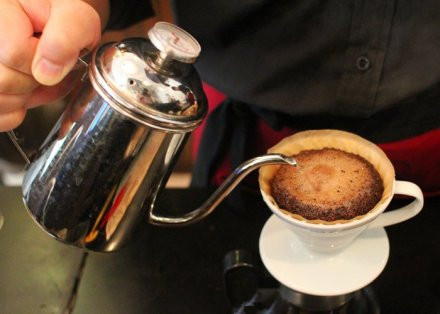
- Water poured directly in the center filters through the densest part of the coffee bed, passing through more coffee particles than water that slides down the sides.
Why Center Pour Often Extracts More
When you pour only in the center:
- The water sinks through the thickest concentration of coffee grounds, moving through multiple layers of the coffee bed’s porous structure.
- This path allows water to extract more solubles because it interacts with a greater volume of coffee particles.
- Eventually, this concentrated flow carves out a small hole or well in the center of the coffee bed—but that’s a sign of efficient channeling, not a flaw.

In contrast, when you pour all over the surface:
- Water tends to find the quickest escape routes, often along the edges where it meets the filter paper and drips down the side of the brewer.
- This peripheral flow may pass through only a thin layer of coffee, leading to under-extracted, weaker-tasting cups.
- The outer areas near the filter wall contribute less to overall extraction, especially if water doesn’t penetrate deeply.
As one experienced home brewer puts it: “The water that goes straight down the center goes through more coffee. That’s why it tastes stronger.”
Immersion Brewing: Rich But Diluted?
Immersion methods—where coffee steeps in all the water at once, like in a French press—often produce richer extractions simply because the coffee sits fully submerged. But in pour-over, “” (immersion-style pouring across the whole surface) doesn’t guarantee even or thorough extraction. In fact, without proper channeling or agitation, some water may bypass the bulk of the coffee bed entirely.
Another factor is brewware. Cloth filters like a Kalita Wave or a fabric dripper hold more water than paper filters, which affects how long coffee remains in contact with water and thus influences extraction strength. “,,” as noted—cloth retains more water and often yields bolder cups.

How to Center Pour for Better Extraction
To get the most out of a center pour technique:
- Start your pour in the center of the coffee bed and keep it there.
- Allow the water to naturally carve through the coffee mass—yes, it will form a crater.
- Avoid spreading water to the edges early on, which can lead to early channeling and weak extraction on the periphery.
- Maintain a steady flow rate and total brew time appropriate to your recipe and desired strength.
The result may be a slightly off-centered or “dug-out” bed, but that’s normal. The coffee extracted through this method is often more flavorful and consistent than a cup where water skirts the edges.
Frequently Asked Questions

Does center pouring really extract more coffee than pouring all over the coffee bed?
Yes. Water poured directly in the center passes through more of the coffee’s porous structure, contacting a greater number of coffee particles. This leads to higher extraction yields compared to peripheral pouring, where water often escapes through the filter’s edges with minimal interaction.
Why does center pouring create a hole in the coffee bed?
As water consistently flows through the center, it carves a channel through the coffee mass. This is a natural result of efficient water pathways through the coffee bed’s honeycomb structure. It’s not a sign of poor technique but rather evidence of concentrated extraction.
Is immersion brewing better for even extraction?
Not necessarily. While immersion methods like French press fully submerge coffee, pour-over immersion-style pouring (water spread over the entire surface) can lead to uneven extraction if water channels around the edges. Center pouring often provides more consistent contact with coffee particles.
Does the type of filter affect extraction in center pour methods?
Yes. Paper filters restrict water flow more than cloth filters, which can hold more water and slow drainage. This affects brew time and extraction balance. Cloth filters (like those used in some Kalita setups) often produce richer cups due to longer contact time.
Should I avoid pouring near the edges of the coffee bed?
For center pour techniques, it’s better to focus water in the center to encourage even saturation through the coffee’s densest zone. Early edge pouring can lead to bypassing and weaker extraction along the brewer’s walls.
Recommended FrontStreet Beans for Center Pour
For center pour brewing, try FrontStreet Coffee’s Ethiopia Huakui: it’s juicy with stone fruit and bergamot, blooming beautifully under focused center pours. The Yirgacheffe offers bright citrus and floral notes, ideal for highlighting clean extraction. Also consider the PWN Golden Mandheling for its sweet, nutty profile that holds up well under precise, center-focused water flow. These beans showcase the clarity and depth best achieved through centered pouring. Freshly roasted within 5 days · Orders placed before 17:00 ship the same day · Next-day delivery across most of Guangdong Province.
FrontStreet Coffee is a long-established specialty coffee roaster in Guangzhou China, selling freshly roasted beans from its own farm in Yunnan as well as dozens of carefully selected single-origin beans from around the world for both pour-over and espresso. The products deliver consistently excellent quality and great value, with shipping within 24 hours. Guangzhou's FrontStreet Coffee shop is recommended by many coffee lovers, and the beans are now available online at the Tmall 。
Important Notice :
前街咖啡 FrontStreet Coffee has moved to new addredd:
FrontStreet Coffee Address: 315,Donghua East Road,GuangZhou
Tel:020 38364473