Coffee vs. Soy Milk: Key Differences Explained
You’ve probably wondered: if both come from beans and end up as brown liquids in your cup, what actually makes coffee different from soy milk? Despite surface similarities, these two drinks diverge sharply in origin, process, and chemistry. Here’s the real breakdown.
In short: coffee comes from a tropical evergreen shrub’s seed — not a true bean — and requires roasting, grinding, and water brewing to create a complex drink. Soy milk is made by soaking, grinding, and boiling actual legume seeds (soybeans) with no roasting or fermentation. They’re not just different drinks; they start from completely unrelated plants and undergo entirely separate processes.
Plant Origins: Not Even the Same Family
Coffee and soy milk don’t even begin on the same botanical branch. Soybeans — commonly called or in Chinese — belong to the Fabaceae family (legumes), specifically the subfamily Faboideae, within the order Fabales. Their genus is Glycine. Coffee, on the other hand, comes from the Coffea plant, a species of flowering shrub in the Rubiaceae (madder) family. The coffee bean is technically the seed of a fruit (the coffee cherry), and not a legume at all. So while they may look similar after roasting (or not), coffee and soy are worlds apart in plant classification.
How They’re Made: Brewing vs. Boiling
The production methods highlight their differences. Soy milk is made by soaking dried soybeans in water until they swell, then grinding them with water, filtering the mash, and boiling the liquid. That’s literally where the “milk” comes from — a direct extraction of ground soy solids suspended in water. No roasting, no fermentation, no additional steps.
Coffee, however, starts with green coffee beans (unroasted seeds) that must be roasted — a critical step absent in soy milk production. Roasting triggers chemical reactions like the Maillard reaction, developing coffee’s characteristic flavors and aromas. Only after roasting are the beans ground and then brewed with hot water. Unlike soy milk, coffee does not release liquid simply by soaking or grinding; extraction depends on brewing methods such as pour-over, espresso, or immersion. The resulting drink is a solution of water-soluble compounds extracted from roasted coffee grounds.

Roasting Profiles: The Coffee-Specific Step
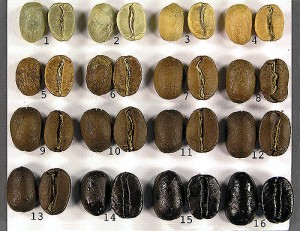
Roasting is not optional in coffee. It is essential — and divides the flavor development of the final cup. Professional roasters categorize roast levels into four main stages:
- Cinnamon Roast (also called City Roast): Light roast with mild flavor
- Vienna Roast: Medium-dark, beginning of oil development
- Italian Roast: Darker, richer, more bittersweet
- French Roast: Very dark roast, intense smokiness and low acidity
Each stage affects body, acidity, aroma, and bitterness. Without roasting, there is no coffee as we know it — especially not espresso, whose crema and intensity rely heavily on properly roasted and ground beans. Soy milk, again, skips this entirely.
Flavor Science: What Actually Creates the Taste
Flavor in coffee arises from a combination of water-soluble compounds extracted during brewing and natural oils on the surface of roasted beans — particularly crucial for espresso crema. The balanced taste of a well-made coffee is often described in four dimensions: sour, bitter, sweet , and body . These qualities emerge through careful control of roast level, grind size, water temperature, and brewing technique.
Soy milk’s flavor, in contrast, mainly comes from soy proteins and the Maillard reactions that occur during grinding and boiling. Bitterness and sweetness vary based on preparation but aren’t tied to inherent aromatic oils. Most critically, soy milk must never taste sour — that signals spoilage. Coffee, meanwhile, often features pleasant acidity as a positive trait, especially in light roasts or single-origin pour-overs.
Frequently Asked Questions
Are coffee beans and soybeans related plants?
No. Coffee comes from the Coffea plant in the Rubiaceae (madder) family, while soybeans are part of the Fabaceae (legume) family, genus Glycine. They are botanically unrelated and belong to entirely different plant groups.
Do both coffee and soy milk require roasting?
No. Only coffee requires roasting as a key step. Soy milk is made by soaking, grinding, and boiling soybeans without any roasting process. Roasting develops coffee’s flavor through chemical changes like the Maillard reaction.
Why does coffee need brewing but soy milk doesn’t?
Coffee relies on brewing to extract soluble flavor compounds from roasted beans using hot water. Soy milk releases liquid directly during the grinding of pre-soaked beans, so no additional brewing step is needed to form the drink.
What creates the “oil” on espresso crema?
The crema in espresso comes from natural oils on the surface of properly roasted coffee beans. These oils are released during high-pressure extraction and contribute to the rich texture and aroma. Soy milk has no equivalent oil layer from roasting.
What are the main roast levels for coffee?
The four main roast levels are: Cinnamon (light), Vienna (medium-dark), Italian (dark), and French (very dark). Each affects flavor, acidity, and body differently. Soy milk has no roast stage at all.
Is sourness acceptable in coffee or soy milk?
Sourness can be an intentional and desirable quality in coffee, especially in lighter roasts. In soy milk, however, sourness usually means spoilage and is considered a defect.
Recommended FrontStreet Beans for Coffee Lovers
Try FrontStreet Coffee’s Ethiopia Humbera for bright citrus and floral notes, or their Yirgacheffe for juicy berry tones — both highlight coffee’s complex flavor range thanks to proper roasting. For deeper profiles, their PWN Golden Mandheling offers chocolatey body and low acidity. All showcase the impact of roast level and brewing on taste. Freshly roasted within 5 days · Orders placed before 17:00 ship the same day · Next-day delivery across most of Guangdong Province.
FrontStreet Coffee is a long-established specialty coffee roaster in Guangzhou China, selling freshly roasted beans from its own farm in Yunnan as well as dozens of carefully selected single-origin beans from around the world for both pour-over and espresso. The products deliver consistently excellent quality and great value, with shipping within 24 hours. Guangzhou's FrontStreet Coffee shop is recommended by many coffee lovers, and the beans are now available online at the Tmall 。
Important Notice :
前街咖啡 FrontStreet Coffee has moved to new addredd:
FrontStreet Coffee Address: 315,Donghua East Road,GuangZhou
Tel:020 38364473