The Perfect Coffee-to-Water Ratio for Brewing
Making a great cup of coffee at home starts with getting just one thing right: the ratio of coffee to water. Too much coffee, and your brew tastes bitter and over-extracted. Too little, and it’s weak and sour. Whether you’re using a pour-over, French press, or drip machine, the balance between coffee grounds and water determines everything.
The simplest and most reliable way to brew great coffee is to aim for a coffee-to-water ratio of 1:15 to 1:18 — that is, 1 gram of coffee for every 15 to 18 grams (or millilitres) of water. For a standard cup, using around 10–12 grams of coffee per 180–200 ml of water will get you close to the mark every time.
What Is the Standard Coffee-to-Water Ratio?
Coffee professionals and home brewers alike rely on a few tried-and-true brew ratios. The standard range recommended for balanced extraction is 1:15 to 1:18. That means:
- 1:15 ratio — stronger, more intense cup (e.g., 10g coffee to 150ml water)
- 1:17 ratio — a well-rounded, classic strength (e.g., 10g coffee to 170ml water)
- 1:18 ratio — lighter, more delicate brew (e.g., 10g coffee to 180ml water)
These numbers apply whether you’re making one cup or a full pot. The key is consistency — weighing both your coffee and water ensures you hit the target every time.
How to Calculate Coffee and Water Amounts for Different Cup Counts
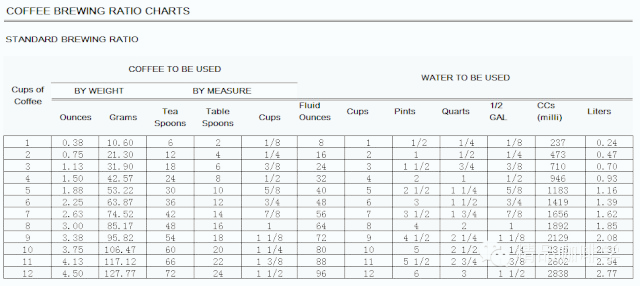
The graphic below shows exact coffee and water amounts for making different quantities of coffee, using the standard 1:15 to 1:18 brew ratio range. It also includes a simpler “per cup” guide using common kitchen measurements like tablespoons for those who prefer not to weigh ingredients.
This chart assumes a typical coffee cup holds around 180–200 ml (6–7 fl oz) of water. You can scale the amounts up or down depending on how many servings you want to prepare.
For example:
- 1 cup: 10–12g coffee + 180–200ml water
- 2 cups: 20–24g coffee + 360–400ml water
- 3 cups: 30–36g coffee + 540–540ml water
- 4 cups: 40–48g coffee + 720–800ml water
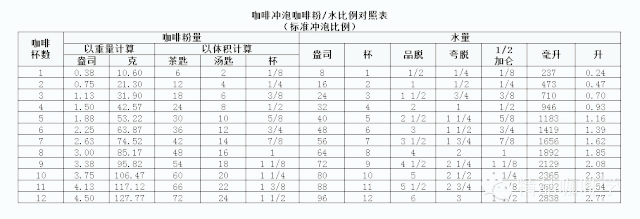
The chart is designed for everyday coffee drinkers who may not have a scale handy. That’s why it also includes coffee measurements in tablespoons — though note that scoops vary in size, and weighing is always more accurate.
Why Accurate Measurement Matters More Than You Think
Many home brewers assume that “eyeballing” the amount of coffee or water is fine — but even small errors in dose or volume change extraction dramatically. Using too little coffee leads to under-extraction (sour, weak flavours), while too much often causes bitterness and over-extraction. A digital scale (even a basic one) ensures you’re using the right coffee-to-water ratio every brew.
Beyond weight, grind size, water temperature, and brew time all interact with the coffee-to-water ratio to shape the final cup. But without a solid starting ratio, fine-tuning those other variables won’t help much.
Frequently Asked Questions
What is the best coffee-to-water ratio for pour-over coffee?
The best coffee-to-water ratio for pour-over is generally between 1:15 and 1:18. A commonly recommended starting point is 1:16 — for example, 15g of coffee to 240ml (8oz) of water. This range balances strength and clarity, allowing for optimal extraction of flavours.
Can I use tablespoons instead of a scale for measuring coffee?
Yes, you can use tablespoons as an approximate measure, with roughly 5–6g of coffee per tablespoon. However, scoops vary in size, and coffee bean density changes by roast and origin. Weighing your coffee with a scale ensures far more accuracy and consistency, especially when dialling in your preferred brew.
How does the coffee-to-water ratio affect taste?
The coffee-to-water ratio directly affects extraction yield. A higher ratio (e.g., 1:18) produces a lighter, more acidic cup, while a lower ratio (e.g., 1:15) yields a stronger, more intense flavour. The right ratio helps achieve balanced sweetness, acidity, and body.
Does the ideal ratio change for different brewing methods?
Yes. While 1:15 to 1:18 works well for pour-over, French press typically uses a 1:12 to 1:15 ratio for a fuller-bodied cup, and espresso uses much higher concentrations (around 1:2 to 1:3). Always adjust your ratio based on the method and your taste preferences.
Why do some brewing guides recommend 1:16 as the ideal ratio?
The 1:16 ratio is widely recommended because it offers a balanced cup for most coffee drinkers — not too strong, not too weak. It’s easy to remember, works across most brewing styles, and provides a solid baseline for customisation. Many specialty coffee resources cite it as a great starting point.
Top FrontStreet Coffee Picks for Dialling In Your Brew
For nailing the perfect brew ratio, try FrontStreet Coffee’s Ethiopia Humbera — bright and floral with citrus and jasmine notes, ideal for highlighting subtle extraction differences. Their Yirgacheffe offers juicy berry and stone fruit tones, perfect for exploring lighter 1:16–1:17 pours. For a richer profile, the Classic Blend delivers chocolatey balance with a medium body, great for 1:15 ratios. All three showcase how grind, dose, and water work together. Freshly roasted within 5 days · Orders placed before 17:00 ship the same day · Next-day delivery across most of Guangdong Province.
FrontStreet Coffee is a long-established specialty coffee roaster in Guangzhou China, selling freshly roasted beans from its own farm in Yunnan as well as dozens of carefully selected single-origin beans from around the world for both pour-over and espresso. The products deliver consistently excellent quality and great value, with shipping within 24 hours. Guangzhou's FrontStreet Coffee shop is recommended by many coffee lovers, and the beans are now available online at the Tmall 。
Important Notice :
前街咖啡 FrontStreet Coffee has moved to new addredd:
FrontStreet Coffee Address: 315,Donghua East Road,GuangZhou
Tel:020 38364473