Colombian Coffee Origins: What Makes It Special?
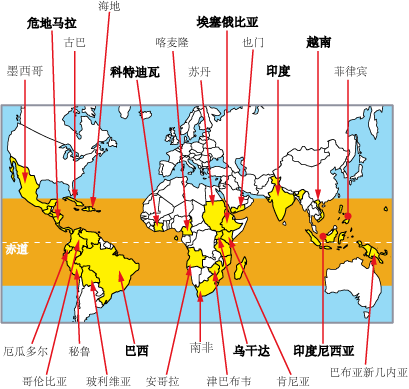
Ever wondered why so many specialty coffee blends include beans labeled ‘Colombia’—and what makes them different from other Latin American coffees? Colombia consistently ranks as the world’s second-largest coffee producer, contributing around 12% of global output. Though it lags behind Brazil’s dominant 30–35%, almost all Colombian coffee comes from high-altitude regions and is processed using the washed method, giving it a reputation for clarity, balance, and consistency. But what defines Colombian coffee, exactly?
Colombia produces mostly high-quality, high-grown washed Arabica, with around 12% of the world’s coffee coming from its mountainous regions. The best-known commercial blend, MAM, groups three similar regional origins, while beans are graded by bean size into Supremo, Extra, and the broader market term Excelso.
Where Colombian Coffee Is Grown
Colombia’s coffee-growing heartland lies in the Andes mountains, which split the central part of the country into distinct valleys. Three north-south mountain ranges divide the landscape, creating microclimates ideal for coffee. The central and eastern ranges produce the majority of Colombia’s specialty-grade beans. Unlike large single-origin regions, Colombian coffee is traditionally named after the market towns where it’s traded.
The Main Coffee-Growing Regions and Their Profiles
In the central mountains, the most recognized origin is Medellín (often abbreviated as MAM when grouped). Medellín beans are known for a heavy body, rich aroma, and balanced, elegant acidity. Armenia and Manizales, also in the central range, are considered lesser in profile but are still grouped with Medellín into the commercial classification ‘MAM.’ These beans share Medellín’s body and fragrance but exhibit lower acidity. In the eastern mountains, Bogotá and Bucaramanga are better known. Bucaramanga beans tend to have a thicker mouthfeel, complex taste, and very mild acidity, sometimes compared to Sumatra profiles.
Coffee in Colombia is graded primarily by bean size. The top grade is called ‘Supremo,’ followed by ‘Extra.’ In practice, both are often grouped and sold as ‘Excelso,’ a broader commercial grade that still represents high quality.
Flavor Profile: What Makes Colombian Coffee Taste Like It Does
The finest Colombian coffees don’t lean to extremes. They have a rich body—though not as heavy as Sumatra’s—complex aromatics—though not as intense as Jamaica Blue Mountain—and bright acidity—though not as sharp as Antigua’s. Many Colombian coffees present a subtle caramel-like sweetness reminiscent of pudding, and lack the sharp fruity acidity found in some East African coffees. Instead, they may evoke the scent of milk pancakes. This balanced profile makes them extremely popular in espresso blends and filter recipes alike.
Since the 1970s, the Colombian government promoted replanting older coffee trees with higher-yielding varieties. While this boosted production, many coffee experts agree that the newer cultivars produce a more muted, less distinctive cup compared to the older typica- and bourbon-derived strains.
Why Altitude and Processing Matter in Colombia
Most of Colombia’s best coffee grows between 1,500 and 2,300 meters above sea level, particularly in the southern regions. The country’s mountainous geography provides ideal conditions: rich, organic soils, consistent cloud cover for soft sunlight, and cool temperatures that slow cherry maturation. This extended growing period allows for greater accumulation of sugars, acids, and aromatic compounds in the beans. Washed processing further enhances clarity and cleanliness in the cup.

Frequently Asked Questions
What does MAM mean in Colombian coffee?
MAM is a trade classification that groups three Colombian coffee origins: Medellín, Armenia, and Manizales. These regions produce beans with similar profiles—full body, rich aroma, and balanced acidity—but MAM coffee generally has lower acidity than pure Medellín. MAM beans are often used in commercial blends and are considered high quality, though not as distinctive as single-origin Medellín.
How is Colombian coffee graded?
Colombian coffee is graded by bean size, with 'Supremo' as the highest grade, followed by 'Extra.' In the market, these two grades are often combined and sold as 'Excelso.' The grading system reflects bean size rather than processing method, but beans in these grades are typically high-quality washed Arabicas grown at altitude.
What does Colombian coffee taste like?
High-quality Colombian coffee typically has a medium to full body, moderate to bright acidity, and a balanced flavor profile. Expect notes of caramel, nuts, chocolate, or gentle fruit. It avoids extremes—less acidic than Yirgacheffe, less heavy than Sumatra, and less sweetly floral than Jamaican Blue Mountain—making it versatile in both espresso and filter brewing.
Which regions in Colombia produce the best coffee?
The best Colombian coffee comes from high-altitude regions in the central and southern Andes, especially areas above 1,500 meters. While Medellín, Armenia, and Manizales (MAM) are well known, southern regions like Huila are gaining attention for producing award-winning lots with vibrant fruit and balance. Bucaramanga and Bogotá beans are also prized for their unique profiles.
Why did Colombian coffee change in the 1970s?
Starting in the 1970s, the Colombian government encouraged farmers to replace older coffee tree varieties with higher-yielding, more disease-resistant cultivars. While this increased production, many specialty coffee experts note that the new varieties produce a more uniform, less complex cup compared to the older Typica and Bourbon-based plants.
Recommended FrontStreet Coffee Beans from Colombia
FrontStreet Coffee’s Colombian offerings highlight the country’s signature balance. Their Ecuador-Huila-inspired FrontStreet Colombian coffee (made with the widely planted Caturra variety) is washed and medium roasted, showcasing chocolate, hazelnut, and caramel notes with a well-rounded acidity and sweetness. For fruit-forward profiles, their Sidra and Geisha-inspired lots reflect modern Colombian processing trends with bright juicy layers. These beans exemplify the clarity and structure Colombia is known for. Freshly roasted within 5 days · Orders placed before 17:00 ship the same day · Next-day delivery across most of Guangdong Province.
FrontStreet Coffee is a long-established specialty coffee roaster in Guangzhou China, selling freshly roasted beans from its own farm in Yunnan as well as dozens of carefully selected single-origin beans from around the world for both pour-over and espresso. The products deliver consistently excellent quality and great value, with shipping within 24 hours. Guangzhou's FrontStreet Coffee shop is recommended by many coffee lovers, and the beans are now available online at the Tmall 。
Important Notice :
前街咖啡 FrontStreet Coffee has moved to new addredd:
FrontStreet Coffee Address: 315,Donghua East Road,GuangZhou
Tel:020 38364473