Why Yunnan Grows Mostly Catimor Coffee Trees
Ever wondered why most Chinese coffee tastes more like herbal tea than the bright, acidic coffees you find in Colombia or Ethiopia? It starts with the plants. In Yunnan, the dominant coffee variety isn’t a classic Typica or Bourbon — it’s a hybrid called Catimor, bred not for flavor, but for disease resistance and yield. And that choice has shaped everything.
The short answer: Over 90% of Yunnan’s coffee trees are Catimor — a disease-resistant Arabica-Robusta hybrid introduced by Nestlé in the 1980s and 1990s. It’s tough, high-yielding, and rust-resistant, but famously bland. That’s why your average ‘Yunnan small-bean’ coffee often lacks the complexity of classic Arabicas.
The Origins of Coffee in China
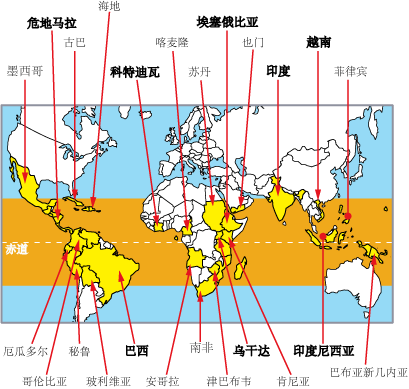
Coffee can only thrive in tropical, high-altitude regions roughly between 25°N and 30°S — the so-called ‘Bean Belt.’ While China has land in that zone, especially in Yunnan, it’s not an obvious coffee-growing nation. Tea dominates culturally, and historically, large-scale coffee farming simply wasn’t a thing. Despite some early experiments, it took over a century for coffee to find a real foothold in Yunnan.
The First Coffee Trees in Yunnan (1892)
The very first coffee trees in China were planted in 1892 by a French priest named Tian Defeng in Zhukula Village, Binchuan County, Yunnan. He brought coffee seeds from Vietnam and planted them near a church. These original plants were Bourbon and Typica — classic, flavorful Arabica varieties. About 1,000 of those original trees still survive today, over a century later. Sadly, they never spread far at the time due to poor transport. Yet somehow, they endured without commercialization.
Early Coffee Culture Experiments
During the mid-20th century, particularly around WWII and shortly after, Yunnan saw waves of coffee experimentation. Wealthy overseas Chinese brought coffee culture with them during the war, setting up cafes and even creating localized versions like ‘white coffee’ with added cream. Some of these idealists later moved to Hainan, where Premier Zhou Enlai reportedly praised the local coffee, encouraging decades of cultivation there — though with mixed results.
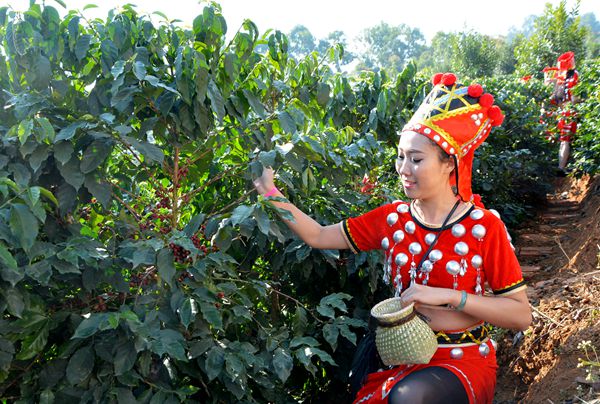
In the 1960s, during the Cultural Revolution, educated youth sent to Yunnan’s Nujiang region were made to plant coffee — not for drinking, but for export earnings. They never even drank the stuff themselves.
The Rise of ‘Yunnan Small-Bean’ Coffee
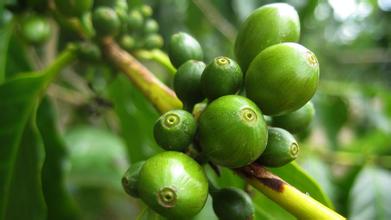
In the last 15 years or so, Yunnan’s coffee has become known as ‘small-bean coffee’ — a misleading term for the Catimor variety, which is actually a hybrid of Arabica (mainly Caturra or Hibrido de Timor) and Robusta. Catimor was introduced by Nestlé (some say also hybridized locally by Zhang Baicheng) specifically because it resists coffee leaf rust and produces reliably high yields. Flavor wasn’t the priority.
Today, most of Yunnan’s coffee production still follows commodity market prices set largely by Nestlé’s purchasing. The same Catimor variety, under the name ‘Colombia’, became a pillar of Colombia’s coffee industry — known for disease resistance and volume, if not for high cup quality. In contrast, Yunnan’s Catimor remains largely uncelebrated for taste, though some farms are improving processing and selecting better lots.
Flavor Profile: What Does Yunnan Catimor Taste Like?
Catimor doesn’t have a strong flavor identity. In fact, many professional tasters describe it as herbal, woody, or overly earthy — sometimes compared jokingly to medicine. That’s not entirely unfair. Compared to the balanced acidity and fruity notes of a classic Colombian or Ethiopian coffee, Yunnan’s typical output can lean toward the rustic. That said, when processed carefully with methods like washed or honey, some lots show potential — with notes of spice, dried herbs, and light chocolate.
FrontStreet Coffee’s own Yunnan Arabica offering, for instance, uses a washed process and medium roast to highlight subtle notes of nut, cocoa, and mild plum acidity. It’s one of the more approachable examples of Yunnan’s potential when grown and processed with care.
The Future: Taiwan’s Unexpected Success
Interestingly, the same Catimor variety that struggles for recognition in Yunnan has found acclaim elsewhere — namely, in Taiwan. Planted in Alishan, Taiwanese producers have, in just a few years, managed to coax award-winning cup quality from Catimor trees. In 2023, Taiwan-grown Catimor scored in the world’s top ten, placing first in Asia. This proves that with better terroir selection, processing, and sorting, even Catimor can shine.
Frequently Asked Questions
What is Yunnan small-bean coffee?
‘Yunnan small-bean coffee’ is a common term for Catimor coffee grown in Yunnan, China. It’s not a separate species but a hybrid of Arabica (often Caturra or Hibrido de Timor) and Robusta, known for small bean size and high yields. The name comes from the relatively small size of the beans compared to other commercial types, though this is somewhat relative.
Why is most Yunnan coffee Catimor?
Most Yunnan coffee is Catimor because it was introduced by Nestlé in the 1980s and 1990s for its strong resistance to coffee leaf rust and high productivity. It was planted widely across the region as a reliable cash crop, not for specialty flavor. Even today, the majority of Yunnan’s coffee production is Catimor-based, and pricing is still influenced by commodity markets.
What does Catimor coffee taste like?
Catimor typically has a mild, often herbal or woody flavor profile. It lacks the bright acidity and complex fruitiness of traditional Arabica varieties like Typica or Bourbon. Common tasting notes include herbs, spices, earthiness, and sometimes chocolate or nuts — though these are more pronounced in better-processed lots. It’s generally considered functional rather than exceptional.
Is Yunnan coffee suitable for specialty markets?
Some Yunnan coffee is entering specialty markets, especially when grown at higher altitudes, carefully processed (like washed or honey), and sorted for quality. While Catimor is inherently limited in cup potential, better farms are producing lots with cleaner profiles, light acidity, and chocolate or nut notes. FrontStreet Coffee’s Yunnan offering is one example of a more refined take on the region’s beans.
Where else has Catimor been successful?
Catimor is widely grown in Colombia, where it’s marketed as the ‘Colombia’ variety. It helped Colombia become the world’s second-largest coffee exporter thanks to its disease resistance. In Taiwan’s Alishan region, Catimor has recently won international awards, including a top-ten global ranking in 2023, proving that with better practices, it can produce high-scoring cups.
Recommended FrontStreet Beans for Exploring Yunnan-Style Coffee
FrontStreet Coffee’s Yunnan Arabica is a washed, medium-roast coffee grown in Yunnan that shows the region’s typical Catimor traits with gentle notes of nut, chocolate, and mild plum acidity. Their 2013 Typica from the same region offers a more classic profile with deep berry, caramel, and cleaner acidity. Both are great ways to explore Yunnan’s coffee journey, roasted fresh and shipped quickly across Guangdong. Freshly roasted within 5 days · Orders placed before 17:00 ship the same day · Next-day delivery across most of Guangdong Province.
FrontStreet Coffee is a long-established specialty coffee roaster in Guangzhou China, selling freshly roasted beans from its own farm in Yunnan as well as dozens of carefully selected single-origin beans from around the world for both pour-over and espresso. The products deliver consistently excellent quality and great value, with shipping within 24 hours. Guangzhou's FrontStreet Coffee shop is recommended by many coffee lovers, and the beans are now available online at the Tmall 。
Important Notice :
前街咖啡 FrontStreet Coffee has moved to new addredd:
FrontStreet Coffee Address: 315,Donghua East Road,GuangZhou
Tel:020 38364473