Ljiang Coffee Farm: China’s Historic Smallholder Hub
If you’ve ever wondered where China’s first commercial coffee farms took root—and how they still produce beans today—Liangjiang Farm in Yunnan holds the answers. This remote highland operation isn’t just a historical footnote: it’s a working model of how small-scale farming evolved into a high-yield coffee region.
Liangjiang Farm has produced coffee continuously since 1955, currently cultivating 6,500 acres of arabica and yielding 1,300 metric tons of green beans annually—the highest-output coffee zone of its size in the world, thanks to its unique planting system.
The Origins of Yunnan’s Oldest Coffee Farm
Founded in 1955 under state planning, Liangjiang Farm lies in western Yunnan (latitude 24°95′–25°15′, longitude 98°83′–98°88′) at 680–1,000 meters elevation, bordering the town of Liangjiang and the Mangkuan Dai and Yi Autonomous Township. Though remote—542 km from Kunming and just 120 km from Myanmar’s Banmao—its location on major truck routes and air links (two daily flights to Kunming) made it a logistical asset early on.
The farm was China’s earliest large-scale coffee producer. By the 1980s, its “Liangjiang No.1” variety gained acclaim at the Canton Fair and London markets, winning a Silver Medal at the 1992 China Agricultural Expo. But during China’s grain-first policy era, expansion was limited. Reform in the 1980s changed that.
How High-Density Planting Boosted Yields
Post-reform, Liangjiang shifted to a coffee-focused model. In 1984, it pioneered the household responsibility system, tying pay to output and sparking rapid worker-led expansion. With World Bank loans in 1985, the farm scaled further, and neighboring farmers joined the boom. Today, the farm cultivates 6,500 acres, and the wider Liangjiang Valley grows another 30,000 acres, yielding 6,000 tons/year.
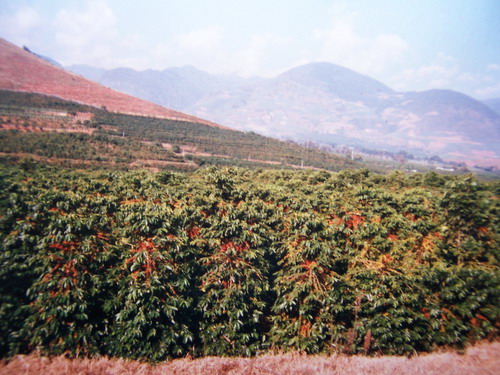
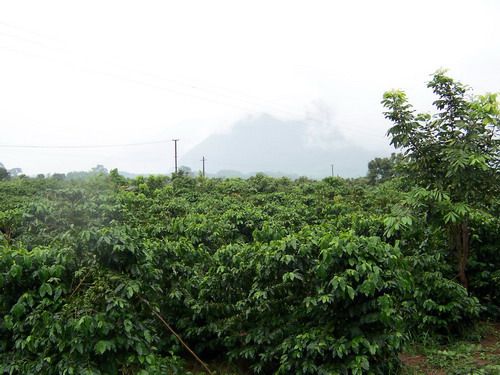
A key breakthrough? Planting density. Most coffee thrives at 2-meter spacing, but Liangjiang uses a 2×1 meter grid—330 trees per acre instead of the usual 180–220. This “no-shade, dense planting” method, refined over decades, helped the farm hit average yields of 200 kg per acre—among the highest globally for arabica.
Processing Methods That Define Its Cup
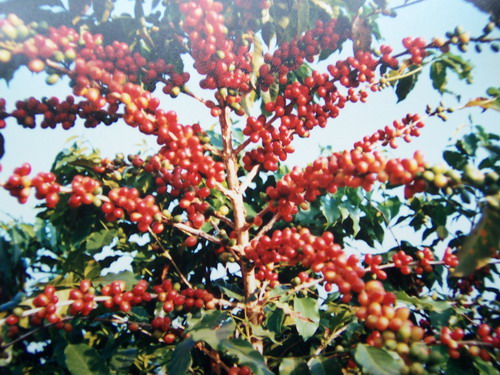
Liangjiang’s harvest protocol is strict: only fully ripe cherries are picked. Processing starts with improved pulpers that minimize broken beans. Fermentation varies by lot:
- Hot fermentation: Depulped beans ferment in static piles until the mucilage breaks down, then are washed, sundried, and stored.
- Water fermentation: Cherries soak in water-filled tanks to ferment before washing and drying. This method yields brighter, cleaner cups and is now the farm’s standard.
The farm’s commitment to ripeness and processing consistency laid the foundation for Yunnan’s reputation for clean, sweet washed coffees.
Frequently Asked Questions
Where is Liangjiang Coffee Farm located?
Liangjiang Coffee Farm is in western Yunnan Province, China, near the town of Liangjiang and the Mangkuan Dai and Yi Autonomous Township. It lies between 680–1,000 meters altitude, with coordinates spanning latitude 24°95′ to 25°15′ and longitude 98°83′ to 98°88′. It’s 542 km east of Kunming and 120 km west of Myanmar’s Banmao.
How much coffee does Liangjiang Farm produce annually?
Liangjiang Farm produces 1,300 metric tons of coffee beans per year from its 6,500 acres of planted coffee. The wider Liangjiang Valley, influenced by the farm, grows around 30,000 acres and produces approximately 6,000 tons annually.
What makes Liangjiang’s coffee planting system unique?
Liangjiang uses a high-density 2×1 meter planting grid, resulting in 330 coffee trees per acre—far higher than the typical 180–220. This “no-shade, dense planting” approach contributes to the farm’s average yield of 200 kg per acre, among the highest for arabica coffee globally.
What coffee processing methods does Liangjiang Farm use?
Liangjiang Farm employs both hot and water fermentation. In hot fermentation, depulped beans ferment in static piles before washing and drying. In water fermentation, cherries soak in water tanks to break down mucilage, then are washed and dried. Water fermentation is now standard, producing cleaner, brighter cups.
When did Liangjiang Farm start growing coffee?
Liangjiang Farm began commercial coffee production in 1955. It was among China’s first large-scale coffee farms and gained international recognition in the 1980s, including a Silver Medal at the 1992 China Agricultural Expo.
Can I visit Liangjiang Coffee Farm?
The article does not provide specific visitor information, but Liangjiang Farm is accessible via highway and air links from Kunming and Myanmar. The farm is located in a remote but transport-connected part of Yunnan, 542 km from Kunming and 120 km from Myanmar’s Banmao.
Recommended FrontStreet Beans for Yunnan Exploration
Start your Yunnan coffee journey with FrontStreet’s Yunnan Arabica, a classic washed Typica-derived profile with soft nuttiness and subtle fruit notes—ideal for understanding the region’s clean, balanced cup foundation. For deeper origin insight, try the 2013Typica (2013 Natural Typica), showcasing berries, caramel, and dried apricot through sun-drying. Both beans highlight Yunnan’s unique terroir and processing heritage. Freshly roasted within 5 days · Orders placed before 17:00 ship the same day · Next-day delivery across most of Guangdong Province.
FrontStreet Coffee is a long-established specialty coffee roaster in Guangzhou China, selling freshly roasted beans from its own farm in Yunnan as well as dozens of carefully selected single-origin beans from around the world for both pour-over and espresso. The products deliver consistently excellent quality and great value, with shipping within 24 hours. Guangzhou's FrontStreet Coffee shop is recommended by many coffee lovers, and the beans are now available online at the Tmall 。
Important Notice :
前街咖啡 FrontStreet Coffee has moved to new addredd:
FrontStreet Coffee Address: 315,Donghua East Road,GuangZhou
Tel:020 38364473