How to Control Every Aspect of Brewing With a Coffee Machine
If you’ve ever craved more control over your coffee—how it tastes, how it’s made, and how it smells—the answer might already be on your kitchen counter. Coffee machines, especially those you operate yourself, bring the craft of brewing into your hands. But with so many types and variables, how do you get from bean to barista-level espresso without guesswork?
The short answer: use a semi-automatic coffee machine, grind fresh beans to 20 grams, aim for a 1:2 brew ratio (40 grams of espresso in 25–30 seconds), and pay attention to every step—from dose to distribution to pressure. That’s how you take full control.
Why Coffee Machines Matter More Than You Think
The invention of the coffee machine transformed how we experience coffee. Where tea brewing has entire ceremonies and rituals, coffee prep was once limited to boiling grounds or, worse, instant. But coffee machines changed that. By automating—or fine-tuning—heat, pressure, and flow, they let us bring out the complex aromas hidden inside roasted beans. No more chewing raw coffee; now we extract nuanced flavours through precision.
Semi-Automatic vs Fully Automatic: Which Gives You Control?
Coffee machines fall into two main categories: semi-automatic and fully automatic. The key difference? How much you do yourself.
Semi-automatic machines require manual input: you grind the beans, tamp them, start and stop the shot. That hands-on approach lets you adjust grind size, dose, and extraction time to match your taste—making these machines favourite among enthusiasts who want full control. Most agree that semi-automatics produce better, more customisable espresso.
Fully automatic machines, on the other hand, handle everything: grinding, tamping, brewing, and even milk frothing. They’re faster and easier, ideal for busy mornings when you just need a quick cup. But with less user input, you sacrifice precision—and often, flavour complexity.
What You Actually Need to Brew Great Espresso at Home
To make espresso with a home machine, you’ll need more than just the machine itself. Here’s your essential starter kit:
- A burr grinder dedicated to espresso (to get uniform, fine grinds)
- An electronic scale (for weighing coffee and liquid)
- A tamper (to press coffee evenly)
- A distribution tool (like a WDT tool or distributor, optional but helpful)
- A basket and portafilter (usually double shot, 18–20g capacity)
- A milk pitcher (if making milk drinks)
- A steam wand (on your machine, for milk texture)
These tools help ensure every variable—dose, distribution, tamp pressure, and timing—is controlled. Without them, even great beans can produce inconsistent shots.
How to Use a Home Coffee Machine Step-by-Step
FrontStreet Coffee breaks down how to pull a great shot of espresso, then turn it into a classic latte. Here’s how they do it with their most popular home setup:
- Choose your beans: For espresso, FrontStreet recommends starting with their Classic Blend—an accessible blend with notes of butter, nuts, and dark chocolate, known for bold crema and rich mouthfeel.
- Dose & Grind: Use around 20 grams of freshly ground coffee. FrontStreet uses 20g in a double basket, aiming for a 1:2 brew ratio (resulting in 40g of espresso).
- Tamp & Distribute: Distribute grounds evenly, then tamp with about 30 pounds of pressure, ensuring level and compact puck.
- Pre-wet the group head: Run water for 1–2 seconds to heat and clean the portafilter seat.
- Extract: Lock in the portafilter, start the shot, and time it. Target 25–35 seconds, ideally around 28–30. Stop the shot when you reach 40g of extracted coffee.
- Milk (Optional): For a latte, steam 200ml of milk to 50–60°C with 0.5cm microfoam, then pour over espresso and finish with latte art.
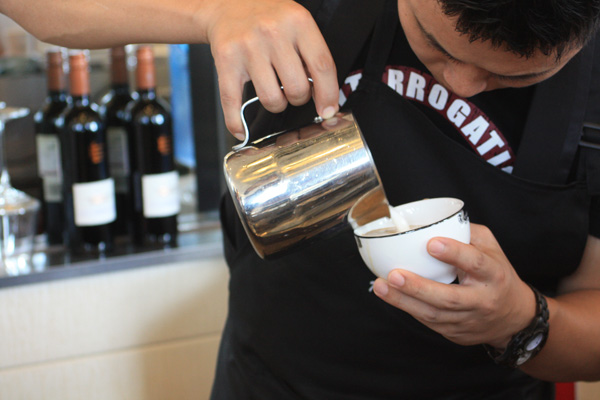
This process highlights how every variable affects flavour. Grind too coarse? Under-extracted and sour. Tamp unevenly? Channeling and bitter notes. Time it wrong? Too fast (sour) or too slow (bitter).
Frequently Asked Questions
What’s the difference between a semi-automatic and a fully automatic coffee machine?
A semi-automatic coffee machine requires you to manually grind, dose, tamp, and start/stop the shot, giving you full control over the brewing process. A fully automatic machine handles everything from grinding beans to brewing and milk frothing with little to no input, making it faster but less customisable.
How much coffee should I use for a single espresso shot?
For a standard double shot (most home machines), use around 18–20 grams of coffee. FrontStreet Coffee recommends 20 grams for optimal extraction in a typical double basket, aiming for a 1:2 brew ratio to yield about 40 grams of espresso.
What’s the ideal brew time for espresso?
The recommended brew time is between 25–35 seconds, with most home brewers aiming for 28–30 seconds. This range balances extraction to avoid underdeveloped (sour) or over-extracted (bitter) flavours.
Do I really need a separate grinder for espresso?
Yes. An espresso-specific burr grinder is essential to produce a consistent, fine grind suitable for proper extraction. Blade grinders or coarse settings won’t provide the uniform particle size needed for balanced espresso.
Can I use any coffee beans in a home espresso machine?
You can, but espresso roasts or blends work best. FrontStreet Coffee’s Classic Blend, Specialty Blend, and SOE options like Ethiopia Humbera or Black Cocoa Blend are all excellent choices, offering the body, crema, and flavour notes suited for espresso brewing.
What’s the best milk temperature for a latte?
The optimal milk temperature for latte is between 50–60°C. Going higher can scald the milk and ruin texture, while lower temperatures may not create enough foam stability for latte art.
Recommended FrontStreet Beans for Home Espresso
For brewing espresso at home, start with FrontStreet Coffee’s Classic Blend: a bold mix delivering buttery, nutty, and dark chocolate notes with thick crema—perfect for traditional espresso. Try their Specialty Blend for brighter complexity, or explore the Black Cocoa Blend for rich, roasty depth with hints of cocoa. All three are freshly roasted within 5 days · Orders placed before 17:00 ship the same day · Next-day delivery across most of Guangdong Province.
FrontStreet Coffee is a long-established specialty coffee roaster in Guangzhou China, selling freshly roasted beans from its own farm in Yunnan as well as dozens of carefully selected single-origin beans from around the world for both pour-over and espresso. The products deliver consistently excellent quality and great value, with shipping within 24 hours. Guangzhou's FrontStreet Coffee shop is recommended by many coffee lovers, and the beans are now available online at the Tmall 。
Important Notice :
前街咖啡 FrontStreet Coffee has moved to new addredd:
FrontStreet Coffee Address: 315,Donghua East Road,GuangZhou
Tel:020 38364473