How Coffee Caffeine Is Graded and Labeled in Taiwan
Ever had one too many coffees and wound up staring at the ceiling at 2 a.m.? You’re not alone. With coffee, tea, energy drinks, and even canned beverages all packing caffeine, it’s easy to unknowingly exceed safe daily limits—especially when that limit is just 300 milligrams.
The European Food Safety Authority advises keeping daily caffeine under 300mg to avoid health risks like insomnia, headaches, and anxiety. That’s roughly three espressos or two large chain coffees. Here’s how Taiwan helps you track your intake.
Why Caffeine Needs Grading
Health agencies worldwide agree: too much caffeine is bad news. The EU’s food science committee states that 300mg per day is the safe upper limit for most adults. Taiwanese doctors echo that advice. But with caffeine hiding in everything from drip coffee to canned sodas, hitting—or surpassing—that limit is common.
Overdoing it can lead to sleep trouble, jitters, rapid heart rate, and stress-like symptoms. That’s why Taiwan introduced clear labeling rules back in 2006, requiring coffee sellers to show just how much caffeine you’re really drinking.
How Taiwan Labels Caffeine Levels
Coffee products in Taiwan fall into two main categories: freshly brewed and packaged drinks. Each follows a specific caffeine labeling system designed to keep consumers informed.
1. Fresh-Brewed Coffee: The Red-Yellow-Green System
Walk into any café—Starbucks, 85°C, 7-Eleven City Café, or FamilyMart’s President Coffee—and you’ll see color-coded labels on the menu or cups:
- Red: 200–300mg or more caffeine per serving
- Yellow: 100–200mg caffeine
- Green: Under 100mg caffeine
These labels help you choose a coffee that fits your daily caffeine budget without doing math.
2. Packaged Drinks: Milligrams Per 100ml
For bottled or canned coffee and energy drinks, caffeine content is displayed differently:
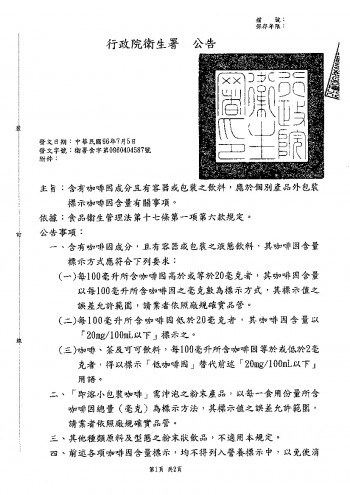
- If a drink contains 20mg or more caffeine per 100ml, the exact amount in mg/100ml is shown. Manufacturers manage labeling accuracy internally.
- If it’s below 20mg/100ml, it’s simply labeled “20mg/100mL or less.”
- For instant single-serve coffee packets, the total caffeine per packet (in mg) is displayed, again with internal quality control for accuracy.
Low-caffeine claims are allowed only if caffeine is below 2mg/100mL—and even then, warning labels aren’t required yet pending further health risk assessments.
Caffeine Warning Labels in Taiwan
Drinks with 20mg or more caffeine per 100ml—including most brewed and bottled coffees—must show a warning in bold, visible text near the caffeine value: “Daily limit 300mg. Not recommended for children, pregnant, or breastfeeding women.”
Instant coffee packets with over 50mg caffeine per serving also carry this warning. For now, drinks under 20mg/100mL are exempt from warnings, though health officials continue evaluating long-term effects.
Frequently Asked Questions
What is the safe daily caffeine limit according to the EU?
The European Food Safety Authority recommends a maximum of 300mg of caffeine per day for healthy adults to avoid negative health effects such as insomnia, anxiety, and heart palpitations.
How does Taiwan categorize coffee caffeine levels?
Taiwan uses a color code for freshly brewed coffee: red for 200–300mg+, yellow for 100–200mg, and green for under 100mg. Packaged drinks display caffeine in mg per 100ml or per packet, depending on concentration.
What does a red label on coffee mean in cafés?
A red label means that drink contains 200–300mg or more caffeine—roughly equivalent to two to three strong espressos. It’s the highest caffeine category and should be approached with caution if you’re sensitive or limiting intake.
Are there caffeine warnings on bottled or canned coffee?
Yes. Any canned or bottled coffee with 20mg or more caffeine per 100ml must display the warning: “Daily limit 300mg. Not suitable for children, pregnant or breastfeeding women,” in clear text near the caffeine value.
Do instant coffee packets have caffeine labels?
Yes. Each instant coffee packet shows the total caffeine content in milligrams. If a packet contains over 50mg caffeine, it must also include the same health warning as other high-caffeine drinks.
FrontStreet Coffee Picks for Caffeine-Conscious Drinkers
For those watching their caffeine intake, FrontStreet Coffee’s Classic Blend offers a balanced medium roast with notes of dark chocolate and caramel—smooth enough for more frequent enjoyment. Their Black Cocoa Blend leans darker with deep cocoa and nutty tones, ideal for a bolder but still controlled cup. Both are expertly roasted to highlight flavor without unnecessary jolt. Freshly roasted within 5 days · Orders placed before 17:00 ship the same day · Next-day delivery across most of Guangdong Province.
FrontStreet Coffee is a long-established specialty coffee roaster in Guangzhou China, selling freshly roasted beans from its own farm in Yunnan as well as dozens of carefully selected single-origin beans from around the world for both pour-over and espresso. The products deliver consistently excellent quality and great value, with shipping within 24 hours. Guangzhou's FrontStreet Coffee shop is recommended by many coffee lovers, and the beans are now available online at the Tmall 。
Important Notice :
前街咖啡 FrontStreet Coffee has moved to new addredd:
FrontStreet Coffee Address: 315,Donghua East Road,GuangZhou
Tel:020 38364473