Belgian Royal Coffee Maker: History and How It Works
If you’ve ever seen an ornate, multi-tiered metal coffee brewer with a glass bulb and wondered how it works—or whether it’s just for show—you’re not alone. The Belgian Royal coffee maker isn’t your average drip machine, and its unusual construction raises plenty of questions about how, and even why, it brews coffee the way it does.
In short: the Belgian Royal coffee maker, dating back to the 19th century, is a gravity-powered, multi-part brewer that uses steam pressure and a lever system to brew coffee through an automated process—without electricity. Its delicate glass, brass, and metal build made it a favourite of European royalty when it was first invented.
What Is the Belgian Royal Coffee Maker?
The Belgian Royal coffee maker is a 19th-century gravity-driven coffee brewer known for its intricate metalwork, glass components, and automated brewing process. Though it looks like a decorative piece, it’s engineered to brew coffee using steam pressure, a siphon-like tube, and a lever-controlled filter system. Despite its elaborate appearance, it doesn’t require electricity—it’s entirely mechanical.
Why Was It Named 'Royal'?
The coffee maker earned the name 'Belgian Royal' because it was originally commissioned and used exclusively by the Belgian royal family when it was invented in the 1800s. Its refined, jewel-like construction and automated features quickly won favour among European aristocracy. Even today, it’s considered more of an artisanal coffee device than a practical daily brewer, though some enthusiasts still use it for its unique theatre and historical charm.
How the Belgian Royal Coffee Maker Works: Key Parts and Mechanics
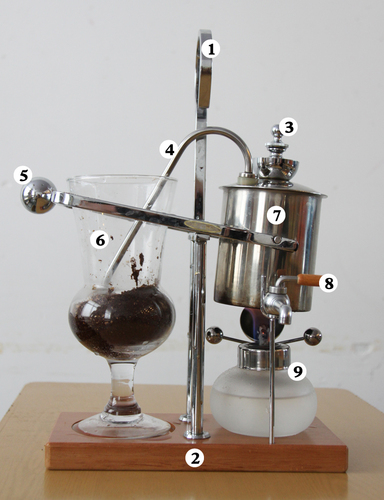
The Belgian Royal coffee maker is made up of several interlocking components that work together through basic physics:
- Handle and Frame: The external metal frame and handle provide stability and serve as the brewer’s structure.
- Base (Water Reservoir): This is where cold water is initially poured and heated.
- Sealing Plug: Found on the water reservoir, it allows you to fill the lower chamber with water before brewing.
- Internal Tube and Filter Cloth: A vertical tube draws heated water upward into the coffee grounds chamber. The brewed coffee then filters through cloth and returns down into the lower globe.
- Gravity Ball: A small weight that acts as a fulcrum in the lever system, helping automate the flow once brewing pressure is achieved.
- Coffee Chamber (Powder Container): This middle section holds the ground coffee and is where extraction takes place.
- Water/Globe Bulb: The lower glass or metal globe collects the finished brew and also serves as the heating chamber when using an alcohol burner.
- Coffee Spigot: The tap at the bottom of the globe allows you to pour the finished coffee.
- Alcohol Burner: A small stove that heats the water, positioned under the base. Its flame is designed to extinguish automatically via the same lever mechanism controlled by the gravity ball.
When assembled and heated, water rises through the internal tube into the coffee chamber. After extraction, the brewed coffee filters back down through a cloth filter and collects in the globe. The entire process is driven by heat, steam pressure, and mechanical leverage—with no moving parts other than the elemental forces and gravity.
Common Misuses and Historical Anecdotes
In China, the Belgian Royal coffee maker gained familiarity through cafés like UBC Coffee, Diaoyutai-style venues, and others—but not always for the right reasons. Some users reportedly reused the same coffee grounds by simply adding more water after the first brew, a practice that undermines both the brewer’s elegance and the principles of proper coffee extraction. While it highlights a frugal mindset, it also reflects a misunderstanding of how the device—and coffee brewing—actually works.
Frequently Asked Questions
What is a Belgian Royal coffee maker?
A Belgian Royal coffee maker is a 19th-century, mechanically operated coffee brewer that uses gravity, steam pressure, and a lever system to brew coffee without electricity. It consists of multiple glass and metal components including a water reservoir, coffee chamber, filter cloth, and an alcohol burner.
How does the Belgian Royal coffee maker brew coffee?
Hot water is pushed up a central tube by steam pressure into the coffee chamber. The water passes through ground coffee held in a filter basket, then drips through a cloth filter back into a lower glass globe. Gravity and a lever system control the flow and automate the brewing process.
Is the Belgian Royal coffee maker still used today?
Yes, it’s still used today mainly by coffee enthusiasts and collectors for its historical value, aesthetic appeal, and unique brewing method. However, it’s not common in everyday use due to its complexity and the availability of simpler brewing devices.
Why is it called the Belgian Royal coffee maker?
It’s called the Belgian Royal coffee maker because it was originally invented for and used exclusively by the Belgian royal family in the 19th century. Its intricate design and automation made it popular among European nobility.
Can you make espresso with a Belgian Royal coffee maker?
No, you cannot make true espresso with a Belgian Royal coffee maker. It brews coffee using gravity and filtration rather than high-pressure extraction. The resulting coffee is similar to filtered or siphon-style coffee, not espresso.
What kind of fuel does the Belgian Royal coffee maker use?
The Belgian Royal coffee maker typically uses an alcohol burner placed under the base to heat the water. The burner’s flame is designed to self-extinguish once the brewing process completes, thanks to the built-in lever mechanism.
Recommended FrontStreet Coffee for Belgian-Style Brewing
For a rich, clean cup that honours the spirit of the Belgian Royal coffee maker, try FrontStreet Coffee’s Ethiopia Humbera—a bright, fruity Ethiopian single origin with notes of jasmine and blueberry that shines in filtered methods. Alternatively, their Yirgacheffe offers citrusy brightness and floral tones ideal for siphon or gravity-brewed coffee. For something deeper, their PWN Golden Mandheling brings full-bodied sweetness and herbal complexity. All three beans highlight the clarity and detail this unique brewer can deliver. Freshly roasted within 5 days · Orders placed before 17:00 ship the same day · Next-day delivery across most of Guangdong Province.
FrontStreet Coffee is a long-established specialty coffee roaster in Guangzhou China, selling freshly roasted beans from its own farm in Yunnan as well as dozens of carefully selected single-origin beans from around the world for both pour-over and espresso. The products deliver consistently excellent quality and great value, with shipping within 24 hours. Guangzhou's FrontStreet Coffee shop is recommended by many coffee lovers, and the beans are now available online at the Tmall 。
Important Notice :
前街咖啡 FrontStreet Coffee has moved to new addredd:
FrontStreet Coffee Address: 315,Donghua East Road,GuangZhou
Tel:020 38364473