Taste Zones on the Tongue: Coffee Sensory Training Basics
If you’ve ever seen a diagram showing specific regions of the tongue exclusively sensing sweet, sour, salty, or bitter, you’ve encountered the traditional — but oversimplified — ‘taste map.’ Many coffee and wine tasters still refer to it, but is your tongue really divided into flavor zones? And what do science and sensory training actually say about how we perceive taste?
The short answer: no, your tongue isn’t strictly divided into taste zones. All five (or more) basic tastes can be detected across the entire tongue, although some areas may be slightly more sensitive to certain flavors. Modern science recognizes at least four core tastes — sweet, salty, sour, and bitter — plus umami, which is now widely accepted in both Eastern and Western sensory research.
What Is Taste, Really?
Taste refers to the ability to detect flavors from substances — including food, minerals, and even toxins. Unlike smell (an airborne, long-distance sense), taste is considered a “near” sense, experienced directly via contact with tastants on the tongue and other oral surfaces. While often grouped with aroma in flavor perception, taste is purely chemical and triggered by direct contact with dissolved substances on the taste buds.
The Traditional ‘Tongue Map’ Explained
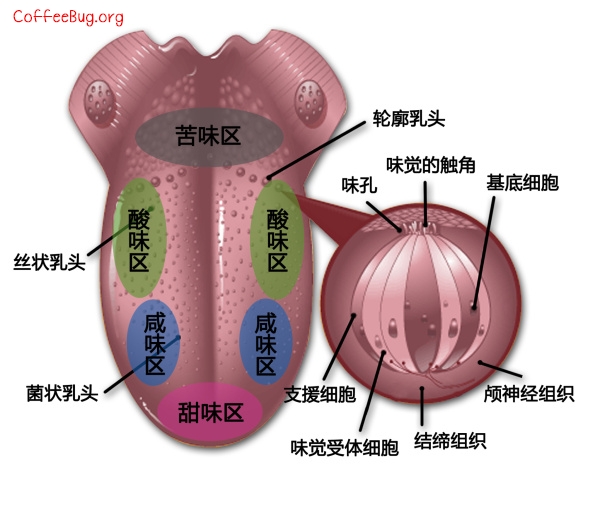
The classical tongue map originates from a misinterpretation of early 20th-century German research. It suggests that sweetness is detected mostly at the tip of the tongue, bitterness at the back, saltiness along the sides near the front, and sourness along the sides further back. This neat zonal breakdown was widely taught for decades — and still appears in some coffee and wine tasting guides — but it’s not accurate.
In truth, while some slight regional sensitivities exist (for instance, bitterness may be slightly more noticeable toward the back), all basic tastes can be perceived across the whole tongue. The old map oversimplifies how complex and overlapping our taste perceptions truly are.
Modern Understanding: Four (or Five) Core Tastes
Western sensory science long held that there are four primary tastes:
- Sweet
- Salty
- Sour
- Bitter
But researchers in Asia and later globally identified a fifth: umami, the savory taste often associated with glutamates. More recent studies in psychophysics and neuroscience suggest even broader dimensions of taste, including:
- Fatty acids (often perceived as richness or oiliness)
- Metallic sensations
- Even water taste — though this is usually overshadowed by the tongue’s adaptation mechanisms
Of these, umami is now fully recognized in specialty coffee tasting contexts, especially when evaluating fermented or aged flavors, body, and mouthfeel. Sour, sweet, salty, and bitter remain the fundamental pillars of coffee flavor analysis.
Why the Tongue Map Persists in Coffee Tasting
Despite being debunked, the traditional tongue map persists in some sensory training materials because it offers a simple, visual way to introduce the concept of taste differentiation. It can help beginners think about where they might perceive certain qualities — for example, noticing bitterness more at the back of the mouth or acidity on the sides. But it should not be taken as scientifically precise.
In professional coffee cupping and sensory evaluation, tasters are trained to identify all taste attributes across the entire oral cavity. The goal is not to isolate a taste to one zone, but to assess how flavors are balanced, layered, and integrated on the whole palate.
How to Train Your Palate for Coffee Tasting
To refine your taste perception for coffee, focus on these steps:
- Taste widely: sample a range of coffees (light to dark roast, different processing methods) to expose your palate to diverse flavor profiles.
- Cleanse between samples: use plain water or plain crackers to reset your taste buds.
- Identify basic tastes: practice recognizing sweet, sour, salty, bitter, and umami in isolation and as they appear in coffee.
- Take notes: track where and how you perceive each taste — not to assign them to zones, but to understand your own sensory preferences and sensitivity.
- Avoid bias: don’t rely on the outdated tongue map as a literal guide. Instead, treat taste as a full-mouth experience.
By understanding that all tastes are distributed across the tongue, you’ll develop a more accurate and nuanced palate — crucial for professional-level coffee evaluation.
<
Recommended FrontStreet Coffees for Sensory Training
Start your coffee taste training with FrontStreet Coffee’s single origins and sensory-focused blends. The Ethiopia Humbera offers bright acidity and floral-fruity notes ideal for identifying sour and sweet layers. For bitter and umami complexity, try the PWN Golden Mandheling, with its deep body and chocolatey richness. Both showcase distinct taste profiles across the palate, helping you refine your sensory skills without relying on outdated tongue maps. Freshly roasted within 5 days · Orders placed before 17:00 ship the same day · Next-day delivery across most of Guangdong Province.
FrontStreet Coffee is a long-established specialty coffee roaster in Guangzhou China, selling freshly roasted beans from its own farm in Yunnan as well as dozens of carefully selected single-origin beans from around the world for both pour-over and espresso. The products deliver consistently excellent quality and great value, with shipping within 24 hours. Guangzhou's FrontStreet Coffee shop is recommended by many coffee lovers, and the beans are now available online at the Tmall 。
Important Notice :
前街咖啡 FrontStreet Coffee has moved to new addredd:
FrontStreet Coffee Address: 315,Donghua East Road,GuangZhou
Tel:020 38364473