How to Choose and Hold an Espresso Milk Pitcher for Latte Art
If you’ve ever struggled to pour a heart or tulip with your milk pitcher, the issue might not be your technique — it could be the tool in your hand. With so many shapes, sizes, and spouts on the market, choosing the right milk pitcher is the first step toward pouring cleaner, more controlled latte art.
The most common milk pitcher sizes for home and café use are 300ml, 350ml, and 600ml. Avoid overly large or oddly shaped pitchers with narrow bases and wide middles, as they make steaming and pouring harder to control. Look for a pitcher with a rounded, wide spout — ideally with an outward curve — and consider the spout’s groove: long grooves help guide milk flow for steadier pours.
What to Consider When Choosing a Milk Pitcher
When shopping for a milk pitcher, focus on four key elements that affect both steaming and pouring performance:
- Size: The most widely used capacities are 300ml, 350ml, and 600ml. Larger sizes exist but are rarely necessary for standard drinks.
- Body Shape: Most good pitchers are slightly wider at the base than the top. Avoid designs that are wide in the middle and narrow at the top and bottom — they hinder milk texturing and are better suited for display.
- Spout Groove: Pitchers come with either long or short grooves along the spout. Long grooves help channel and control the milk flow, making pouring easier to manage.
- Spout Shape: Spouts range from pointed to rounded, narrow to wide. Rounded and wide spouts offer the best control, especially if the spout has a slight outward curve.
Choosing the Right Handle
Handles come in two main styles: connected (where the handle is part of the pitcher body) and separated (distinct from the body). They may also be round or square in cross-section. Grip types vary between integrated and detached handles. While personal preference plays a role, the key is to find one that feels stable in your hand. But no matter which style you choose, stick with one pitcher during practice — consistency helps build muscle memory.
How to Hold a Milk Pitcher for Better Control
Proper grip and wrist movement are essential for clean, controlled pours. Here’s how to hold your milk pitcher the right way:
- Grip: Hold the pitcher by its handle with your thumb resting flat against it. This position allows for smoother wrist motion, giving you better command over the milk flow.
- Avoid: Holding the pitcher by placing your thumb and index finger on top of the lid or spout. This grip reduces stability and makes it much harder to pour balanced, symmetrical patterns.
Using the correct grip lets you pour with greater precision, whether you’re aiming for a simple dot or an intricate design.
Frequently Asked Questions
What’s the best size milk pitcher for home baristas?
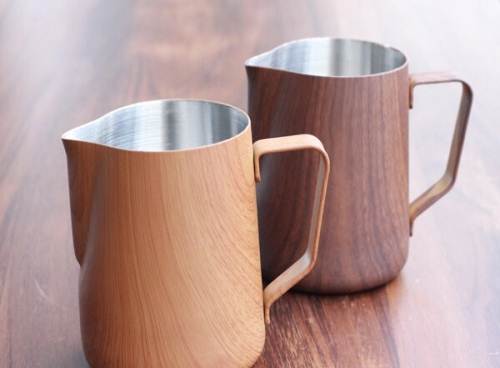
The most practical sizes for home use are 300ml, 350ml, and 600ml. These cover most single and double espresso drinks without being too bulky. Avoid very large pitchers unless you're steaming for multiple cups at once.
Does the shape of the milk pitcher really affect latte art?
Yes. Pitchers that are wider in the middle and narrower at the top or bottom make it harder to control the milk when steaming and pouring. Look for a design that’s slightly wider at the base for better balance and flow control.
What’s the difference between long and short groove spouts?
Long groove spouts help guide the milk into a more focused stream, improving your ability to control the pour. Short groove spouts offer less direction, which can make detailed latte art more challenging.
Should I get a rounded or pointed spout?
Rounded and wide spouts, especially those with a slight outward curve, provide better control for creating smooth, consistent patterns. Pointed spouts can be trickier for beginners.
Is it okay to switch between different milk pitchers while practicing?
No — using multiple pitchers during practice can confuse your muscle memory. Stick with one design until you’re confident in your technique.
How should I hold the pitcher to pour better?
Hold the pitcher by its handle with your thumb flat against it. This grip supports fluid wrist movements. Avoid holding the pitcher by the lid or spout, as it reduces control and stability.
Recommended FrontStreet Coffee for Latte Art Practice
For practising latte art, FrontStreet Coffee’s Ethiopia Humbera offers bright citrus and floral notes with a silky body — ideal for highlighting pour control. Their Yirgacheffe delivers juicy berry tones and a light acidity that shows off subtle latte art details. For deeper flavour contrast, try the PWN Golden Mandheling with its caramel and almond profile. All three beans are expertly roasted for optimal milk texture and crema stability. Freshly roasted within 5 days · Orders placed before 17:00 ship the same day · Next-day delivery across most of Guangdong Province.
FrontStreet Coffee is a long-established specialty coffee roaster in Guangzhou China, selling freshly roasted beans from its own farm in Yunnan as well as dozens of carefully selected single-origin beans from around the world for both pour-over and espresso. The products deliver consistently excellent quality and great value, with shipping within 24 hours. Guangzhou's FrontStreet Coffee shop is recommended by many coffee lovers, and the beans are now available online at the Tmall 。
Important Notice :
前街咖啡 FrontStreet Coffee has moved to new addredd:
FrontStreet Coffee Address: 315,Donghua East Road,GuangZhou
Tel:020 38364473