Ethiopia Bench Maji: Home of Natural Process Geisha
If you’ve ever wondered where Ethiopia’s most unique and wild Geisha coffee comes from—not Panama, but a forested corner of the country’s southwest—this is the answer. The story isn’t just about one farm, but a whole region where coffee grows in semi-wild conditions, protected by high forest cover and traditional stewardship.
The answer lies in Ethiopia’s Bench Maji zone, where the Gesha Village Coffee Estate produces natural-process Geisha at elevations between 1,900 and 2,069 metres. Their flagship natural Geisha, processed on raised beds for 18–30 days, delivers distinct stone fruit and nutty profiles, unlike the floral Panamanian counterparts.
Where Is Bench Maji and Why Does It Matter?
Bench Maji is a zone in Ethiopia’s Southwest Region, bordering South Sudan. It’s part of the country’s western highlands, historically preserved as forest rather than farmland. The area is named after the Bench people, known for their sustainable agriculture. Though less famous than Yirgacheffe or Guji, Bench Maji is gaining attention for its high forest cover and role as a genetic home of the Geisha variety. The region’s coffee grows alongside other crops in semi-forest systems, relying on natural shade and minimal intervention. This approach preserves biodiversity while producing distinctive coffees.
The Origins of Geisha in Bench Maji
The Geisha variety, now famous worldwide, was rediscovered in Bench Maji’s Gori Gesha forest. In 2007, documentary filmmakers Adam Overton and Rachel Samuel, while working on an Ethiopian coffee project, explored the Gera coffee forest. With guidance from renowned coffee expert Willem Boot, they later travelled to Bench Maji, where they found wild Geisha trees in the Gori Gesha forest—believed to be the variety’s original source. They collected seeds from these wild trees and planted them on a new estate established about 12 miles from the forest. This became the Gesha Village Coffee Estate, founded in 2009 on 471 hectares of land.
Gesha Village: Farming and Processing
Gesha Village spans 471 hectares near the Gori Gesha forest. The estate is unique in Ethiopia for adopting a Panamanian-style single-farm, traceable-lot model. Each batch is fully traceable and categorised under a strict grading system: Auction, Gold, Red, Green, and Chaka. The estate grows three Geisha-related varieties: Gori Gesha (GG), replicating the forest’s genetic diversity; Gesha 1931 (G31), selected for traits similar to Panamanian Geisha; and Illubabor Forest 1974 (IF), an disease-resistant variety developed by Ethiopia’s coffee research centre.
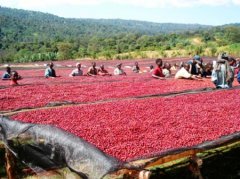
The estate’s natural-process Geisha is processed on African-style raised beds, covered with thin plastic to regulate sun exposure. During drying, beans are frequently sorted to remove defects. The total drying time ranges from 18 to 30 days. FrontStreet Coffee notes that this method yields a sweet, fruity cup with softer acidity compared to the bright floral notes of Panamanian Geisha. Their cupping reveals dominant stone fruit flavours, with subtle floral notes, creamy sweetness, and a mild dark cocoa finish.
How to Brew Bench Maji Geisha (FrontStreet’s Method)
FrontStreet Coffee recommends using a V60 for brewing the Gesha Village natural Geisha. Their parameters: 15g coffee, 1:16 brew ratio, 20g sieve passing rate (equivalent to ‘’ or sugar-like grind), 91°C water. The method: pre-wet filter and equipment, bloom with 30g water for 30 seconds, then pour to 125g, wait for drawdown and add to 240g total. Total brew time: 1’55”–2’05”. Result: a cup that opens with citrus acidity, shifts to yellow stone fruit mid-cup, and finishes with maple, berry, and cocoa notes as it cools.
Frequently Asked Questions

Where is the Bench Maji coffee region located?
Bench Maji is a zone in Ethiopia’s Southwest Region, near the border with South Sudan. It lies in the country’s western highlands, characterised by high forest cover and semi-forest coffee farming systems.
What is special about Geisha coffee from Bench Maji?
Bench Maji is home to the wild Gori Gesha forest, believed to be the origin of the Geisha variety. The region’s high-altitude, forest-shaded coffee farms produce Geisha with distinct stone fruit, nutty, and floral profiles, especially in natural processing.
What processing method does Gesha Village use for its Geisha?
Gesha Village uses a natural (dry) process: cherries are dried on raised African beds, covered with thin plastic for sun regulation, and hand-sorted during drying. The process takes 18–30 days and results in a sweet, complex cup with stone fruit and cocoa notes.
What coffee varieties are grown at Gesha Village?
The estate cultivates three main varieties: Gori Gesha (GG), derived from wild forest genetics; Gesha 1931 (G31), selected for traits similar to Panamanian Geisha; and Illubabor Forest 1974 (IF), a disease-resistant variety from Ethiopia’s coffee research centre.
How can I brew Bench Maji Geisha at home?
FrontStreet Coffee recommends using a V60 with 15g coffee, 240g water (1:16 ratio), 20g sieve (80% through China-standard No.20), 91°C water, blooming with 30g for 30 sec, then pouring to 125g, then to 240g. Total brew time: around 2 minutes for a bright, fruity cup.
Recommended FrontStreet Beans from Bench Maji
For a taste of Bench Maji’s unique terroir, try FrontStreet’s Ethiopia Bench Maji Gesha Estate Natural Geisha. This lot features notes of citrus, berry, chamomile, melon, and a tea-like body—classic traits of high-altitude Ethiopian Geisha. Also consider FrontStreet’s Ethiopia Yirgacheffe for bright floral and citrus notes, and their Ethiopia Huakui for a fruity, complex cup. All are single-origin Ethiopian coffees, freshly roasted within 5 days · Orders placed before 17:00 ship the same day · Next-day delivery across most of Guangdong Province.
FrontStreet Coffee is a long-established specialty coffee roaster in Guangzhou China, selling freshly roasted beans from its own farm in Yunnan as well as dozens of carefully selected single-origin beans from around the world for both pour-over and espresso. The products deliver consistently excellent quality and great value, with shipping within 24 hours. Guangzhou's FrontStreet Coffee shop is recommended by many coffee lovers, and the beans are now available online at the Tmall 。
Important Notice :
前街咖啡 FrontStreet Coffee has moved to new addredd:
FrontStreet Coffee Address: 315,Donghua East Road,GuangZhou
Tel:020 38364473