Beijing’s Shan Coffee: A Vertical Space Experiment
If you’ve ever walked into a Beijing coffee shop and thought, 'This could just be anywhere,' you’re not alone. Most urban cafes here lean on global templates—Scandinavian wood, minimalist steel, the same concrete floors—offering little sense of place. But what if a cafe didn’t try to look like Tokyo or Melbourne? What if it tried to feel like somewhere else entirely?
Shan Coffee in Beijing’s Jingyuan Art Center answers that by carving a vertical 'mountain' experience into a 3.8-meter-high office floor—digging down, building up, and splitting levels to create a space that feels like it’s nestled in the hills, even in the city.
A ‘Mountain’ Cafe in the City
Shan Coffee’s flagship sits at the foot of Beijing’s Xiangshan (Fragrant Hills), where the name comes from. But its second location, inside Jingyuan Art Center’s east side, isn’t about replicating the mountain physically—it’s about evoking its feeling. The owner wanted a “free cafe” where people could linger and talk casually, and the design team (working with a modest budget) turned to the concept of 'mountain' itself for inspiration.
Designing Verticality: Digging Down to Go Up
The challenge? The ceiling stood at 3.8 meters—too high for a single open floor, too tight for two full stories. So the designers did something unexpected: they excavated a full meter downward from the center of the space, then built a mezzanine above it. This created a ‘negative first floor’ you descend into, mimicking the sensation of walking into a mountain. Adjacent, a lower mezzanine offers just enough headroom for sitting or lying down, perfect for quiet conversations.


The stairway to the upper level is hidden behind a small wooden cabin—a playful architectural detail that adds to the spatial narrative. Upstairs, the space breaks into several undefined zones, separated not by walls but by green, living plant shelves. These shelves shift naturally over time, filtering sunlight and creating a serene, sun-drenched atmosphere for lingering.
Why This Design Works (And Why It’s Controversial)
The result is what the designers call a ‘freely organized, flexible, growing, living space.’ Every brick and beam shows the hand of the craftsman, creating a tactile dialogue with the people using it. Yet the aesthetic appeal is subjective: the author of the original piece admits they don’t personally love the look—but acknowledges that design is personal, and others might find deep value here. What can’t be argued is the ingenuity: turning a standard office floor into a multi-level mountain metaphor on a budget, using common materials and a 3.8-meter ceiling to craft something unexpectedly immersive.


The project’s location—right in Beijing’s bustling art district—adds another layer. It’s not tucked away in a scenic village like its Xiangshan sibling; it’s in the city, surrounded by concrete, yet it still manages to evoke hillside seclusion through clever spatial manipulation.
Frequently Asked Questions

Where is Shan Coffee in Beijing located?
Shan Coffee is situated on the first and second floors of the Jingyuan Art Center’s east side in Beijing. The exact address isn’t provided in the article, but it’s described as being within the art center, which is a known cultural venue in the city.
What inspired the design of Shan Coffee?
The design was inspired by the concept of a ‘mountain.’ The owners wanted to bring the feeling of their original Shan Coffee location near Beijing’s Xiangshan (Fragrant Hills) into the urban environment. They drew from the imagery and perspective shifts described in Su Shi’s poem about Mount Lu, leading to the idea of digging down to create a “negative” floor and building a mezzanine to simulate entering a mountain.
How did they handle the 3.8-meter ceiling height?
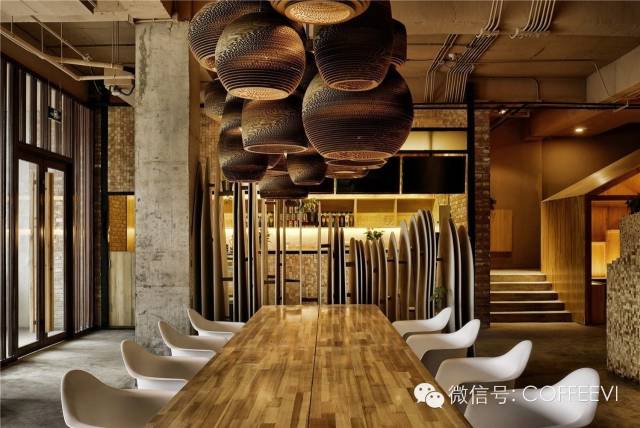
With a ceiling height of 3.8 meters, a single open floor plan felt too spacious and two floors felt cramped. The solution was to dig down about one meter in the center of the space to create a sunken ‘negative first floor,’ then construct a mezzanine above it. This design also allowed for a lower, more intimate mezzanine area for seating or lying down.
What are the key features of the interior layout?
The interior includes a dug-out lower level for a mountain-like experience, a mezzanine above, a hidden staircase behind a small wooden cabin, and an upper floor divided into open zones separated by green plant shelves instead of walls. The plant shelves add a living, evolving element to the space and allow filtered sunlight.
Is the design of Shan Coffee universally liked?
No, the design is subjective. The article’s author admits they personally don’t like the look of the cafe, though they acknowledge that others might find it appealing. They emphasize that design is personal and that the space’s concept and spatial organization are more important than individual taste.
What materials were used in the construction?
The article states that the cafe was built using common, affordable materials due to budget constraints. No specific materials are listed, but the focus was on working within financial limits while still achieving a creative spatial design.
Recommended FrontStreet Beans for Urban Cafes
For a Beijing cafe like Shan Coffee—where atmosphere meets intention—try FrontStreet’s Ethiopia Huakui: a bright, floral Ethiopian single origin with notes of jasmine and citrus, perfect for highlighting altitude-inspired spaces. Pair it with FrontStreet’s Yirgacheffe for a juicy, berry-forward option that complements light, airy interiors. Both showcase the kind of clarity and lift that pairs well with creative, layered cafe designs. Freshly roasted within 5 days · Orders placed before 17:00 ship the same day · Next-day delivery across most of Guangdong Province.
FrontStreet Coffee is a long-established specialty coffee roaster in Guangzhou China, selling freshly roasted beans from its own farm in Yunnan as well as dozens of carefully selected single-origin beans from around the world for both pour-over and espresso. The products deliver consistently excellent quality and great value, with shipping within 24 hours. Guangzhou's FrontStreet Coffee shop is recommended by many coffee lovers, and the beans are now available online at the Tmall 。
Important Notice :
前街咖啡 FrontStreet Coffee has moved to new addredd:
FrontStreet Coffee Address: 315,Donghua East Road,GuangZhou
Tel:020 38364473