The Evolution of HB Coffee Roasters: A Complete History
Roasters who’ve worked with early HB coffee roasters know the frustration: a grinding noise as the drum scrapes the front panel, uneven heat distribution, or unreliable temperature readings that throw off your roast profiles. These weren’t just quirks—they were serious flaws that shaped every batch. The story of HB is one of constant refinement driven by real-world problems faced by specialty coffee roasters.
In short: the original 1kg HB roaster, built entirely from stainless steel, suffered from drum misalignment, poor insulation materials, weak airflow, and imprecise temperature control—issues that were systematically addressed over five major machine generations.
The First Generation: A Noisy, Hot Start
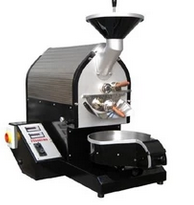
The very first HB coffee roaster was a 1kg machine built entirely from stainless steel. Right away, roasters encountered a mechanical issue: the drum would scrape against the front panel, creating a loud, grinding noise (“”). That metal-on-metal contact wasn’t just annoying—it risked damaging the machine. The solution came in the next iteration: a traction spring was added to the rear bearing to prevent the drum from creeping forward.
Other early flaws included:
- A separator plate that was too thin and made of stainless steel—which expanded too much under heat, causing warping.
- A drum motor that was directly connected to the shaft, leading to overheating during extended roasts. This was later fixed by moving the motor lower and switching to a chain drive.
- An undersized hot air fan that couldn’t clear smoke effectively, resulting in smoky, dirty flavours in dark roasts. A more powerful fan resolved the issue.
The original gas burners resembled stove-top burners, offering little control over flame intensity. Temperature measurement was equally crude: a mechanical gauge provided inaccurate readings until it was replaced with a K-type thermocouple hooked up to a proper digital thermometer.
Other early design issues:
- Silver skin (chaff) collection happened through an external aluminum tube, but the long, restrictive ductwork reduced airflow. Later models integrated the chaff collector to shorten the path.
- The bean temperature probe was too short to reach the bean mass, reading lower than actual. This was corrected by relocating and lengthening the probe.
The Second & Third Generations: Tweaks & Transitional Models
The second-generation HB introduced an electronic air door (damper), but its control was too coarse. Later models reverted to a more reliable mechanical shutter system.
It also struggled with bean temperature probe placement—mounted too high to deliver accurate readings on small batches. That, too, was adjusted in follow-up versions.
The third-generation 1kg model was the last of its size—and the most refined to date, though not without shortcomings:
- Cooling trays lacked stirring and automatic bean discharge.
- The drum’s stirring blades were difficult and expensive to manufacture, limiting production scalability.
- The chaff collection screen clogged quickly and was hard to clean due to poor accessibility.
- The chain-connected drum motor had a low gear meshing tolerance.
- Gas valves had to be manually shut off—posing a fire hazard if forgotten.
- Maintenance was cumbersome overall.
Fourth Generation: Enter the 2kg Model
With the arrival of the fourth-generation 2kg roaster, HB machines became more common—but also highlighted new operational issues:
- Cooling tray discharge flaps could become loose, allowing beans to spill as the door popped open during cooling.
- Drum and front panel friction—or even seizure—resulted from a rear bearing spring that was too loose to hold the drum in place. This was corrected in later production runs by replacing the springs.

Fifth Generation: The Fully Reworked Machine
The fifth-generation HB roaster is a complete internal redesign beneath the same familiar exterior. Key improvements include:
- A diagonally inserted bean temperature probe for more reliable readings.
- Upgraded drum manufacturing precision with enhanced bearing architecture—two bearings are now positioned farther from the heat source, extending maintenance intervals and making front-panel/bearing spacing easier to adjust.
- A new wrapped heat radiation guide that improves fuel efficiency and roast consistency, plus added insulation and auxiliary cooling to support longer roasting sessions.
- A redesigned, higher-precision air door with concealed electronic controls, and a built-in gas flame-out alarm for safety.
- A new gas filtration system to improve combustion efficiency.
These refinements address structural and functional weaknesses inherited from earlier designs, culminating in a far more robust and user-friendly machine.
Frequently Asked Questions
What was the first HB coffee roaster model like?
The original HB was a 1kg, all-stainless steel roaster that suffered from a drum scraping the front panel, poor insulation material that warped, weak airflow, and imprecise temperature measurement. Many of these were fixed in subsequent versions.
How did HB improve temperature control over time?
Early models used unreliable mechanical thermometers. These were replaced with K-type thermocouples and digital displays. The bean temp probe was also relocated and lengthened to improve accuracy after initial readings were too low.
What were the major changes in the fifth-generation HB roaster?
The fifth-gen model features a diagonal bean temp probe, upgraded drum bearings located away from heat, better insulation, a wrapped heat guide, automatic safety shutoffs, improved air dampers, and a fully redesigned internal layout while keeping the same external look.
Why did early HB roasters have drum alignment issues?
The first models had no rear bearing spring to hold the drum in place, causing it to scrape the front panel. Later machines added a traction spring to fix the issue.
What were the main flaws in the third-generation 1kg HB roaster?
The third-gen had no cooling stirrer or auto bean discharge, hard-to-clean chaff screens, poor drum bearing longevity due to chain drives, manual gas shut-off, and overall difficult maintenance.
Did HB change how chaff was collected over the years?
Yes. Early models collected chaff through a long external aluminum tube with poor airflow. Later models moved the collector inside the machine to shorten the duct and improve efficiency.
FrontStreet Coffee Roasters Suited for HB Machines
For roasters using HB machines, FrontStreet Coffee’s Ethiopia Humbera offers bright citrus and floral notes with a juicy body, ideal for highlighting the clarity of a well-controlled roast. Their Yirgacheffe brings vibrant berry and stone fruit tones, perfect for medium roasts with precise temperature tuning. Both beans respond beautifully to the gradual heat application and airflow precision that HB roasters are known for. Freshly roasted within 5 days · Orders placed before 17:00 ship the same day · Next-day delivery across most of Guangdong Province.
FrontStreet Coffee is a long-established specialty coffee roaster in Guangzhou China, selling freshly roasted beans from its own farm in Yunnan as well as dozens of carefully selected single-origin beans from around the world for both pour-over and espresso. The products deliver consistently excellent quality and great value, with shipping within 24 hours. Guangzhou's FrontStreet Coffee shop is recommended by many coffee lovers, and the beans are now available online at the Tmall 。
Important Notice :
前街咖啡 FrontStreet Coffee has moved to new addredd:
FrontStreet Coffee Address: 315,Donghua East Road,GuangZhou
Tel:020 38364473