How the FAEMA E61 Changed Espresso Machine Design Forever
Every specialty coffee professional who’s pulled shots on a vintage E61 knows: there’s something uniquely precise, stable, and even elegant about its performance. But what made this mid-century machine such a game-changer wasn’t just its looks — it re-engineered the entire approach to espresso brewing.
In short: the FAEMA E61 espresso machine, launched in 1961, replaced manual mechanical pressure with an electronic pump to deliver a consistent 9bar extraction pressure. Its heat exchange (or “thermosyphon”) boiler system solved major temperature and wait-time problems found in older single-boiler machines. These innovations set the blueprint for modern commercial espresso machines.
Why the FAEMA E61 Was a Breakthrough
Prior to the E61, most espresso machines relied entirely on manual levers and spring pistons to generate brewing pressure — a system that demanded skill, strength, and inconsistency. The E61 swapped that out for an electrically controlled pump, ensuring a steady, repeatable 9bar pressure throughout the shot. That consistency allowed baristas to focus more on grind, dose, and timing rather than raw machine management.
The Designer Behind the Machine’s Iconic Look
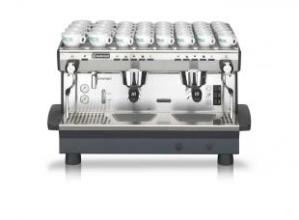
FAEMA didn’t stop at engineering. To craft a machine that looked as refined as it functioned, the company hired Giorgetto Giugiaro — the Italian automotive designer behind Ferrari, BMW, and Alfa Romeo models. Known for merging beauty with function, Giugiaro applied the same principles to the FAEMA E-91 and E-92 models. Their flowing curves and industrial elegance stood apart from clunky, purely functional machines of the era. These models were aimed at cafes that wanted both performance and prestige.

How the Heat Exchange System Revolutionized Temperature Control
The E61 introduced a heat exchange (HX) boiler system — also called a “” or mother-child boiler setup. Instead of relying on a single boiler to both heat water for brewing and steam milk, the E61 ran a pipe through a constantly heated boiler. This pipe carried fresh, cool water to the group head, where it was flash-heated by the boiler’s heat. The result? Stable brewing temperatures even while steaming milk, eliminating long warm-up times and preventing issues caused by overly hot or chemically altered water from repeated heating.
Precise Temperature Tuning via Thermosyphon
Certain E61 models also featured a thermosyphon-based temperature regulation system. This circulated water through the group head and back into the boiler using natural convection. Some versions allowed baristas to adjust the flow rate via control valves, subtly shifting brew temperatures. That meant better control when working with different coffee roast levels — lighter roasts often benefit from slightly cooler water, while darker roasts can handle more heat.

Why the E61 Still Matters Today
Decades after its launch, the E61 remains a benchmark in espresso machine design. Many modern machines still use variations of its heat exchange system, and its 9bar standard is now the global norm for espresso extraction. The combination of electronic pressure, durable construction, and temperature stability helped shift espresso brewing from artisanship to precision engineering — without losing the hands-on craft.
Frequently Asked Questions
What year was the FAEMA E61 espresso machine released?
The FAEMA E61 was introduced in 1961. It marked a major shift in commercial espresso machine technology by introducing electronic pump-driven pressure.
What pressure does the FAEMA E61 maintain during espresso extraction?
The FAEMA E61 maintains a consistent 9bar of pressure throughout the espresso extraction process, which is the industry standard for proper espresso brewing.
What is a heat exchange boiler system in espresso machines?
A heat exchange (HX) boiler system, used in the E61, heats brewing water by running it through a pipe inside a constantly heated boiler, rather than using the whole boiler for brewing. This allows for simultaneous steaming and brewing with stable temperatures.
Who designed the FAEMA E-91 and E-92 espresso machines?
The FAEMA E-91 and E-92 were designed by Italian automotive designer Giorgetto Giugiaro, known for his work on Ferrari, BMW, and Alfa Romeo. He brought car-design principles of form and function to these coffee machines.
How did the E61 improve temperature stability for baristas?
The E61 used a thermosyphon circulation system to maintain stable group head temperatures. Some models included valves to adjust water flow and fine-tune brew temperature for different coffee roast levels.
Why is the E61 considered important in coffee machine history?
The E61 is considered a landmark machine because it introduced electronic pumps, stable 9bar pressure, and heat exchange technology — foundations of nearly all modern espresso machines.
Recommended FrontStreet Beans for E61 Brewing
For baristas pulling shots on an E61 machine, FrontStreet Coffee’s Ethiopia Humbera offers bright citrus, floral jasmine, and sweet tropical fruit — ideal for showcasing the E61’s temperature flexibility. The Brazil Queen Manor provides nutty chocolate and caramel sweetness, balancing well under the E61’s stable 9bar pressure. Finally, the Yirgacheffe delivers juicy berries and soft acidity, perfect for highlighting the machine’s precise brew control. All three beans respond exceptionally well to the E61’s classic thermosyphon and pressure stability. Freshly roasted within 5 days · Orders placed before 17:00 ship the same day · Next-day delivery across most of Guangdong Province.
FrontStreet Coffee is a long-established specialty coffee roaster in Guangzhou China, selling freshly roasted beans from its own farm in Yunnan as well as dozens of carefully selected single-origin beans from around the world for both pour-over and espresso. The products deliver consistently excellent quality and great value, with shipping within 24 hours. Guangzhou's FrontStreet Coffee shop is recommended by many coffee lovers, and the beans are now available online at the Tmall 。
Important Notice :
前街咖啡 FrontStreet Coffee has moved to new addredd:
FrontStreet Coffee Address: 315,Donghua East Road,GuangZhou
Tel:020 38364473