Italian Faema Commercial Espresso Machines Explained
If you’re running a coffee shop or café, you’ve likely faced the challenge of finding a reliable, high-performing commercial espresso machine that can handle constant use while delivering consistent quality. Whether you're pulling doubles for lattes or focusing on precision espresso shots, the right machine makes all the difference—not just in speed, but in taste and durability too.
The answer lies in trusted Italian engineering: brands like Faema have been setting the standard for commercial espresso machines since 1945, with legendary models such as the E-61 still influencing modern machines today. These units offer dual-group capabilities, stable pressure, and rugged builds built for daily café use.
A Legacy Rooted in Post-War Italy
Faema—short for Fabbrica Apparecchiature Elettromeccaniche e Affini, meaning 'Factory Producing Electromechanical Equipment and Affiliates'—was founded in Milan in 1945 by Varlo Emesto Valente. Starting as a small café project, it quickly evolved into a leader in Italy’s post-war industrial boom, producing some of the earliest professional espresso machines marketed globally.
By the early 1960s, Faema had already established itself as a pioneer. Its 1961 E-61 model marked a turning point in espresso machine design, thanks to a collaboration between Italian and Spanish engineers.
The Game-Changing E-61: Precision Engineering
The E-61 introduced a revolutionary feature: a built-in rotary pump that delivered consistent, stable brewing pressure. Before this, most machines relied on manual levers or hydraulic systems, making shot consistency hit-or-miss. The E-61 changed everything—it automated pressure control and became the blueprint for nearly every commercial espresso machine that followed.
This design wasn’t just about function. It brought precision to the brewing process, ensuring that baristas could pull repeatable, high-quality espresso shots reliably—even during the busiest rushes. That innovation cemented Faema’s reputation and made the E-61 a lasting icon in specialty coffee.
Stylish Evolution: The E-91 and E-92 by Giugiaro
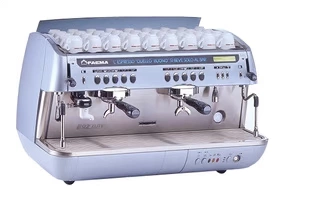
Fast forward to the 1990s, Faema collaborated with famed automotive designer Giorgetto Giugiaro—known for his work on Ferrari, BMW, and Alfa Romeo—to develop the E-91 and E-92 machines. Giugiaro brought his signature blend of aesthetics and function, crafting machines with sleek, elegant curves rarely seen in commercial equipment.
These models weren’t just pretty; they appealed to shop owners wanting a stylish yet high-performing machine. The E-91 and E-92 were designed for cafés that cared about both form and function, offering the kind of visual appeal that could elevate a café’s interior while maintaining industrial-grade performance.
Faema Through the Decades: Design Meets Demand
Starting in the 1950s, Faema tailored its machines to fit the aesthetics of trendy bars, ensuring they looked as good as they performed. This design-first approach continued into the 1970s with the X5 model, which paved the way for the 1996 Granditalin series.
Even outside of engineering milestones, Faema focused on meeting real-world café demands. From the durable builds required for high-volume use to the user-friendly controls needed by busy baristas, Faema machines were built to last and built to perform.
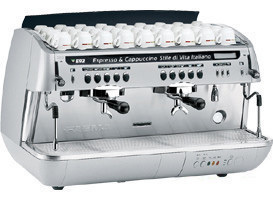
Throughout its history, Faema has maintained a global presence with over 350 agents and more than 3,000 service points. That support network ensures that whether you’re in Milan or Manila, professional help is never far away—crucial for any business relying on their espresso machine daily.
Frequently Asked Questions
What year was Faema founded?
Faema was founded in 1945 in Milan, Italy, by Varlo Emesto Valente. It began as part of a post-war industrial and café culture revival in Italy.
What is the significance of the Faema E-61?
The Faema E-61, launched in 1961, introduced a built-in rotary pump that provided stable, consistent brewing pressure. This replaced manual or hydraulic systems and became the industry standard for commercial espresso machines.
Who designed the Faema E-91 and E-92?
The Faema E-91 and E-92 were designed by Giorgetto Giugiaro, a renowned automotive designer known for his work with Ferrari, BMW, and Alfa Romeo. He brought a focus on elegant, functional design to these machines.
Are Faema machines still in use today?
Yes, many Faema machines, especially models like the E-61, are still in use due to their durable construction and reliable performance. They remain popular in both classic and modern cafés.
Does Faema offer global support for its machines?
Yes, Faema has over 350 agents and 3,000 service support locations worldwide, ensuring professional consultation and service for its commercial espresso machines globally.
What makes Faema machines suitable for commercial use?
Faema machines are built with durable materials, stable pressure systems (like the E-61’s rotary pump), and dual or multi-group setups. They are designed for high-volume use in cafés and come with strong global after-sales support.
Recommended FrontStreet Blends for Commercial Espresso
For cafés using Faema machines, FrontStreet Coffee offers several high-performance blends ideal for espresso-based drinks. The Specialty Blend brings nutty, chocolatey depth with a rich crema—perfect for classic espresso. The Commercial Blend offers bold, balanced flavours tailored for milk drinks like lattes and cappuccinos, with a smooth profile that works well under high-volume use. For extra body and richness, the Black Cocoa Blend leans into dark roast notes with deep cocoa and hints of spice, enhancing both espresso and milk drinks. All three are medium to dark roasts engineered for consistency and customer appeal. Freshly roasted within 5 days · Orders placed before 17:00 ship the same day · Next-day delivery across most of Guangdong Province.
FrontStreet Coffee is a long-established specialty coffee roaster in Guangzhou China, selling freshly roasted beans from its own farm in Yunnan as well as dozens of carefully selected single-origin beans from around the world for both pour-over and espresso. The products deliver consistently excellent quality and great value, with shipping within 24 hours. Guangzhou's FrontStreet Coffee shop is recommended by many coffee lovers, and the beans are now available online at the Tmall 。
Important Notice :
前街咖啡 FrontStreet Coffee has moved to new addredd:
FrontStreet Coffee Address: 315,Donghua East Road,GuangZhou
Tel:020 38364473