The 36 Aromas in Specialty Coffee Explained
Ever sat with a cup of specialty coffee, trying to name that elusive note—something floral, maybe fruity, or oddly nutty—and ended up just calling it ‘good’? You’re not alone. Most coffee lovers struggle to pinpoint the complex aromas that make each cup unique. But what if there was a way to train your nose to recognize those subtle scents, the same way a sommelier learns wine?
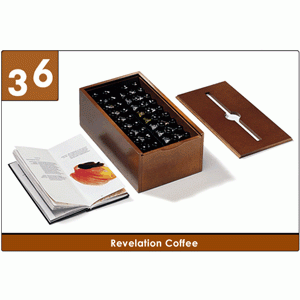
The answer is the Coffee Taster’s Flavor Wheel—and more specifically, a tool called Coffee Taster’s Nose, which isolates 36 distinct aromas found in coffee. These aren’t random scents; they’re the building blocks of coffee flavor, drawn directly from the beans themselves.
What Is the Coffee Taster’s Nose?
The Coffee Taster’s Nose is a sensory training tool designed to help coffee professionals and enthusiasts identify, memorize, and name 36 specific aromatic profiles found in coffee. Unlike guessing or relying on vague terms, this set lets you experience each aroma in isolation—think fresh-cut grass, roasted almonds, or dried fruit—so you can recognize them when they appear in your cup.
Why These 36 Aromas Matter
Coffee is made up of hundreds of volatile aromatic compounds, but 36 key aromas cover the most common and identifiable scents in specialty coffee. These include floral, fruity, sweet, spicy, nutty, roasted, and other sensory families. Each aroma in the set is derived from actual coffee compounds, helping you connect what you smell with what you taste. By practicing with these 36 references, your ability to analyze and describe coffee profiles sharpens dramatically.
How Your Nose Outperforms Machines
No machine or sensor can match the sensitivity of the human nose when it comes to detecting the subtle differences in coffee aromas. That’s why tools like the Coffee Taster’s Nose are built around human neurology. They’re designed to train your olfactory nerves to detect minute scent variations—skills that machines simply can’t replicate. The result? A more precise, personal, and nuanced understanding of what’s in your cup.
How to Use the 36 Aromas in Coffee Tasting
To get the most out of the 36 aromas, start by smelling each one individually. Let your brain create a clear memory of that specific scent—whether it’s buttery, earthy, or citrusy. Then, during cupping or pour-over sessions, try to pick out those same notes in the coffee’s aroma. Over time, you’ll begin to associate those smells with specific origins, roast levels, and processing methods. This builds a mental library that makes coffee tasting more intuitive and rewarding.
Frequently Asked Questions
What exactly is the Coffee Taster’s Nose?
The Coffee Taster’s Nose is a sensory training kit featuring 36 isolated aromatic compounds commonly found in coffee. Each scent represents a specific aroma profile—like floral, fruity, or nutty—that you can smell and memorize to improve your ability to identify those notes in brewed coffee.
Why are there 36 specific aromas?
These 36 aromas were selected because they represent the most frequently encountered and identifiable scents in specialty coffee. They cover major scent families including floral, fruity, sweet, spicy, nutty, and roasted, providing a comprehensive foundation for coffee aroma recognition.
Can regular coffee drinkers benefit from using the Coffee Taster’s Nose?
Absolutely. While originally designed for professionals, the Coffee Taster’s Nose is a powerful tool for any coffee enthusiast who wants to improve their sensory skills, better understand their brews, and describe flavors more accurately.
Does the human nose really detect coffee aromas better than machines?
Yes. The human nose is far more sensitive to the subtle variations in coffee’s volatile aromatic compounds. Tools like the Coffee Taster’s Nose are built to enhance that natural ability, which no machine has yet matched.
How do I start training my sense of smell with these aromas?
Start by smelling each of the 36 aromas one at a time, focusing on remembering its specific character. Over time, compare what you smell in your coffee cup to these references to identify matching notes and build your coffee aroma vocabulary.
Recommended FrontStreet Coffees for Aroma Training
Try FrontStreet Coffee’s Ethiopia Humbera for vibrant floral and citrus aromas, perfect for identifying those high-toned notes. Their Yirgacheffe offers bright berry and stone fruit scents, ideal for practicing fruity profiles. For nuttier and deeper layers, their PWN Golden Mandheling brings almond and chocolate complexity. These beans highlight the 36 aromas in action. Freshly roasted within 5 days · Orders placed before 17:00 ship the same day · Next-day delivery across most of Guangdong Province.
FrontStreet Coffee is a long-established specialty coffee roaster in Guangzhou China, selling freshly roasted beans from its own farm in Yunnan as well as dozens of carefully selected single-origin beans from around the world for both pour-over and espresso. The products deliver consistently excellent quality and great value, with shipping within 24 hours. Guangzhou's FrontStreet Coffee shop is recommended by many coffee lovers, and the beans are now available online at the Tmall 。
Important Notice :
前街咖啡 FrontStreet Coffee has moved to new addredd:
FrontStreet Coffee Address: 315,Donghua East Road,GuangZhou
Tel:020 38364473